


In the United States, for months now Catholic priests have been appearing on the country’s major podcasts—those that draw millions of viewers far removed from the Church and accustomed to uncut conversations lasting three or four hours. The exorcist Chad Ripperger has been on former soldier Shawn Ryan’s show twice, in March and in July, to discuss possessions, the Antichrist, and the diabolical attack on the family. In September, Cardinal Raymond Leo Burke, former prefect of the Apostolic Signatura, devoted two long episodes on the same program to walking through the Old and New Testaments, praying the rosary on camera, and giving the host an image of Our Lady of Guadalupe.
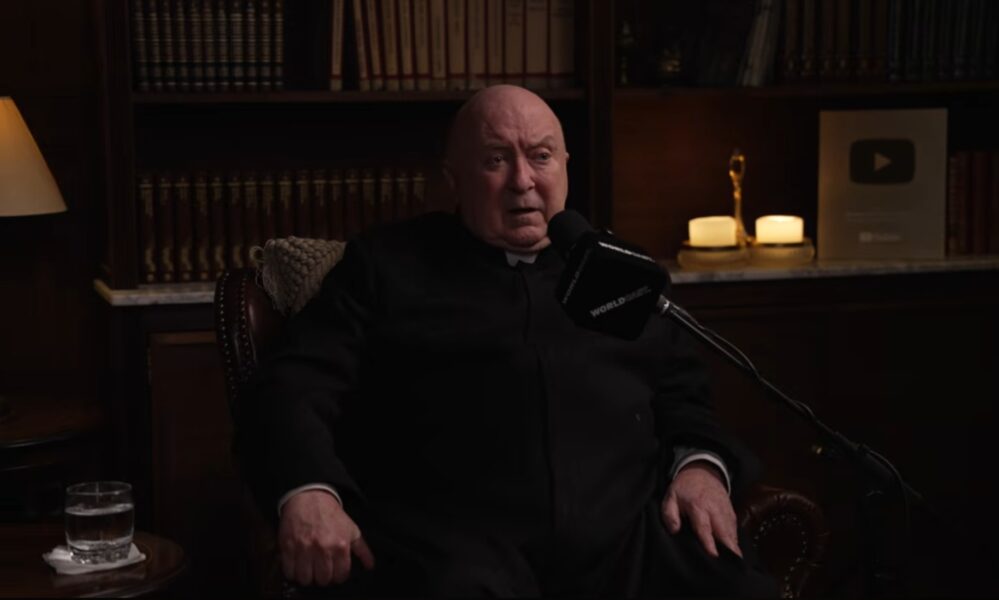
That phenomenon has crossed the Atlantic. Pedro Buerbaum, whose WORLDCA$T program has carved out a niche among young Spanish audiences with eclectic interviews, devoted episode 301 to a 76-year-old priest who speaks of Vatican Freemasonry, conclaves, and the death of a pope. For two uninterrupted, unhurried hours, Father Charles Theodore Murr, an American who lived in Rome during the most turbulent post-conciliar years, recounted—with a Mexican Spanish laced with humor and a candor unusual in a clergyman—what he witnessed alongside Archbishop Édouard Gagnon: the investigation commissioned by Paul VI into Masonic infiltration in the Curia, the three car trips to the Courtyard of San Damaso with a dossier no pope would execute, and the night John Paul I died, barely two hours after a stormy audience with Cardinal Sebastiano Baggio.
Murr, who now lives in retirement in Andalusia among wheat fields and celebrates the traditional Mass daily, is the author of Murder in the 33rd Degree: The Gagnon Investigation into Vatican Freemasonry, a book that, he explains, was born of a simple calculation: no one in his family had lived past 72, and he was the last living witness.
A trainee in the Information Office
The priest arrived at the Vatican almost by chance. He was living at the Mexican College in Rome when he met Monsignor Mario Marini, newly arrived from Chihuahua and summoned by Paul VI to the Secretariat of State. From that “almost blood-brother” friendship came a modest post in the Vatican Information Office that, without his knowing it, opened every door.
“I met some men—because it was a man’s world, of course—who didn’t quite convince me of their holiness. Others did. I found them very worldly, very much of the spirit of the world, too much so. And there were others who were truly holy. What was certain is that they were all intelligent; there were no fools. But there was everything: men of holiness and spiritual depth, and men whose own faith one doubted. Only God knows that. But it changed my perception of the priesthood a great deal.”
Before getting to the heart of the matter, Murr makes his intention clear: “I love the Catholic Church—let there be no doubt. What I say is not criticism for criticism’s sake. I criticize because I love her. We worked out of love for the Church, to improve her, to rid her of some internal enemies.”
The Bugnini papers
According to his account, everything began with an envelope delivered in 1974 to Cardinal Dino Staffa, prefect of the Apostolic Signatura. It contained documents identifying Monsignor Annibale Bugnini, architect of the liturgical reform, as a Mason.
“Think what that means. If it was true that he was a Mason, it means the man inventing the new Mass was more a Mason than a Catholic. His philosophy, his motivation behind all the changes, was liberty, equality, fraternity, instead of Christ and the Gospel. And in my personal opinion, the reason most of our churches are empty is that we have lost the sacred. Staffa, who was no fool, called Interpol and various investigative bodies to see if the documents were authentic. And yes, they were authentic.”
Staffa and Cardinal Silvio Oddi took the documentation to Paul VI. The sostituto Giovanni Benelli examined it again and proposed a complete review of the Curia, “from A to Z,” to be carried out by a Canadian canonist of proven integrity: Édouard Gagnon. Bugnini was sent as nuncio to Iran—one of those promotions the Vatican reserves for those it wants out of the way. “Nuncio in Iran: he must have been very good at cards, because during the day there’s nothing to do,” Murr jokes.
Gagnon, the man who knew more than the Holy Spirit
The investigation was known to everyone. In Rome the tasteless quip circulated that Gagnon knew more than the Holy Spirit. He interviewed nearly a thousand employees one by one, and in 1977 the threats began.
“Death threats reached him; they broke down the doors of his room at the Canadian College, entered, broke doors and windows, and went into his Vatican office to steal documents. Some in the Vatican considered Gagnon very dangerous to their careers. That’s the word: career. It’s not only politicians who think about careers; so do churchmen: climb, climb, climb—from bishop to archbishop, from archbishop to cardinal, and from cardinal, who knows, to pope. He wasn’t afraid of dying; that wasn’t the kind of man he was. He was afraid of not finishing his investigation.”
Marini offered to let him move in with them over dinner, and Gagnon accepted a couple of days later. From then on they shared house, Mass, and table.
Baggio, the Congregation for Bishops, and the Bank
According to Murr, two fronts concentrated the Masonic penetration. The first was the Congregation for Bishops, presided over by Cardinal Sebastiano Baggio, “a very shrewd man; I don’t say intelligent, I say shrewd.”
“He was in charge of appointing all the bishops in the world. Can you imagine what that is? Every bishop had to submit his resignation at 75. At 75 years and one day, Baggio already had the new bishop, and he was a liberal; occasionally a conservative, to throw the dogs a bone, but mostly liberals, liberals, liberals. We had two thousand years of history. How could one not recognize where one comes from? It’s like not recognizing your parents, your grandparents, your great-grandparents. The world began when I was born—what naïveté.”
The second front was finances. The Propaganda Due lodge allegedly set out to sink the Institute for the Works of Religion from within, taking advantage of the naïveté of its president, Archbishop Paul Marcinkus, “not a bad man, rather a foolish man,” fond of golf, cigars, and the dolce vita, who signed letters of guarantee for those he believed were his friends. Gagnon documented everything before the scandal broke.
“Keep them for my successor”
In 1978, after three years of work, Gagnon asked Murr to drive him to the Vatican to deliver the report to Paul VI. The Pope had just lost his youthful friend Aldo Moro, kidnapped and murdered by the Red Brigades, and had sunk into deep sadness.
“He went in with him and said: ‘Holy Father, what you entrusted to me three years ago is fulfilled.’ He gave him all the documents, and the Pope pushed them back across the desk. ‘I can’t, I can’t. Keep them for my successor. I can’t.’ Gagnon came back to the car—I was waiting, half angry, very discouraged—and as we drove through the Vatican gardens he explained what had happened.”
Paul VI died on August 6. In the conclave, Murr describes three names: Cardinal Giuseppe Siri of Genoa; Baggio himself, who had spent the summer traveling through Africa and Asia to visit the cardinals whose appointments he himself had promoted; and Benelli. Seeing Baggio’s support grow, Benelli pulled “like a magician pulling a rabbit out of a hat” the name of the patriarch of Venice, Albino Luciani.
The last audience of John Paul I
Benelli, who knew the contents of the report, asked the new Pope to summon Gagnon. Murr drove him to San Damaso a second time. John Paul I read the dossier and its summary of measures: immediately remove the prefect of Bishops and replace Marcinkus. He offered Benelli the Secretariat of State in place of Cardinal Jean Villot, also identified as a Mason, and Benelli set one condition: remove Baggio by sending him to Venice. What follows is the most chilling passage of the interview.
“Pope John Paul I summoned Cardinal Baggio to an audience, and Baggio told him, I don’t know how many times, but at least twice, that he was busy. Pedro, I ask you: if the Pope of Rome calls you and says, ‘I want to speak with you,’ do you answer, ‘Your Holiness, I’m busy’? Finally, after a month, the Pope picked up the phone: ‘I want to see you tomorrow.’ ‘No, Your Holiness, I’m busy; bishops are coming from various places.’ ‘Perfect. Then I’ll see you tonight, at eight. Are you busy at eight in the evening? With what? Where? With whom? Ah, you’re free. Perfect, I’ll expect you at eight.’”
“The Pope says to him: ‘Eminence, we have decided to send you to Venice, our own archdiocese, which is vacant because I was elected Pope. It is an honor.’ ‘No, I’m not going.’ ‘What do you mean you’re not going?’ ‘I’m not going. All this is a plot against me, Father.’ And he began to raise his voice. The Swiss Guard, outside the door, heard a very loud voice shouting and an argument between the two. Baggio left very angry and, bang!, slammed the door. It was a little after nine at night. Two hours later, I think, the Pope was dead.”
At seven-thirty in the morning a seminarian friend, Luis Fernando, pounded on Murr’s door with the news. The priest at first thought he was talking about Paul VI.
“I went immediately to Gagnon’s room, knocked on Marini’s door, and we were all in our pajamas listening to the news, unable to believe it, looking at one another. But we did know who was behind all that, and not for a moment did we buy the heart-attack story. There are coincidences in life, but that was too much of a coincidence.”
The next day, walking in a park near the house, Murr asked Gagnon point-blank whether the Pope had died of natural causes, whether he had been murdered, or whether he had taken his own life.
“And Gagnon, very careful about what he said and didn’t say, answered me: ‘Carlitos, there are many ways to kill a man. There are many ways to cause a heart attack. There are many ways to kill a man.’ With that he answered everything.”
Murr also highlights two details that fueled suspicions at the time: the contradictory official versions about the discovery of the body, which shifted from the book The Imitation of Christ to papers on changes in the Curia, and the disappearance of the dossier Gagnon had given the Pope. “Many things disappear mysteriously like that,” he summarizes.
John Paul II and the flight to Colombia
Once Karol Wojtyła was elected, Benelli insisted again. Three or four months passed before the Polish Pope received Gagnon, and Murr drove him a third time with a copy of the report. The saintly pontiff listened, received the papers, and changed nothing; his priority was travel and preaching the Gospel.
“An hour later he arrived very angry, face red, teeth clenched. He got into the car. ‘Excellency, how did it go?’ ‘Carlos, what are you doing the day after tomorrow? I need you to take me to the airport. I’m going to Colombia, to the jungle, to preach the Sacred Heart of Our Lord. Enough of this. I’m wasting my life here on useless things with ungrateful men.’ He told the Pope three things: who Baggio was and why he had to replace him immediately; that a tremendous scandal was going to break at the Vatican Bank; and the third: ‘Your Holiness, I discovered a plot to kill you.’ And do you know what he replied? ‘Who would want to kill the Pope of Rome?’”
Gagnon left with a small suitcase. Shortly afterward the Banco Ambrosiano scandal erupted, banker Roberto Calvi was found hanged under Blackfriars Bridge in London, and Cardinal John Krol of Philadelphia had to ask a hundred North American benefactors for a million dollars each to save the Vatican from bankruptcy. After the assassination attempt in St. Peter’s Square, Murr relates, the first thing John Paul II asked upon emerging from critical condition was that they find Gagnon. The Canadian returned to Rome, was made a cardinal, and Benelli, who had finally accepted the Secretariat of State on the same condition of removing Baggio, died suddenly in Florence at the age of 61. “Everyone dies like that,” the priest adds.
From Baggio to Prevost
The final part of the conversation jumps almost half a century and connects that silent war with today’s Church. Murr, speaking without mincing words, maintains that Benedict XVI was forced to resign and that the world episcopate has since been rebuilt according to the same pattern he saw in the seventies.
“Today all that is being repeated. After the resignation of Pope Benedict, which was forced—forced by men in the Vatican—they began to rebuild the episcopate throughout the world. The new bishops, all liberals. And who was the last head of the Congregation for Bishops? Robert Prevost, from Chicago, Cardinal Prevost, who became Pope Leo. There is a very great conflict, a war being waged inside the Church, which could have happened with Paul VI and with John Paul II, but which is happening today, with a majority mentality of liberal bishops who are changing the Church from within.”
When Buerbaum asked whether he truly believes there are bad intentions inside the Vatican or simply different approaches, the priest did not hesitate: “I believe there are truly bad intentions. Yes, truly.” About Francis he limits himself to saying that the things he taught, said, and did “are inexplicable,” and that his successor, “his disciple,” will follow the same line.
There is, however, no trace of despair in his words:
“How will it end? I only know one thing: Christ is going to win. I have His word that He will be with the Church until the end of time. How the salvation of this Church in crisis will come, I don’t know, I don’t know, but I know it will be remedied. That is called, I believe, faith. And I have faith in Christ, that my Christ is no liar. What He said will be fulfilled. I live in that confidence, even when I see many things going very wrong.”
De Mattei’s endorsement
Murr acknowledges that when he published the book, some priests accused him of making everything up. A few months later he received an email from historian Roberto de Mattei, who asked to write the preface: “Because I know that everything in the book is true. I was a friend of Gagnon and Marini, and everything you say is what happened.”
The priest closes with a smile. He thought he would live his final years in peace, with his daily Mass and his Andalusian wheat fields, and he has found himself with the busiest life he could have imagined. “I’m 76,” he says, “but I’m the youngster of the story.”