


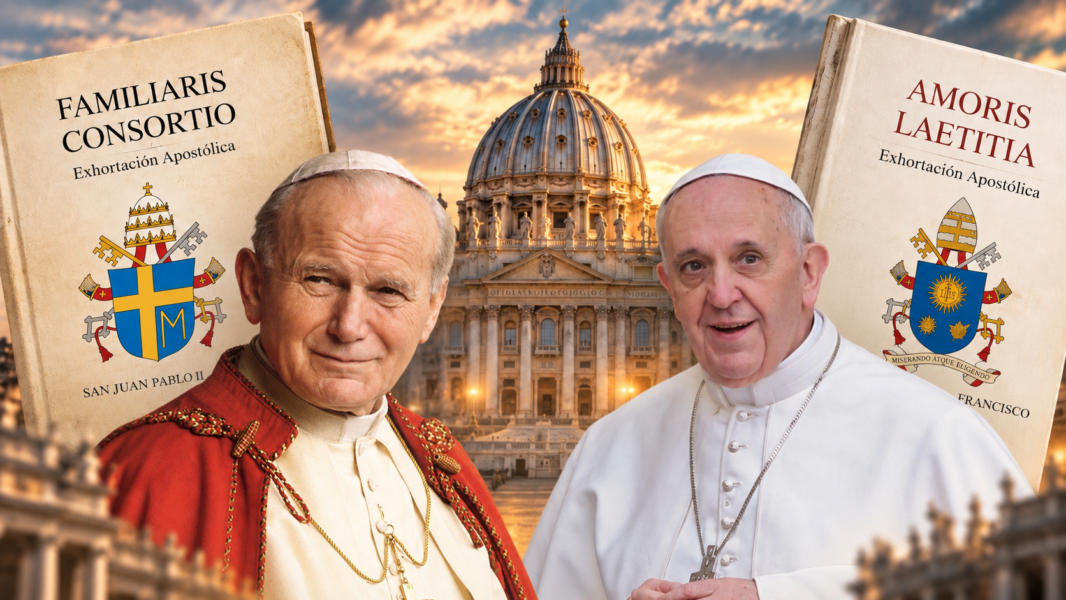
Rome begins this Wednesday to take stock of the ten years of Amoris laetitia. From October 7 to 14, nearly 250 bishops, including presidents of Episcopal Conferences and heads of the Eastern Catholic Churches, will join families and experts in a meeting convened by Leo XIV to examine the application of Francis’s exhortation and the current challenges of matrimonial and family pastoral care.
The gathering comes a decade after one of the most debated documents of the previous pontificate. Amoris laetitia, published in April 2016 following the two synodal assemblies on the family in 2014 and 2015, launched a broad process of implementation in local Churches, especially regarding the accompaniment of divorced and remarried persons and other so-called “irregular” situations.
Ten years later, Rome wants to know what has happened during that process.
The meeting has been presented by the Holy See as eminently pastoral. There is no plan to revise the exhortation or to produce a new magisterial document to replace it. Participants are expected to share experiences, identify difficulties, and assess what paths may be followed in the coming years.
However, the anniversary also brings back to the forefront some of the questions that have accompanied Amoris laetitia practically since its publication and that never received a formal clarification.
What will be discussed during this week
The work will take place in the Paul VI Hall and will be organized around five major areas: the reality and challenges of today’s families, the matrimonial vocation of young people, the early years of marriage, accompaniment in difficult situations, and the Christian family as a subject of the Church’s mission.
The methodology will also have a distinctly synodal character. Participants will work through the so-called “conversation in the Spirit,” alternating interventions, listening, and moments of silence. The groups will be asked to identify convergences, divergences, tensions, pending questions, and possible future steps.
At the end of the five thematic days, a synthesis report will be prepared, discussed by the assembly, delivered to Leo XIV, and subsequently published.
The meeting will conclude on October 14, after a week primarily devoted to listening to what has happened in local Churches during the ten years since the publication of Amoris laetitia.
From Familiaris consortio to Amoris laetitia
One of the keys to understanding what lies behind this anniversary is the relationship between Amoris laetitia and the earlier teaching of Saint John Paul II.
In 1981, Familiaris consortio explicitly addressed the situation of divorced persons who had entered a new union while a valid matrimonial bond still existed.
John Paul II then reaffirmed “the practice of not admitting to Eucharistic communion those who are divorced and remarried,” because their state and way of life “objectively contradict the union of love between Christ and the Church, which is signified and made present in the Eucharist.”
When serious reasons—for example, the education of children—advised maintaining cohabitation, Familiaris consortio linked the return to the sacraments to the commitment to live “in complete continence,” abstaining from the acts proper to spouses.
Amoris laetitia maintained the doctrine of the indissolubility of marriage, but placed greater emphasis on the discernment of each situation and on factors capable of diminishing subjective responsibility.
Its paragraph 305 states that, due to “conditioning or mitigating factors,” a person may find themselves “in an objective situation of sin” without being fully culpable. And the well-known footnote 351 added that the help offered by the Church “in certain cases” could also include the sacraments, with explicit references to Confession and the Eucharist.
The exhortation did not specify at that point what those cases were, nor did it reiterate the condition of continence established by Familiaris consortio.
From that difference arose one of the main controversies that accompanied the reception of the document.
The five dubia that Francis did not answer
On September 19, 2016, barely five months after the publication of Amoris laetitia, Cardinals Walter Brandmüller, Raymond Leo Burke, Carlo Caffarra, and Joachim Meisner sent Francis five dubia, doctrinal questions formulated to obtain an affirmative or negative response.
The first went directly to the point that had generated the greatest discussion.
The cardinals asked whether, after Amoris laetitia 300-305, it was possible to grant sacramental absolution and admit to the Eucharist a person who, being bound by a valid marriage, was living more uxorio—maintaining a relationship proper to spouses—with another person without fulfilling the conditions set forth in Familiaris consortio 84.
The other four questions broadened the problem. Taking Veritatis splendor as a reference, they asked whether the teaching on the existence of absolute moral norms, intrinsically evil acts, the objective situation of grave sin, the role of circumstances, and the limits of conscience in relation to moral norms remained valid.
Francis did not formally respond to the questions. The four cardinals decided to make them public in November 2016. Caffarra and Meisner died the following year without having received a response.
Ten years of different applications
The lack of a formal response did not halt the application of Amoris laetitia.
In the years that followed, various Episcopal Conferences and dioceses developed pastoral guidelines to interpret chapter VIII of the exhortation. The question of divorced and remarried persons occupied a large part of the debate, precisely because the criteria adopted were not identical everywhere.
One of the most significant episodes occurred with the guidelines of the bishops of the pastoral region of Buenos Aires. The Argentine document maintained that, when it was not feasible to live in continence and certain circumstances existed, a path of discernment could be opened that might eventually include access to the sacraments.
Francis endorsed that interpretation in a letter of September 2016, stating that the text explained “thoroughly the meaning of chapter VIII” and that “there are no other interpretations.” Both documents were later published in the Acta Apostolicae Sedis, accompanied by a rescript that described them as authentic magisterium.
That development provided an important element for interpreting Francis’s intention, but it did not produce a formal response to the five dubia nor eliminate the differences in pastoral application among the various local Churches.
It is precisely that decade of experiences that Rome now begins to examine.
Leo XIV places Amoris laetitia alongside Familiaris consortio
In his message of March 19 on the anniversaries of Familiaris consortio and Amoris laetitia, Leo XIV recalled both exhortations together and affirmed that they have driven the Church’s doctrinal and pastoral commitment in service to young people, spouses, and families.
The Pope thus wished to situate the October meeting within a broader trajectory of family pastoral care, rather than presenting it solely as a commemoration of Francis’s document.
That approach also appears in the presentation of the work. The organizers of the meeting have explicitly recalled the roots of Amoris laetitia in the Second Vatican Council and in Familiaris consortio, which this year marks its 45th anniversary.
What is at stake this week
The meeting that begins today is not convened to answer the dubia, to revise chapter VIII, or to determine once again who may receive the sacraments. Nor is it expected to produce a new apostolic exhortation.
The official question is much more “pastoral”: what has the Church learned during these ten years and what must it do from now on.
But the assessment comes after a decade in which Amoris laetitia has been the object of different interpretations and applications. For this reason, alongside the experiences presented by the Episcopal Conferences, a question that has accompanied the exhortation since 2016 will remain in the background: how its proposal of discernment should be understood in continuity with Familiaris consortio and with the moral principles reaffirmed by Veritatis splendor.
On October 14, the synthesis report of these proceedings will be made public. The five dubia of Brandmüller, Burke, Caffarra, and Meisner, meanwhile, remain without a formal response.