


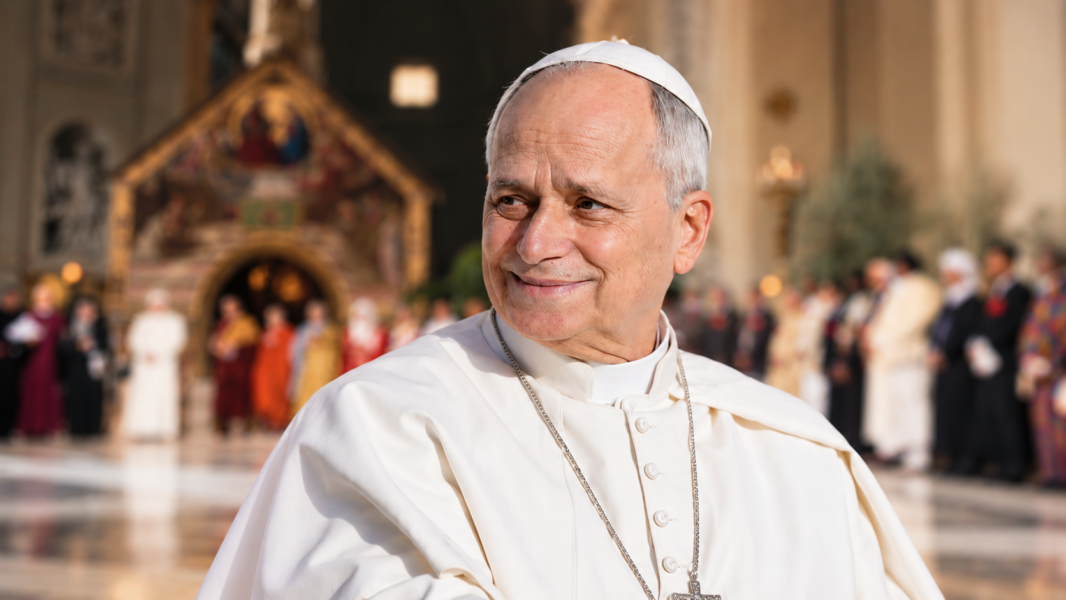
Pope Leo XIV will travel to Assisi on the upcoming October 27, exactly forty years after the historic interreligious gathering convened there by Saint John Paul II in 1986. The Pontiff will take part in the closing day of a three-day meeting organized by the Community of Sant’Egidio, the influential Catholic movement based in Rome that for decades has promoted international encounters among representatives of different religions.
The event will be held from October 25 to 27 under the motto “Disarmed and Disarming Peace” and will bring together 384 personalities from 53 countries, including representatives of religions, culture, and institutions. According to data presented this Tuesday in Rome by the president of Sant’Egidio, Marco Impagliazzo, 155 speakers and 24 thematic forums are also planned. Organizers expect total participation to reach 5,000 people.
The Pope’s presence will be concentrated on the final day, October 27, the exact anniversary of the World Day of Prayer for Peace that John Paul II convened in Assisi on that same day in 1986. Vatican News has confirmed that Leo XIV will participate in the closing events.
Among the attendees will be the Ecumenical Patriarch of Constantinople, Bartholomew I, as well as representatives of other Churches and Christian communities and of Judaism, Islam, Hinduism, Buddhism, and other religions.
Christians will pray together; other religions, separately
One of the aspects that Sant’Egidio has sought to clarify when presenting the program is the way the prayers on October 27 will unfold, a particularly significant issue due to the controversies that accompanied the original 1986 gathering.
Leo XIV will join the Christian representatives in a prayer for peace in the Lower Basilica of St. Francis. There, both the Pope and Patriarch Bartholomew will deliver a meditation, according to the program presented by the organizers.
Representatives of the other religions will not take part in that Christian prayer. Muslims, Jews, Hindus, Buddhists, and members of other traditions will have separate spaces in Assisi, where they will pray according to their respective beliefs.
Impagliazzo expressly presented this separation of religious acts as a safeguard against any syncretic interpretation of the gathering.
Once the prayers are concluded, participants will gather in the square in front of the Basilica of St. Francis for the final ceremony. There, countries currently affected by wars will be remembered, Leo XIV will deliver a speech, and afterward the Pope and around 80 religious leaders will jointly proclaim and sign an appeal for peace.
Also among the attendees will be Metropolitan Antonij, head of the Department for External Church Relations of the Patriarchate of Moscow. According to KNA, the representative of the Russian Orthodox Church will be present in Assisi, although he has chosen not to make a public intervention.
Three days of encounters and 24 forums
Although Leo XIV will attend only the closing day, the gathering will begin on Sunday, October 25, and will last three days.
The official information from Sant’Egidio indicates that during the working days 24 thematic forums will be held. Among the issues to be addressed are armed conflicts, nuclear disarmament, immigration, poverty, the situation of young people, new technologies, and the defense of human dignity.
Questions related to nationalism, the environment, the Mediterranean, Christian unity, and the role of religions in contemporary conflicts will also be discussed.
The motto chosen for this edition, “Disarmed and Disarming Peace”, echoes one of the expressions used by Leo XIV since the beginning of his pontificate. In his first public appearance after being elected, the Pope spoke precisely of the peace of the risen Christ as a peace that is “disarmed and disarming, humble and persevering.”
The controversy that accompanied Assisi 1986
The choice of October 27 inevitably returns attention to the gathering convened by Saint John Paul II forty years earlier.
On that day in 1986, representatives of different religions came to Assisi at the Pontiff’s invitation for a World Day of Prayer for Peace. The initiative became one of the most emblematic—and also most debated—events of the interreligious dialogue promoted after the Second Vatican Council.
One of the main objections raised at the time was the risk that the simultaneous presence of representatives of numerous religions might convey an image of equivalence among them or favor an indifferentist interpretation of the prayer for peace.
John Paul II himself had expressly addressed that problem five days before the gathering. In the general audience of October 22, 1986, he explained that what would happen in Assisi “will certainly not be religious syncretism” and formulated a fundamental distinction to understand the convocation: “That is why the formula chosen for the Assisi gathering is: to be together to pray.”
The Pope was even more explicit: “Certainly one cannot ‘pray together,’ that is, make a common prayer, but one can be present when others pray.”
The organization of the original day responded to that criterion. As John Paul II himself explained on October 27, 1986, the different religions had separate places to express their prayer according to their own rites and afterward gathered in the Lower Square of St. Francis.
The clarification, however, did not dispel the controversies. The very symbolic force of bringing together in Assisi representatives of very different religions fueled for years the debate within the Church about the limits of interreligious dialogue and the danger that certain gestures might obscure the uniqueness of the Christian faith.
Dialogue without equating religions
The issue is not secondary from a Catholic perspective. The Church can promote dialogue and cooperation with those who profess other religions, but that dialogue does not mean considering the different confessions equally true or relativizing the Christian affirmation that Jesus Christ is the only Savior.
The recognition of elements of truth and goodness present in other religious traditions does not eliminate the Church’s evangelizing mission or modify its confession of Christ as “the way, the truth, and the life.”
This context also helps to understand the insistence of the organizers of the 2026 gathering on keeping the different prayers distinct. Sant’Egidio presents the upcoming meeting as a continuation of the so-called “spirit of Assisi,” but formally preserving the religious identity of each participant.
Since 1987, the Roman community has regularly organized international gatherings inspired by John Paul II’s initiative. In 2016, Francis also went to Assisi to participate in the commemoration of the 30th anniversary.
Leo XIV, forty years later
Now it will be Leo XIV who returns to the city of St. Francis on a particularly symbolic date.
The Assisi 2026 program retains recognizable elements of that day: representatives of numerous religions will be simultaneously in the city, prayers will unfold according to the different traditions, and afterward participants will gather in front of the Basilica of St. Francis to proclaim an appeal for peace.
This year’s edition also comes at a time of international scenario marked by numerous wars. Sant’Egidio intends the gathering to serve as a call to lay down arms and to affirm the role that religions can play in the search for peace.
The anniversary will also revive the questions that have accompanied the so-called “spirit of Assisi” since its birth: how to promote encounter among religions without falling into indifferentism, how to distinguish cooperation for peace from a common interreligious prayer, and how to keep unequivocally, in that context, the Christian confession of Jesus Christ as the only Savior.
On the upcoming October 27, forty years after the gathering convened by John Paul II, Leo XIV will participate in the closing day of Assisi. Christian representatives will pray in the Lower Basilica of St. Francis, while members of other religions will do so separately in other places in the city. Afterward, participants will gather in front of the basilica for the reading and signing of an appeal for peace.