


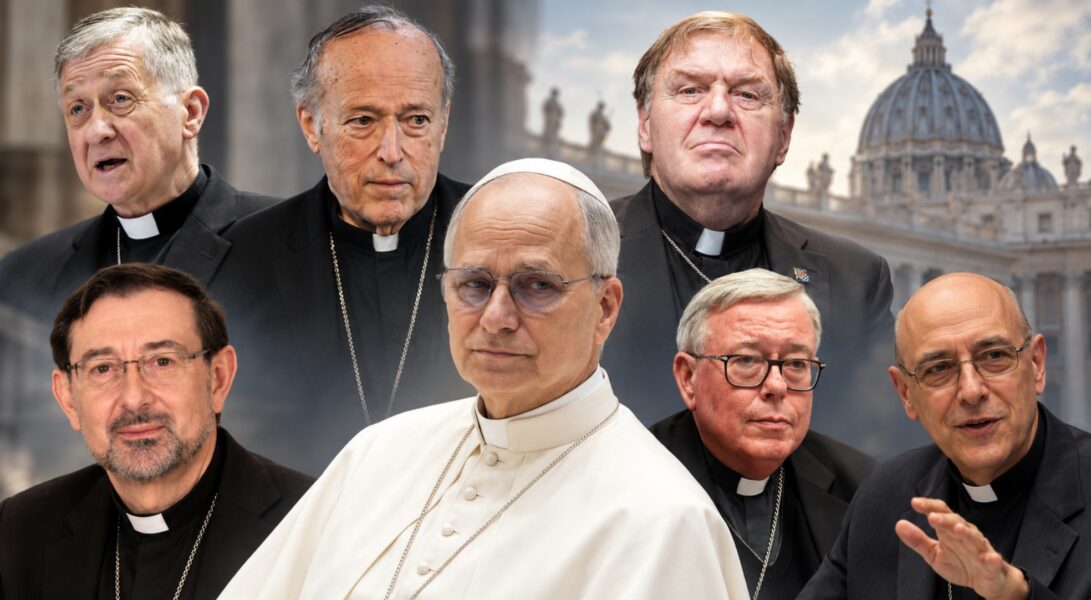
The list of personal guests invited by the Pope to the meeting from October 7 to 14, published this Friday by the Press Office along with the program of proceedings, brings together the most prominent names from the progressive wing of the Church and excludes all critics of Francis’s exhortation.
In four days, cardinals and bishops from around the world will sit down with Leo XIV at the Vatican to discuss the family in light of Amoris laetitia. The official convocation speaks of “synodal discernment” and “mutual listening,” but the roster of guests the Pope has added in his own hand to the ex-officio participants says something more precise. Cupich, McElroy, Tobin, Cobo, Hollerich, Fernández, Tagle, David: all the names that set the agenda of the previous pontificate on the matrimonial question are there. None of those who questioned it have been summoned.
A meeting “that is not a synod”
Leo XIV announced the gathering on March 19, the feast of Saint Joseph and the tenth anniversary of the exhortation, through a message convening the presidents of the world’s episcopal conferences and the heads of the Eastern Catholic Churches to “proceed, in mutual listening, to a synodal discernment on the steps to be taken to proclaim the Gospel to families today.” The format recalls the February 2019 summit on abuse, at which Francis gathered in Rome the heads of the episcopates of the five continents.
On July 6 the Press Office published the thematic itinerary drawn up by the General Secretariat of the Synod and the Dicastery for the Laity, the Family and Life. Five blocks structure the proceedings: the reality of families today, young people and the vocation to marriage, the early years of marriage, the family as an evangelizing subject, and the accompaniment of those who have experienced “suffering, abandonment, separation and divorce.” This last heading, the only one that touches the nerve of chapter eight of the exhortation, is what has aroused the expectations of some and the unease of others.
According to the program presented this Friday in the Press Office, the sessions will be held behind closed doors in the Paul VI Hall, with some 190 participants: the presidents of the 115 episcopal conferences, the heads of the Eastern Churches, eleven married couples from the five continents, and about thirty experts and moderators. The Pope will be present only at the opening on the 7th and the closing on the 14th. The ex-officio participants are therefore the conference presidents, with the plurality that implies: African, Polish, Hungarian or Central European episcopates that at the time received Amoris laetitia with prudence or with public reservations. To that assembly the Pope has added twenty-two personal guests, and it is in that roster, chosen name by name from Santa Marta, that the direction Rome wants to give the meeting can be discerned.
Ten years of an open wound
Amoris laetitia, signed by Francis on March 19, 2016 after the two synods on the family in 2014 and 2015, is the most debated pontifical document of the last half-century. The controversy centers on a handful of paragraphs and, above all, on a footnote, 351, which opens the door to sacramental communion for the divorced and civilly remarried in “certain cases,” after a process of discernment in the internal forum.
Reception was immediately contradictory. The bishops of the Buenos Aires region drafted criteria in September 2016 that admitted such communion, and Francis endorsed them by letter, stating that “there are no other interpretations.” Episcopates such as the Polish one or dioceses such as Philadelphia, under Chaput, maintained the discipline of Familiaris consortio: access to communion only for those who commit to living as brother and sister. Germany, Malta and much of the Central European Church embraced the more open reading.
In September 2016 four cardinals, Burke, Brandmüller, Caffarra and Meisner, presented the Pope with five dubia on the compatibility of the exhortation with previous magisterium. They never received a reply. Two of them died waiting for one. In 2023 a second group, again led by Burke and including Sarah, Zen, Sandoval and Brandmüller, repeated the operation on the eve of the Synod on Synodality and received a response from Francis himself and from the newly appointed prefect of the Doctrine of the Faith, Cardinal Víctor Manuel Fernández, regarded as the drafter of the controversial chapter eight. Weeks later, on December 18, 2023, the same Fernández signed Fiducia supplicans, the declaration allowing the blessing of couples in irregular situations and same-sex couples, which Africa rejected en bloc.
With the election of Leo XIV, a large part of the episcopate hoped the new pontificate would bring order to this diversity of practices. Some read the October gathering as the opportunity to do so. Others fear it will serve to consolidate, under the seal of “synodality,” what until now was one interpretation among several.
The Pope’s guests
The official list of participants places under the heading “Invitati” twenty-two prelates who do not participate by reason of their office but by pontifical appointment. The reading of the North American and European bloc leaves no doubt.
From the United States come three cardinals and one bishop. Blase Cupich, Archbishop of Chicago, was the great promoter of Amoris laetitia in the North American episcopate and the first to affirm that the conscience of the divorced and remarried could lead them to communion. Robert McElroy, now in Washington, defended the same thesis from San Diego and extended it to homosexual couples in a celebrated 2023 article in which he called for “radical inclusion.” Joseph Tobin, Archbishop of Newark, is the third vertex of the same triangle, welcoming pilgrimages of homosexual Catholics in his cathedral. Daniel Flores, Bishop of Brownsville and a key figure of the Synod on Synodality in the United States, completes the delegation.
From Europe, Cardinal Jean-Claude Hollerich, Jesuit and general relator of the Synod on Synodality, has openly called for a revision of the doctrine on homosexuality. And from Spain, Cardinal José Cobo, Archbishop of Madrid and vice-president of the Episcopal Conference, who will sit alongside Monsignor Argüello, present ex officio as president. That the Pope wants Cobo in the room apart from his office, when Spain already has assured voice, is in itself an indication of whom Rome listens to in the Spanish episcopate.
From the Curia attend Cardinal Fernández, prefect of the Doctrine of the Faith and material author of the text being celebrated, and Cardinal Luis Antonio Tagle, pro-prefect of Evangelization, who in 2016 called for a “case-by-case” application of the exhortation. From the Philippines comes Cardinal Pablo Virgilio David, Bishop of Kalookan, and from Canada Cardinal Gérald Lacroix, of Quebec, together with Bishop Joseph Dabrowski.
The rest of the roster gathers less marked profiles: Giuseppe Baturi, secretary general of the Italian Episcopal Conference; Cardinal Ignace Bessi Dogbo, of Abidjan; Cardinal Protase Rugambwa, of Tabora; Bishops Jean Bondu (France), Jaime Calderón (Zacatecas), Robert Llanos (Antigua and Barbuda), Peter Machado (Vasai), Pierantonio Tremolada (Brescia) and Bruno Elizeu Versari (Brazil). None of them has ever stood out for questioning the exhortation.
Those who are not there, and the two bishops of Beijing
As eloquent as the list is its reverse. Not a single signatory of the 2016 or 2023 dubia has been called: neither Burke, nor Brandmüller, nor Sarah, nor Zen. Nor Cardinal Gerhard Müller, prefect of the Doctrine of the Faith when the exhortation was published and a persistent critic of its application, nor Charles Chaput, whose Philadelphia guidelines were the most articulated counterweight to those of Buenos Aires. No European of the profile of Péter Erdő, general relator of the family synods and defender of traditional discipline, figures among the personal guests. If plurality exists in the hall, it will be provided by the conference presidents by right, never by the will of the one who drew up the list.
The other striking datum is the presence of two bishops from the People’s Republic of China: Giuseppe Huang Bingzhang, Bishop of Shantou, ordained without pontifical mandate in 2011, excommunicated and reconciled in 2018 in the wake of the provisional agreement with Beijing, and Matteo Zhen Xuebin, Bishop of Beijing, elected according to the mechanisms of that same agreement. Their pastoral contribution to a debate on the family is difficult to imagine in a country that for four decades imposed the one-child policy and where the Church operates under the surveillance of the Patriotic Association. Their invitation speaks less of Amoris laetitia than of the continuity of the previous pontificate’s China policy, renewed by Leo XIV without visible alterations.
The list as message
In Rome, convocations are read before speeches. Francis governed for twelve years through appointments and invitations, and whoever knew the roster of a synod already knew its final document. Leo XIV, who since May 2025 has cultivated the image of a serene, institutional pontiff little given to internal wars, has just signed with this list his first unequivocal stance on the most divisive issue inherited from his predecessor. To take a position on footnote 351, it was enough for him to decide who sits at the table.
The meeting is presented as an exercise in listening. The question that remains open is who has been invited to speak.