


By: Mª Trinitat Cabrero OV / Pilar Abellán OV
Today, September 30, the Church celebrates the liturgical memorial of Saint Jerome of Stridon (349 – 420).
That is almost all that can be said about this Doctor and Father of the Latin Church, alongside Saint Augustine, Saint Ambrose of Milan, and Saint Gregory the Great.
Jerome studied in Rome, lived as a hermit in the desert of Chalcis (only two years, having to flee because of the Arian heresy); he learned from Saint Gregory of Nyssa and Gregory Nazianzen, two of the great Cappadocian Fathers of the fourth century; he was secretary to Pope Damasus I and professor of Sacred Scripture to an illustrious group of matrons in Rome, and finally a monk in Bethlehem. He translated the Bible into Latin in the edition that the Church recognized as official for centuries, the Vulgate, and wrote commentaries on various biblical books. He wrote and received letters from dozens of figures throughout his life, of which the 150 that form his epistolary have been identified.
There is no end to what could be said about Saint Jerome, so we will focus on four issues in this brief writing – homage: 1) his genius; 2) his translation of the Bible and the revision of the psalter by Cardinal Bea under Pius XII; 3) Saint Jerome and the priesthood, and 4) Saint Jerome and virgins consecrated to Christ. As can be seen, we do not intend to follow a chronological order.
The genius of Saint Jerome:
Saint Jerome was, in the words of Horacio Delàs, a character in the novel The Awakening of Miss Prim, “an intellectual giant, a man of prodigious mind, with an iron temperament and will. Tremendously strict with himself, very demanding”.
That is why we have referred to his genius in the title of this text: because he was a man of vast culture, intelligence, and capacity for work, which enabled him to undertake the titanic task of translating the Vulgate (which Saint Augustine reproached him for, as it was something practically impossible for a human being); and because of his volcanic character, which led him into the harshest dialectical debates always in defense of the Church, sound doctrine, and the honor of God. He was a madman for Christ, who gave everything for Him and gave himself entirely to Him.
Although many today consider that in present times Saint Jerome would not be canonized because of his bad temper, he is in reality living proof of the legitimacy of holy anger, defended by so many saints: Saint Thomas Aquinas would affirm centuries later that “the lack of passion of anger is also a vice”, citing a document attributed to Saint John Chrysostom according to which “he who does not get angry when he has cause sins”. Saint Jerome suffered in a very personal way the attacks against the Church and against Christ.
Saint Jerome, the Vulgate, and the anecdote of Cardinal Bea’s psalter:
The life of Saint Jerome revolved around passionate love for Christ and Sacred Scripture: in his epistolary we read many counsels regarding Scripture never falling from one’s hands, that it be read every day, that from the monk’s mouth only words of the Bible should come forth, and more. In Bethlehem, his nuns, successively led by Saint Paula and her daughter Eustochium and by Saint Paulina, granddaughter of the first, sang the psalms in Hebrew and asked him for explanations of the biblical books, which is why he wrote many of his celebrated commentaries.
These are a wonderful weaving of the Bible as a unity between the Old and New Testaments, always with Christ at the center. In Saint Jerome’s commentaries, it flows naturally how the Old Testament points to the New; how in the New the Old finds its fulfillment.
There exists in letter 51 of Saint Jerome’s epistolary a powerful sentence always attributed to him, which curiously is neither the writer nor the recipient of the epistle, but was written by Epiphanius of Salamis and addressed to John, bishop of Jerusalem. Saint Jerome merely translated it into Latin and preserved it, and that is why it is preserved in his epistolary.
The moment of this letter marks the beginning of one of the most tragic stages of his life: Origenism. Jerome’s admiration for Origen would be damaged by the entry onto the scene of the bishop of Salamis in Cyprus, Epiphanius, determined to proscribe Origen and his teachings, which according to him were undermining the faith of many Christians and even hierarchs of the Church. The letter aroused strong opposition from John and the monk Rufinus against Epiphanius and, by extension, against Jerome. Rufinus accused Jerome of inaccuracy in the translation and the whole matter reached Rome, where it caused great scandal. The date of this letter is the year 394 and the phrase in question is “Have I not hated, O Lord, those who hate you, and been consumed because of your enemies?”. In the Latin version of the letter, this phrase, which reads “nonne odientes te, Domine, odiui et super inimicos tuos tabescebam?”, actually belongs to Psalm 138 (139). It is possible that those accustomed to praying the Liturgy of the Hours do not find it familiar, and this is because the paragraph in which it is found was eliminated after the reform of the Breviary following the Second Vatican Council. That is, the paragraph is found in the Psalm in Sacred Scripture, but in the Breviary it has been eliminated.
Letter 51 and the cited paragraph also give us the occasion to bring up the revision of the translation of the psalter in the Vulgate that Pius XII ordered to be carried out fifteen hundred years after Saint Jerome’s translation and after fifteen centuries during which that version had been the one of official use approved by the Holy Catholic Church.
Regarding this, the historian Yves Chiron, in his biography of Msgr. Annibale Bugnini, indicates that “the revision of the Latin translation of the psalms was one of the projects that mattered most to Pius XII. Like many theologians, exegetes, and scholars of his time, he considered that the translation used in the Church—the Vulgate—suffered from too many deficiencies. He would soon write: ‘The obscurities and errors of this Latin translation (…) became, in a recent period, all the more evident to everyone’s eyes inasmuch as the knowledge of ancient languages, particularly Hebrew, had advanced greatly, the art of translation had been perfected, the laws of meter and rhythm of Eastern languages had been studied more thoroughly, and the rules of textual criticism, as it is called, had become clearer’.
Therefore, he desired a new translation ‘close to the original text and more faithful’. For this reason, from the first moments of his pontificate, he commissioned a new translation of the psalter. Without involving the Biblical Commission, he entrusted the task to Fr. Agostino Bea, a German Jesuit and president of the Pontifical Biblical Institute. He, assisted by five professors from his Institute, worked on it between 1941 and 1944. The result was not a revision of previous versions, but a new translation, in classical Latin, of the Hebrew text. The new translation, Liber Psalmorum, was published in 1945.
This new translation was heavily criticized. In particular, La Maison-Dieu, organ of the C.P.L., which devoted a large dossier to it entitled: “Debate on the New Psalter”. Although it recognized the importance of this bold initiative (“There is no doubt that the publication of a new psalter, after a sixteen-century practice of Saint Jerome’s psalter, constitutes an event”), the journal, after several critical studies carried out by various Benedictines and Dominicans, considered that the new psalter had been “renewed too radically” and asked that “it not be imposed upon us as such”. The judgment was severe: the Latin of the new translation is too classical, too close “to the language of Cicero and Horace” than to the Latin of the Church.
Pius XII felt offended by these criticisms, and Fr. Bea attempted, in a book, to clarify the meaning of the work of the Commission he had directed and to justify the result. Given the atmosphere, on March 24, 1945, without imposing it on the whole Church, Pius XII, through the motu proprio In cotidianis precibus, had offered this new translation of the psalter “to all those who are obliged to recite the canonical Hours each day” and authorized that it be integrated and adapted to the Roman Breviary.
This revised translation, more commonly known as the Bea Psalter, was adopted only by a few religious or monastic communities, although it was incorporated into the new editions of the breviary that were published. But the general opinion held that the Bea Psalter “adauget latinitatem, minuit pietatem” (“increases Latinity and diminishes piety”). It failed to impose itself and, during the revision of the breviary, which would be carried out from the pontificate of John XXIII onward, this translation was abandoned.
Many centuries earlier, Saint Jerome’s criteria for translation had been very different: “I only declare – he says to Pammachius in epistle 57 – that (…), in the Holy Scriptures the very structure of the words contains their mystery” (…). So that the authority of my words may not remain without any support – although all I have intended to prove is that, from my youth, I never intended to translate words, but ideas – you may read what is said on the matter in the small preface to the book describing the life of the blessed Anthony: “A literal translation from one language to another conceals the meaning. (…). The day would end for me if I wished to adduce the testimonies of all who have translated according to the sense. For the moment it suffices to cite the confessor Hilary, who translated from Greek into Latin the homilies on Job and many treatises on the psalms. Hilary did not confine himself to the sleeping letter nor did he torture himself with the affected translation of the ignorant, but, as it were, with the right of the conqueror he captured the sense and transposed it into his own language. This is not surprising in others, that is, in men of the world and even of the Church, when the Seventy interpreters and the very evangelists and apostles did the same in the sacred books. We read in Mark that the Lord says: talitha cumi, and immediately adds: which is translated: little girl, I say to you, arise. Accuse the evangelist of lying because he added “I say to you”, when in Hebrew only “little girl, arise” is written. But he added “I say to you” to give more emphasis and to express the sense of the invocation and also of the command. It is evident, in the passage where Judas returns the thirty pieces of silver according to Matthew’s account, that this text is not found at all in Jeremiah (as the evangelist says) but in Zechariah, but with very different words and in a totally different order. The difference between the translation of the Seventy and the text of the evangelist is evident. But in the same Hebrew text, the sense being the same, the words are transposed and are almost different”.
After numerous similar examples, Saint Jerome says: “on the other hand, Aquila, a proselyte and meticulous translator, who endeavored to translate not only the words but the very etymologies of the words, is with good reason rejected by us. For how many things are there that, correctly said by the Greeks, if we translate them literally do not sound in Latin; and, on the contrary, things that among us are pleasing, if we translate them in the same order, sound discordant to them”.
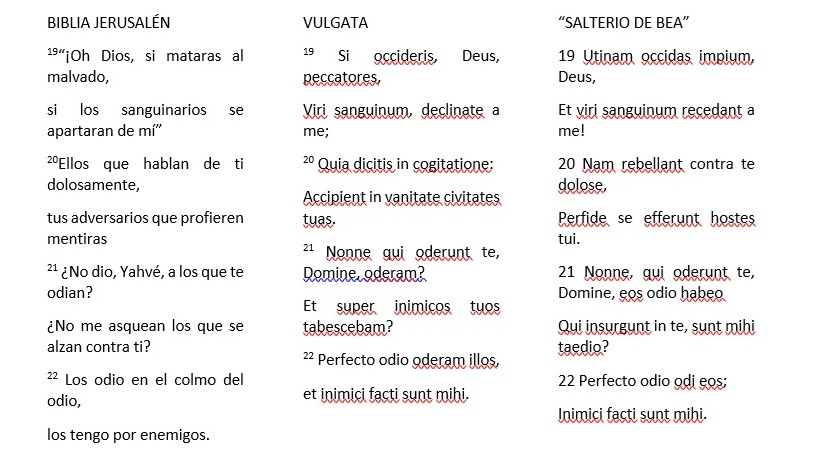
In the table below we can observe, as an example of what has been said, in three columns, the Spanish version of the paragraph with which we began this explanation of Psalm 138, 19 – 22 from the Jerusalem Bible in the first column; the original version of Saint Jerome’s Vulgate in the center and Cardinal Bea’s revision in the third.
Saint Jerome has been manipulated by Protestants and their principle of Sola Scriptura, but he never separated it from Tradition as both sources of Revelation and the authority of the Magisterium to interpret it. His writings are proof of this.
Saint Jerome, the priesthood, and the liturgy:
Epiphanius of Salamis is fundamental for understanding Jerome’s relationship with the priesthood. A monk before becoming a bishop, he felt a special love for the study of Sacred Scripture, traits that undoubtedly made the bishop especially dear to Jerome, as the Benedictine monk Basil Nixen indicates in his recent book “The last communion of Saint Jerome”. Epiphanius affirmed that “Ignorance of the Scriptures is a precipice and a deep abyss”, which recalls what is perhaps the most famous phrase that has come down to us from Saint Jerome: ignoratio Scripturarum, ignoratio Christi est, that is, “Ignorance of the Scriptures is ignorance of Christ”.
Despite the similarities of character and life trajectory between the two, there was one matter in which the elderly bishop of Salamis had a somewhat different vision from Jerome: Epiphanius represented a current of desert monasticism—probably a minority one—that did not consider monasticism and the priesthood to be mutually exclusive. On the contrary, as his own example attests, he thought that both complemented each other quite well, an opinion shared by Saint Augustine in the West and Saint Basil in the East. “Although we cannot know for certain – affirms the Benedictine Nixen-, it seems that, once Epiphanius entered his life, Jerome saw, so to speak, the signs of what was coming, and deduced that, with all probability, he was not going to be able to avoid priestly ordination. Apart from this assumption, he was clear that he was called to dedicate his life—and wished to do so with all his heart—to the study and explanation of the Scriptures, and probably understood that such a vocation would be benefited by the grace and priestly character conferred by the sacrament. And so, he agreed to be ordained a presbyter in the year 379”.
However, it was not Jerome who requested ordination; rather, it was Paulinus—and surely also Epiphanius—who raised the matter with Jerome. Jerome himself would recount it many years later: “Bishop Paulinus, of blessed memory, heard me, a miserable man, say: ‘Did I ask you to ordain me? If in conferring the priesthood upon us you do not deprive us of the monastic life, do what seems best to you. But if, with the title of priest, you strip me of that for which I abandoned the world, I will cling to what I have always had: you have suffered no loss with this ordination’”.
“We can imagine – affirms Basil Nixen – that, from Paulinus’s point of view, the reputation Jerome was building as a devout ascetic and learned master of the Scriptures had made him an obvious candidate for priestly ministry. Jerome was very astute in handling this situation: although accepting ordination seemed the most appropriate thing, since it would benefit his own vocation to explain the Scriptures and help the orthodox cause in Antioch, nevertheless, he was a monk and had no doubt about the preeminence of this vocation above all else”, as we have read in the previous paragraph.
The priestly ordination of Saint Jerome was, therefore, a kind of paradox, according to Nixen: “he accepted the priestly state, but, from the beginning, expressly renounced all priestly ministry and duty; and, although we cannot know for certain, subsequent events in his life suggest that this renunciation was absolute. He did so expressly, moreover, to safeguard the primacy of the monastic life in his life”.
Another obvious reason why he may have chosen to abstain from priestly ministry was to dedicate himself to the great work of his life: explaining the Scriptures and transmitting to his Latin-speaking brothers the erudition of both the Hebrews and the Greeks. Therefore, he needed to acquire that knowledge for himself, both through continuous personal study and by attending the conferences of distinguished men of letters, which required a great deal of free time. During his stay in Antioch, he frequently attended the conferences of Apollinaris of Laodicea on the interpretation of the Scriptures and strove to learn his methods of exegesis, without regard for his erroneous Christology. Shortly afterward, he left Antioch for Constantinople to study with Saint Gregory Nazianzen, a bishop of profound intellect, vast erudition, refined eloquence, and unquestionable orthodoxy. Both through Apollinaris and Gregory Nazianzen, Jerome would come into considerable contact with the teachings and writings of Origen, and would thereafter incorporate the exegetical methods of the Alexandrian master into his own teaching of the Scriptures.
It is also very important to mention here, regarding the liturgy, what the Jeronymite chronicler fray José de Sigüenza affirmed about Saint Jerome in his history of the order, which appeared in 1595.
The idea has come down to us that Saint Jerome did not celebrate Mass, for he did not consider himself worthy. Having accepted being ordained a priest out of obedience, it is said that once in Bethlehem his male and female communities only attended Sunday Mass in Bethlehem and that Saint Jerome only preached to them, but did not celebrate. Some of his homilies are preserved in his complete works.
However, the chronicler Sigüenza affirms that Jerome “celebrated Mass very frequently, and with all the devotion and fervor that can be imagined in so holy a soul. Our Lord, during these celebrations, granted him great lights for all things and favored him with many graces and favors, as His Divine Majesty is wont to do in favor of such servants of His, who, fully aware of what they are called to do, first prepare their soul, awaiting with the greatest fervor the arrival of so great a Spouse. And as reverence and fear before such majesty absorb their minds, directing their gaze toward their own smallness and vileness, they empty themselves of all that is within them, so that nothing may shame them, lest such royal eyes be offended and their capacity be diminished (…). This kept our saint in continuous vigilance in all things: custody of the gaze, great prudence and consideration in his words, in his dealings and in his conversation. He feared that, unless they were well guarded, something might enter through those windows which, in the moment of need, would suffice to close the doors to the coming of God. Thus he himself expressed it in the epitaph of Marcella: ‘I acted with great modesty regarding my gaze, so as not to look upon the Roman matrons’.
Thus was seen in Saint Jerome, who came forth from that sacred banquet ‘like a lion that shoots forth fire from its mouth’ (for thus Saint Chrysostom affirms of good communicants), turning for divine honor, terrifying to demons, unbearable to the wicked. In memory of this, and as relics of great value and esteem, the city of Rome preserves the chalice with which Saint Jerome consecrated, and it is shown to the people with great reverence, together with the chasuble which he himself wore. Perhaps it is the same chasuble that his great friend Nepotianus, nephew of Heliodorus, sent him when he was about to die, as a precious legacy in proof of their friendship. The saint himself says in the epitaph which he later wrote about him and dedicated to that uncle: ‘This chasuble which I used in the holy ministry of the altar of Christ, send it to my beloved, my father by age and my brother by office, and, for all the affection you feel toward your nephew, deliver it to him whom you love as much as I’. Upon pronouncing these words, he fainted, clinging to his uncle’s hand and carrying me in his memory”.
“He was skillful – continues Sigüenza – in handling all the things that were under his charge and that belonged to divine worship, keeping them all scrupulously clean. He considered that the church was the palace of the most exalted of kings, and the table, that of the greatest of lords. He knew well the respect described in the Old Testament toward the Holy of Holies, which was only the shadow of these present things, and he judged that all diligence was very little. He could not bear those who, in this respect, were careless and lacked decorum; on the contrary, he felt great delight when he found someone who excelled in these matters; he greatly admired this same priest Nepotianus for this quality of circumspection and care in his office (…). I have included this here, not only because in itself it radiates all that is fresh, beautiful and pleasing, and so that we may see what was the care and pious inclination that our saint had toward all these things (which, in truth, was my purpose), but so that, in passing, we may consider how impious are those who reprove all that they see in the church regarding sacred ceremonies and ornamentation, saying that all these things are novelties and of little fruit, when in reality they have been used since primitive times, have been fostered and multiplied, and are well rooted and accepted, from the time of Saint Jerome until our days—even the most insignificant customs—a truth demonstrated with erudition by those who have written treatises in defense of this truth against the monsters of these times (a reference to the Protestant “reformers”).
And Sigüenza concludes: “It is precisely because Saint Jerome was so meticulous and strict regarding divine worship that it has resulted, as by inheritance, that his Order and his spiritual children are distinguished by this same love of cleanliness and extreme care in divine service, and yet consider themselves very much below what it should be. It fosters devotion to contemplate the order and impeccable cleanliness of the altars, sacristies and temples of this Order; while it completely destroys devotion to see the neglect of all these qualities in many places of worship, and in a matter in which all care is insufficient; and it is a correct conclusion what the interior life of the soul must be when the exterior is thus neglected”.
We are thus left with the doubt, awaiting new information, as to whether Saint Jerome did celebrate holy Mass in Rome, but ceased to celebrate it once he was a monk in Bethlehem
***
It remains for us to see how Saint Jerome was surrounded by virgins and widows consecrated to Christ, who were his disciples; consecrated women who chose the solitary life or the common, cenobitic life.
So as not to lengthen today’s text further, we will present it in a separate text.