


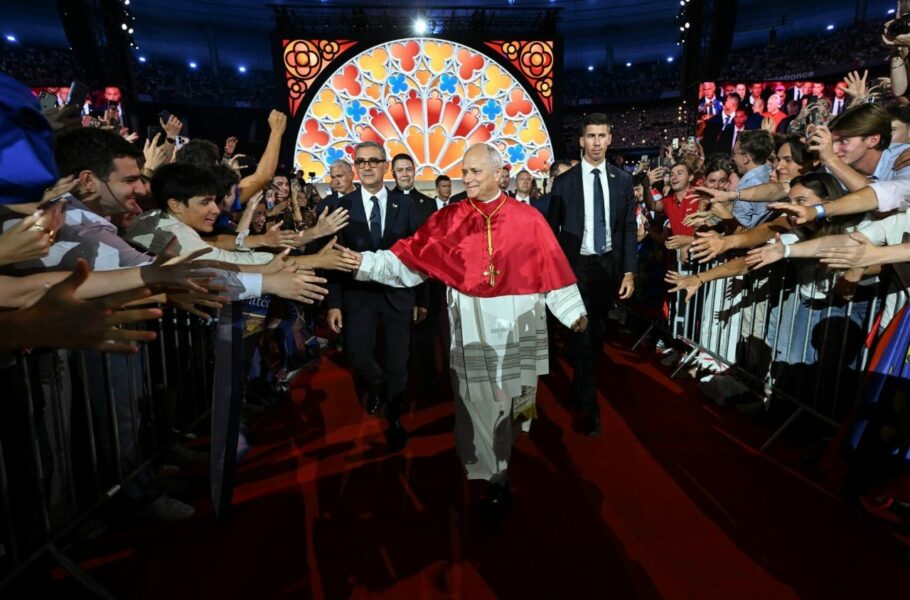
Pope Leo XIV dedicated this Wednesday, September 30, the general audience in St. Peter’s Square to reviewing his recent apostolic journey to France, where he highlighted several signs of a renewed awakening of the faith: the “notable and growing number” of young people and adults requesting Baptism, the response of thousands of young people, and the massive participation of the faithful in public celebrations.
The Pontiff used the reconstruction of Notre-Dame as an image of the “rebirth” he observes in the French Church. Recalling the multitude gathered for the Mass in the Place de la Concorde, which stretched along the Champs-Élysées to the Arc de Triomphe and beyond, he stated: “Here is the true reconstruction, the restoration of the Church that only God can accomplish, through the intercession of the Virgin Mary.”
Leo XIV once again highlighted the growth of conversions and adult baptisms in France, which he described as a beautiful “surprise” from God, and recalled the vigil with French youth, to whom during his journey he said: “You are the saints of France!” “That Vigil was a great sign of hope,” he affirmed this Wednesday.
GENERAL AUDIENCE LEO XIV
Dear brothers and sisters, good morning and welcome!
Today I wish to speak to you about the apostolic journey to France that I made in recent days. It was a great gift for me and for the people of God in that country, and I thank the Lord for it. I once again express my gratitude to all who welcomed me, civil authorities and pastors of the Church, and to the countless people who wished to meet the Pope or simply greet him in the streets, as an apostle of Christ and a messenger of peace. Thank you all!
I would like to gather the thoughts and impressions—still very vivid—of this pastoral visit around a single great symbol: the Cathedral of Notre-Dame in Paris. There, on the evening of the first day, we celebrated Vespers of the Blessed Virgin Mary, a solemn yet festive liturgy in which the music, the singing, and the beauty of the temple made the hearts united in prayer vibrate.
Precisely Notre-Dame, with the drama it has lived, can symbolically illuminate this entire apostolic journey, offering a key to interpretation that I would summarize in one word: rebirth.
The Cathedral of Paris, which only seven years ago seemed mortally wounded by a massive fire, is now rebuilt and more splendid than ever. That disaster provoked a positive reaction at all levels, some more visible and practical, others more hidden, of a spiritual nature.
Its restoration was a proof of the possible collaboration between Church, State, public institutions, and civil society. This attitude made it possible to best value both the generosity of benefactors and the expertise of professionals and workers. Synergy for the common good should be the normal style of institutions, political and social forces, and those with civil and economic responsibilities. This is the message I wished to convey to the French authorities, as well as to the members of UNESCO, the United Nations Educational, Scientific and Cultural Organization, based in Paris, indicating the fundamental criterion on which such collaboration must be based: the dignity of the human person.
But above all, Notre-Dame is an image of the Church of living stones, of the holy people of God.
It is interesting to draw a parallel between the celebration of Vespers in the Cathedral and the Vigil of the youth held that same night in the great Stade de France in Paris. Two completely different places and yet two complementary events, almost spiritually united. What united them? The Church, which is not made of stones or cement, but of people who love Jesus Christ because they have been loved by Him. In Notre-Dame were the priests and deacons, consecrated persons and pastoral agents; in the stadium was the new French generation: new—I would say—not only in age, but even more in spirit, in freedom of heart and faith. Young people who sang, shouted, but who also remained silent, listening. Attentive and moved faces, manifesting hearts longing for truth and love. To them I joyfully said: “You are the saints of France!” That Vigil was a great sign of hope.
Also a sign of hope—in the smallness that God prefers—was the meeting at the Maison Bakhita, a welcoming home for various people in difficulty: one of many places, fruits of the Gospel, where every day work is done to serve with love the dignity of the human person.
There is, however, in the Church in France a sign of rebirth that has been ongoing for some years: the notable and growing number of young people and adults requesting Baptism. Regarding this beautiful “surprise” from God, a provincial synodal assembly is taking place in Paris, in which I was able to intervene, encouraging the path of catechumens and neophytes, together with the communities to which they belong.
The culminating event of my visit to the capital was the Mass at the Place de la Concorde. There the sign of rebirth appeared in a surprising way: the liturgical assembly, which in the immense square gathered the priests, the choir, and a notable multitude, stretched throughout the Avenue des Champs-Élysées to the Arc de Triomphe and beyond. At the moment of Communion, all were able to approach the Eucharist, distributed everywhere. Here is the true reconstruction, the restoration of the Church that only God can accomplish, through the intercession of the Virgin Mary.
And then it was natural and necessary that, after Paris, I go as a pilgrim to Lourdes, to venerate the Mother of the Church, Mary, who in the hour of passion and death keeps the lamp of faith and hope burning. In Lourdes, the Lord, through the maternal solicitude of the Virgin Mary, communicates to all, pilgrims and especially the sick in body and spirit, a message of hope and rebirth. A message I wished to openly relaunch: every human life, in any condition, even in the most serious fragility, retains its inviolable dignity and deserves to be cared for, accompanied, relieved of suffering with human compassion and with the help of the means offered by science. That is why Lourdes represents for the whole world a sanctuary of the civilization of love. In this context I met some victims of abuse and asked them to help me express also to other victims my will and that of the entire Church to listen to them and walk with them as they seek healing, recognizing the pain caused in their lives and working for the prevention of abuse.
The third and final stage of the apostolic journey was the city of Metz, in a region of France and Europe martyred by the Second World War. There worked Robert Schuman, one of the main inspirers of the process of European unification. Contemporary Europe was born precisely as a project of peace after the destruction of war. We can say that what happened in Notre-Dame of Paris with the fire had happened in Europe with the Second World War. And Europe was reborn on the basis of those principles of democracy, solidarity, and fraternity among peoples that owe much to their Christian roots. Today too, on these foundations and with this vital “sap,” the European project can be renewed, in a much more globalized world, where interreligious dialogue plays a role of primary importance. That is why, in Metz, I met with representatives of the various religious traditions, who read and signed in my presence the “Metz Appeal” for dialogue and peace.
Dear friends, the theme of my pastoral visit to France was «Pour que le monde ait la vie», “That the world may have life” (cf. Jn 6:51). These are words of Jesus, which summarize His entire mission of salvation and which, during the journey, fully expressed the evangelical meaning of each encounter. May they now inspire our prayer, as we ask God that this event of grace may produce abundant and lasting fruits.
Greetings
I cordially greet the French-speaking pilgrims from Canada, France, and Luxembourg. I was impressed by the fervor and enthusiasm with which I was received in France! I thank God and pray that pastors may continue to respond to the expectations of the faithful, especially those of young people. I bless you from the heart!
I extend a warm welcome to all English-speaking pilgrims and visitors taking part in today’s audience, especially those from England, Ireland, Denmark, Ghana, Australia, India, Indonesia, the Philippines, Malaysia, Sri Lanka, and the United States of America. A special greeting to the seminarians of the Pontifical Irish College and to the pilgrims who will attend the diaconal ordination at the Pontifical North American College tomorrow. Upon all of you and your families I invoke the peace and unity of our Lord Jesus Christ. May God bless you all!
I address a cordial greeting to the German-speaking pilgrims. In Lourdes I invited everyone to pray, during the month of October dedicated to the Rosary, for peace among peoples and also in the hearts of all men. May Mary, Queen of Peace, intercede for us.
I cordially greet the Spanish-speaking pilgrims. Let us ask the Lord, through the intercession of Our Lady of Lourdes, to keep the lamp of faith, hope, and charity burning within us, and that we may be one in Christ, so that the world may believe in Him. May God bless you. Thank you very much.
I address my cordial greeting to Chinese-speaking people. Dear brothers and sisters, rekindle the flame of faith in your families and parishes, to become a gift of God for all. I bless you from the heart.
I joyfully greet all Portuguese-speaking pilgrims, especially the new students of the Brazilian Pius College. Dear brothers and sisters, may the public witness of love for Jesus Christ that we have seen in France be a source of inspiration for the whole Church. Let us not hide our faith! The Lord bless you.
I greet the Arabic-speaking faithful. Let us bring the peace of Christ to our world, so that it may have life in hope and love. May the Lord bless you all and protect you always from all evil!
I cordially greet the Polish faithful. Thirty years ago, Saint John Paul II beatified Vincent Lewoniuk and his 12 companion martyrs. To the shedding of their blood, they defended their belonging to the Catholic Church and communion with the Successor of Peter, remaining faithful to their own Eastern tradition. To their intercession I entrust the issues of the unity of Christ’s disciples and Catholics persecuted today because of their faith. Praised be Jesus Christ!
Appeal
I now address an appeal for the Tigray region in Ethiopia:
I continue to follow with deep concern the situation in Tigray and the neighboring regions of Afar and Amhara, where hostilities have flared up again. I make my sincere appeal to all parties to choose the path of dialogue. Armed conflict never solves problems but only aggravates them, leaving behind a trail of death, destruction, and resentment. Only sincere commitment can lay the foundations for lasting peace.
I fervently hope that the international community will offer its generous and timely contribution to ensure that all humanitarian aid reaches those who need it.
Last Sunday, in Bologna, three martyred priests were beatified: Ubaldo Marchioni, diocesan; Elia Comini, Salesian; and Martino Capelli, Dehonian, murdered in 1944, during a dramatic phase of the Second World War, because of the Nazi troops’ contempt for their ministry in favor of the faithful. The supreme sacrifice of these ministers of God shows today’s Christians the value of becoming neighbors to their brothers and sisters, especially in times of trial.
I extend my cordial welcome to the Italian-speaking pilgrims, in particular to the Missionary Daughters of the Holy Family of Nazareth, to the parish of Santa Maria della Valle in Scanno, as well as to the parishes of Ferrara di Monte Baldo and Tesero. I also greet the Vocational Training Center “Artigianelli” of Fermo, the students of the Visconti Institute in Rome, and those of the Gonzaga Institute in Palermo.
My thoughts finally turn to the young, the sick, and the newly married. May the month of October, which begins tomorrow, be an occasion to pray the Holy Rosary, dedicating it in a particular way to the end of wars and the attainment of peace.
To all, my blessing.