


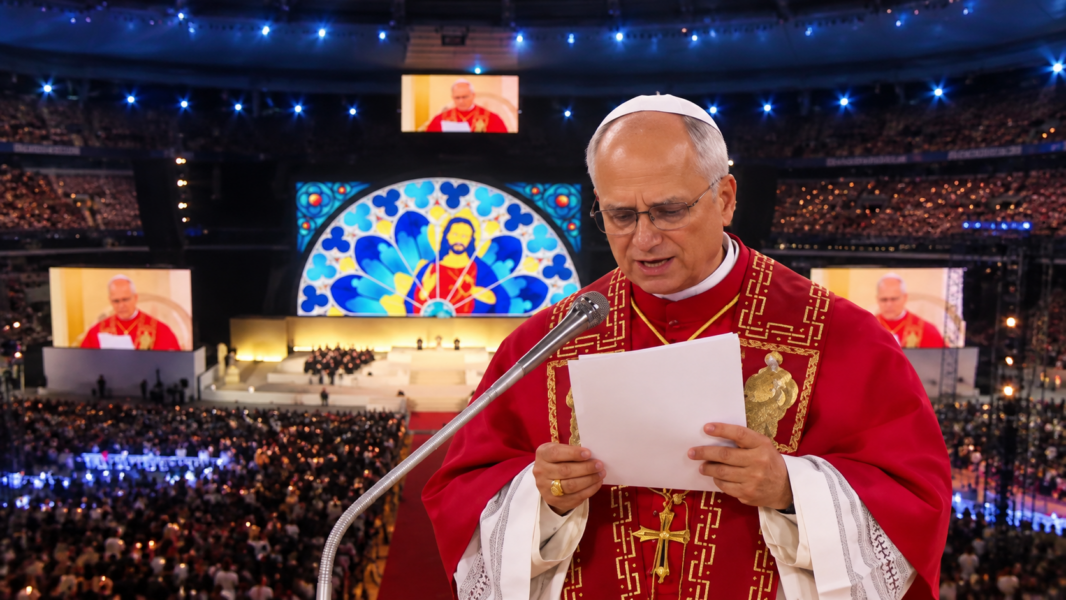
The Pope made a call to the young people gathered this Friday, September 25, at the Stade de France to take the path of holiness and to understand freedom not as the absence of bonds, but from a living relationship with Jesus Christ. “Good gives life, it never takes it away; good cares, it does not take for itself,” the Pontiff affirmed during the meditation he delivered at the vigil held in Saint-Denis.
After the dialogue previously held with two young French people, the litanies of the saints, and a moment of recollection before the relics present in the stadium, the Pope structured his meditation around three verbs taken from the first letter of Saint Paul to Timothy: “flee,” “strive,” and “fight.”
Meditation with the Holy Father
In the night, the light seems even more dazzling to us. Thus, dear young people, we have listened together to the words of Saint Paul. We want to hold them high, like a torch that illuminates not only the prayer of each one, but the entire history of the Church. The apostle observes his time and welcomes the divine inspiration, that is, the Holy Spirit, who always opens luminous perspectives of the future. Yes, God is the Lord of history and, whatever happens, He leads it toward salvation: in Christ every evil has an end, precisely because the end becomes the beginning of a new and eternal life.
Dear friends, to illuminate our time and transform the present in the light of the Spirit, let us remember above all that we too, like Timothy, are men and women of God. This expression —of God— chosen by Saint Paul, refers to a relationship, not to a possession. Whoever lives of God is free: free from everything that obscures life, making it empty and meaningless. Young people of France, you carry in your heart an immense desire for freedom, a word that resonates strongly in your culture. What, then, is the source of true freedom? Jesus indicates it clearly to us when He tells us that the truth will set us free (cf. Jn 8,32); and that the Truth is Himself (cf. Jn 14,6). Here, then, is the source of true freedom: the living relationship with Jesus.
The company of the Lord, in fact, gives wisdom to our projects and beauty to the desires we carry in our hearts. God passes through our soul like light, calling us to permanent renewal, to a conversion that gives full meaning to existence, because it makes us protagonists of a story that moves from confusion to the search for truth; from indifference to the commitment to justice. Saint Paul expresses this with three verbs that challenge our freedom: flee, strive, fight. The apostle writes to Timothy: first, “flee from these things,” that is, pride, vanity, violence, and greed (cf. 1 Tm 6,4.10). These are all feelings that take hold of us and dominate us. The selfishness that characterizes them hides a terrifying loneliness. To enjoy the closeness of God and human fraternity, it is therefore necessary to reject that greed that consumes relationships without giving anything in return and that fills us with things without nourishing us. That way of life pushes us to have everything, but to be no one; to receive a great number of “likes,” but remaining alone with ourselves.
When we decide not to follow that style, then we begin to strive toward “righteousness, godliness, faith, love, patience, gentleness” (v. 11). Yes, whoever lives of God strives toward what is best: he is in constant training. He seeks virtue, that is, the strength that makes him good and true. Dear friends, the dynamic that characterizes Christian existence has a precise name: it is called the path of holiness. It is the path that the Lord opens before each one of us, accompanying us along the way. And how many sons and daughters of this beloved land of France have allowed themselves to be guided by this path! Let us think, for example, of Blessed Marcel Callo, a young Frenchman, scout and worker who, in the darkness of the concentration camp, never ceased to strive toward good, preserving his inner freedom.
As we advance on this path toward holiness, it becomes clear that it is not enough to avoid evil: we must choose good. It is not an abstract principle, nor an obvious statement: choosing good is the proper action of freedom, and in carrying it out, freedom itself is realized, corrected, and matures. To make the right decision, remember this criterion: good gives life, it never takes it away; good cares, it does not take for itself. Good is not a nice concept, but the radiant face of love: it is God Himself! The virtues that Saint Paul presents to us as reflections of His goodness are these: justice toward humanity; piety and faith toward God; charity toward all; patience toward those who make us suffer; gentleness that distinguishes those who seek peace with a pure heart. The principles of equality and fraternity that inspire your society find here their foundation: more than simple legal prescriptions, they are radical and courageous decisions of a free heart. Making these qualities our own is not only a moral commitment: it is the decision to become authentic men and women, free from concessions. In this regard, the apostle gives us a third verb: fight. In fact, fleeing from evil and striving toward good implies fighting. Yes, fighting as Saint Paul did, often depicted with a sword in his hands, a sign of the Word of God, “the sword of the Spirit” (Eph 6,17). This verb resonates strongly here in France, the land of Saint Joan of Arc, a young woman who knew how to fight with boldness. But beware: the fight to which we are called is that of faith, that is, the commitment to live according to the Gospel, as disciples of Jesus, the Son of God who makes us all brothers and sisters. It is in His name that we have the strength of the righteous to resist temptation. In His name we have the perseverance of the meek, to dedicate ourselves to good. Our fight is not a battle against others; it does not resort to the weapons of violence, contempt, or oppression. Our only weapon is love that gives itself. We know, unfortunately, that there are forces contrary to our bond with God, powers that seek to divide people and peoples, setting them against each other. These evils not only have a violent face, but sometimes also assume an insidious appearance, because they promise precisely what they take from us: happiness. But when we feel enveloped in their darkness, the light of the Holy Spirit illuminates and strengthens us: tonight, therefore, let us choose together the virtues we must cultivate to follow the Lord.
We are not alone on this path toward holiness, because we walk it united with all our brothers and sisters who surround us. In fact, they experience it tonight and during great gatherings like the World Youth Days. Moreover, we have the saints as allies: they are friends who sustain us in trials. Dear friends, when life’s decisions require courage, turn to their intercession and imitate their example: as we have sung in the litanies, the breath of the saints assures us that we are never alone in prayer, never alone in the Church. Especially at this time, let us ask for their help to be artisans of peace: the eternal desire of God and the constant commitment of humanity! Tonight I have mentioned some of them. Let us also ask Saint Thérèse of the Child Jesus to teach us her “little way” of daily love, the solid foundation of all lasting peace.
The Lord makes this peace a reality through the Covenant He establishes with all of us through Jesus Christ. That is why, in pointing out the foundation of our experience of faith, Saint Paul speaks not only of what we can do in responding to God, but also of what God does for us. The apostle summarizes it in an episode: Jesus before Pilate, the truth of love facing the hypocrisy of power. The “good fight” coincides, then, with the “beautiful testimony” (cf. 1 Tm 6,12-13). This is shown by the use of the same adjective: kalos, which here means well done. The work well done, that which is good, is the redemption that Jesus accomplishes for us. In His fight against sin and death, the victory of Christ frees us all: He saves us from all evil, He invites us to all good.
In this light, let us contemplate the two relics we have before our eyes: the tunic and the cross. One was taken from Christ; the other was given to Christ. In this sense, both are signs of His passion: Jesus is stripped of His tunic to cover us with the white garment, washed “in the blood of the Lamb” (Rev 7,14). Thus the cross, from an instrument of death, becomes a sign of hope: together, therefore, the tunic and the cross represent us, us the Church that is born from the life of God given to the world. Dear young people, to grow in holiness and improve our society, be luminous witnesses of this Gospel, that is, of the good news that is Christ Himself, our Savior: “To Him be honor and eternal power. Amen” (1 Tm 6,16).
The visit in France continues
The meeting ended with the hymn of compline, the prayer, the blessing, and the singing of the Salve Regina. With the vigil of Saint-Denis, Leo XIV closed the first day of his apostolic journey to France, which will continue until Monday, September 28, with stops in Paris, Lourdes, and Metz.
The agenda will continue this Saturday, September 26, at 9:00 a.m. with a visit to Maison Bakhita, a center for social accompaniment and integration in Paris. At 10:15 a.m., the Pope will meet at the Catholic Institute of Paris with members of the Provincial Synodal Assembly, catechumens, and neophytes, and at 3:00 p.m. he will celebrate Holy Mass in the Place de la Concorde.
In the afternoon, Leo XIV will depart from Orly Airport for Lourdes, where his arrival is scheduled for 7:05 p.m. The day will conclude at 7:40 p.m. with the Pontiff’s prayer at the Grotto of Massabielle, in the Sanctuary of Our Lady of Lourdes.