


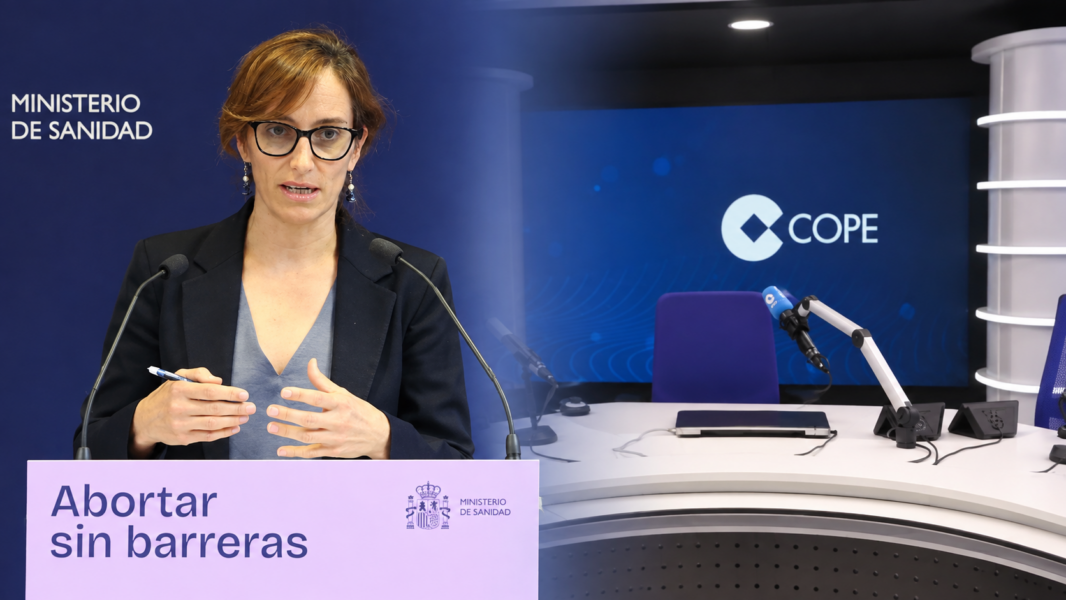
On Tuesday the 22nd, the Minister of Health presented an institutional campaign whose slogan is «Everything will be fine» and whose thesis, read in the video by a young voice, is that «perhaps you decide to have an abortion, and it will be fine», that «perhaps you are 16 years old, decide to do it and it will be fine» and that there is a right to do so in the public health system. At the same event, Mónica García announced that she had asked the State Attorney’s Office to force the Community of Madrid to lift the register of objecting doctors, and when a journalist from El Debate, María Curiel, asked her if she could guarantee that the fetus does not suffer and that the mother does not suffer after-effects, the minister twice replied that she did not understand the question, finally said that there is no fetal suffering «of course», and called her a denialist. So much for the Government, which did what it announces.
What is interesting is what the bishops’ radio did during the following twenty-four hours, and to know that you have to listen to it in full. Herrera en COPE, from six to one, is the programme that sets the agenda of the network and of half of Spain’s right-wing, and in those seven hours Carlos Herrera did not utter the word abortion. Not once. The issue came up at 06:23, in Jorge Bustos’s slot, for thirty seconds («one more; perhaps if she saw those figures, maybe it wouldn’t be necessary to do it and waste hundreds of thousands of euros»), and again at 07:10 in a news bulletin. Nothing else.
At one forty-four, José Luis Restán, who is the editorial voice of Ábside, said in two minutes what the network had not said in seven hours: that the campaign is «among the supreme immoralities of this age», that the minister «had the nerve to wave science around» and that «you are the denialist, minister». And he quoted Luis Argüello: «as the president of the Episcopal Conference has repeatedly denounced, we are facing the empire of biopolitics». No bishop on the phone. No statement read. Not a line from the Sub-commission for Family and Life. At the time of writing this piece, there was also no reaction from the Episcopal Conference to a State campaign that tells a sixteen-year-old girl that having an abortion is fine.
La Tarde did its job, and it must be said: twelve minutes with Leire Navaridas, who had an abortion in 2008 and for eight years has been accompanying women who have done so, and with Ana Martín, from El Debate, who recalled that the Criminal Code already punishes with prison those who pray outside clinics. The network itself had plenty of ammunition: a COPE report on Tuesday calculates that the State spends 47 million a year on abortions and the regions five on helping women with difficult pregnancies, ten times more on the former than on the latter. The flagship did not use it. It preferred Delcy, Conde-Pumpido, Marlaska’s inflatable buoy and the Moroccan elections.
The voice of the bishops, on the other hand, was heard. It was heard at 09:54 and at 09:58, four minutes apart, in the middle of Herrera’s morning: «your will can be an act of faith; by including your parish or diocese in it, you will leave a legacy of solidarity». Eleven spots that day. It is the only episcopal message that COPE broadcast between the minister’s «abortion is fine» and the following dawn: not a word for the life of the one about to be born, but a management of the inheritance of the one about to die. Everything will be fine.