


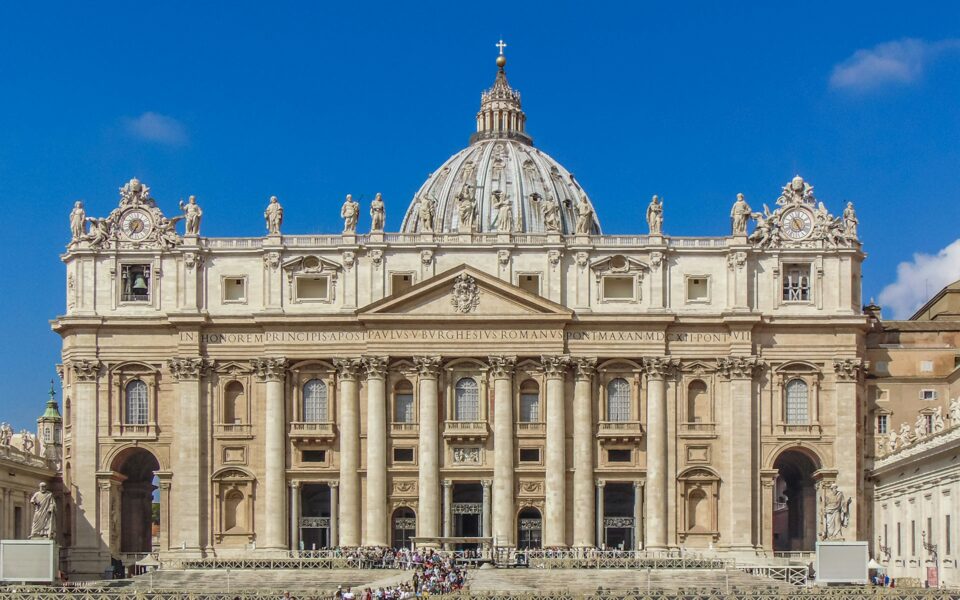
The atrium of St. Peter’s Basilica hosts this Monday, September 21, Sounds of Loss, an international sound installation conceived by German filmmaker Philip Gröning for the United Nations International Day of Peace. The initiative, which takes place simultaneously in churches, cathedrals, museums and other institutions in different countries, has the support in the Vatican of two dicasteries of the Holy See and of the Fabric of St. Peter.
The intervention consists of the playback, for 49 hours, of an irregular succession of clicks, knocks and other brief sounds, each of which symbolically represents a person killed in armed conflicts.
An intervention for the UN International Day of Peace
Vatican News reports that the installation presented at St. Peter’s is composed of 1,096 individually recorded sounds played at irregular intervals over 49 hours.
According to the 2026 statistics used for this version of the project, each sound represents a person who died in a war and is heard, on average, once every 2.62 minutes.
The official Sounds of Loss website, for its part, currently presents the international intervention as a composition of approximately 1,500 sounds. It also notes that the estimates used place the number of people who die daily as a direct consequence of wars between 550 and 700.
The 49-hour duration is intended to cover September 21 in all time zones around the planet. The intervention begins when that date arrives in Kiribati and ends when the day concludes on Baker Island.
Two Vatican dicasteries back the project
The Vatican’s participation is supported by the Dicastery for Culture and Education, the Dicastery for Communication and the Fabric of St. Peter.
Cardinal José Tolentino de Mendonça, prefect of the Dicastery for Culture and Education, has described Gröning as a “true master of silence” and has defined the initiative as a “call to responsibility” in the face of the victims of violence and war.
Cardinal Mauro Gambetti, archpriest of St. Peter’s Basilica and president of the Fabric of St. Peter, has stated that hosting the installation means offering “a space for listening and reflection on the victims of conflicts.”
Paolo Ruffini, prefect of the Dicastery for Communication, has also endorsed the initiative, highlighting that the sounds aim to remember the concrete lives behind the statistics on wars.
Cathedrals, churches, museums and public spaces
Sounds of Loss was not conceived specifically for religious spaces. According to the project’s official website, schools and universities, museums and galleries, public administrations, stations, cultural institutions and places of worship of different religions can participate.
The intervention can also be incorporated into exhibitions, conferences, concerts, religious events and other activities without the need to modify their usual programming.
Among the places participating in the initiative are the Berliner Dom and the Zionskirche in Berlin, the Cathedral of St. John the Divine in New York, Verona Cathedral, St. Paul’s Cathedral in Melbourne and the National Museum of Singapore.
In New York, the installation also accompanies the traditional event held for the so-called UN Sunday, during which an intervention by the president of the United Nations General Assembly is planned.
The project’s website indicates that participating institutions must register and have a valid license to access the sound intervention. The initiative is financed through contributions from participating entities, although its organizers also seek donations to reduce these costs.
More than 24,000 recorded sounds
Gröning began developing the work during the winter of 2026. Over three months, his team recorded more than 24,000 samples belonging to about 50 different categories.
The sounds come from everyday objects such as light switches, clocks, locks, old telegraph devices, cardboard boxes or pencils tapping on tables.
The sequence does not follow a uniform rhythm. Some sounds appear grouped together and others are separated by periods of silence; their intensity also varies. The organizers explain that this irregularity is intended to represent the unpredictability of war and the unequal attention given to its victims.
The director of Into Great Silence
Philip Gröning is especially known among Catholic audiences for Into Great Silence, the documentary released in 2005 after the filmmaker lived for months with the Carthusian monks of Chartreuse in France.
The director was raised Catholic, although in various interviews he has described a complex relationship with the religious formation he received during his childhood and has expressed disagreements with various aspects of the institutional Church. His experience among the Carthusians, however, later occupied a prominent place in his filmmaking career.
The installation remains located in the atrium of St. Peter’s Basilica. Vatican News has also accompanied the initiative during September 20 and 21 with a connection to St. Peter’s Square linked to the audio of Sounds of Loss.