


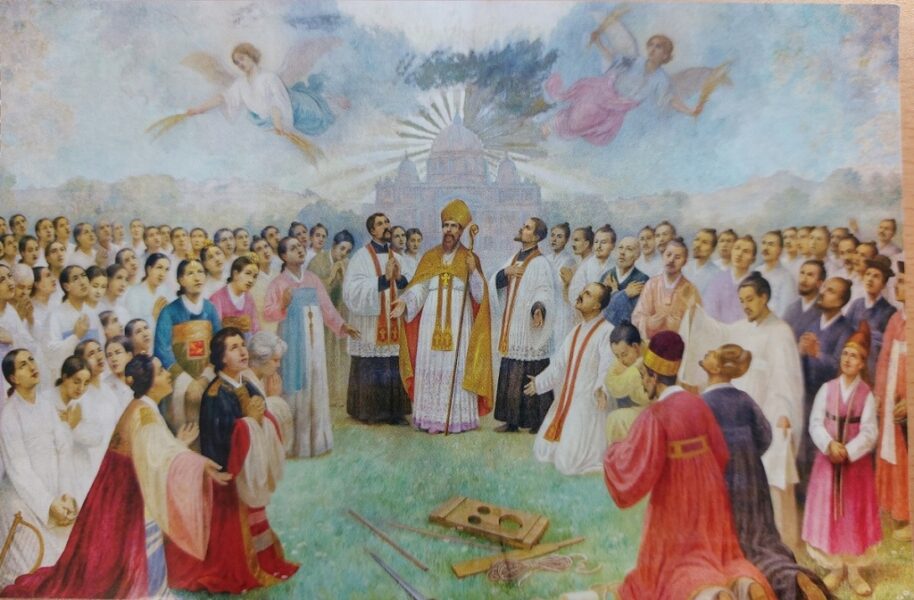
The Church celebrates this Sunday, September 20, the memory of Saint Andrew Kim Taegon, Saint Paul Chong Hasang and their companion martyrs, representatives of the generations of Catholics who gave their lives during the persecutions suffered by Christianity in Korea between the 18th and 19th centuries.
Their story presents an exceptional particularity within evangelization: the Korean Catholic community began to form on the initiative of laypeople who came to know the faith through Christian books that arrived from China. When they finally managed to establish contact with priests, there were already baptized people and communities that wished to be fully incorporated into the Church.
Among the canonized martyrs are the first Korean priest, Andrew Kim Taegon, and the layman Paul Chong Hasang. Together with them, men and women of different ages and social conditions were raised to the altars.
A Church that began with the laity
Christianity had had earlier contacts with the peninsula, but the birth of a stable Catholic community occurred in an unusual way.
Korean intellectuals came into contact during the 18th century with Christian writings from China. Those texts awakened interest in Catholic doctrine and some began to study and practice it before having their own priests available.
One of the decisive events occurred when Yi Seung-hun traveled to Beijing, received baptism and returned to Korea in 1784. From then on the new community began to grow.
The first Catholics even tried to organize certain aspects of ecclesial life by themselves. When they understood that the celebration of the sacraments and priestly ministry required the sacrament of Holy Orders, they sought to establish contact with the Catholic hierarchy and asked that priests be sent.
The persecution
The new religion soon clashed with the political and social order of the Joseon dynasty.
The Christian refusal of certain ritual practices related to the cult of ancestors was interpreted as a threat to the Confucian system on which much of the social order rested.
Successive persecutions then began.
For decades bishops, priests, catechists, entire families and numerous laypeople died. The persecution did not succeed in extinguishing the community and, in certain periods, the Church continued to exist for years with a very reduced number of priests.
Andrew Kim, the first Korean priest
Andrew Kim Taegon was born in 1821 into a Christian family. His father, Ignatius Kim, also died a martyr.
Young Andrew was sent to train for the priesthood and was ordained in 1845, becoming the first Korean Catholic priest.
His ministry was extraordinarily brief. He worked to facilitate the clandestine entry of missionaries into Korea, but was arrested in 1846.
He was barely 25 years old when he was executed.
His figure remained forever united with that first Korean Church that had survived for decades amid persecutions, clandestinity and scarcity of priests.
Paul Chong Hasang, the layman who asked for priests for Korea
Paul Chong Hasang represents the other fundamental characteristic of that Church.
He was a layman and the son of a martyr. For years he made dangerous journeys and arrangements to ensure that priests could enter Korea and attend to Catholics.
His requests contributed to the establishment of a more stable ecclesial structure and the creation of the Apostolic Vicariate of Korea.
He was arrested during the persecution of 1839 and executed after defending his faith.
Saint John Paul II canonized in Seoul in 1984 103 Korean martyrs, headed by Andrew Kim Taegon and Paul Chong Hasang. It was the first canonization celebrated by a Pope outside Rome in modern times.
Francis returned to this story during his trip to Korea in 2014, when he beatified another 124 martyrs and recalled the fruitfulness of that first Christian community.
One of the most singular stories of evangelization
The liturgical memory of this September 20 does not only recall a martyred priest or a group of persecuted Christians.
It also recalls a circumstance uncommon in the history of missions: a local Church whose first seed was not planted directly by foreign missionaries, but by Koreans who discovered the Gospel, sought to understand Catholic doctrine and began to transmit it among their compatriots.
The priests would come later. And when they arrived they found something extraordinary: a community that was already waiting for them.