


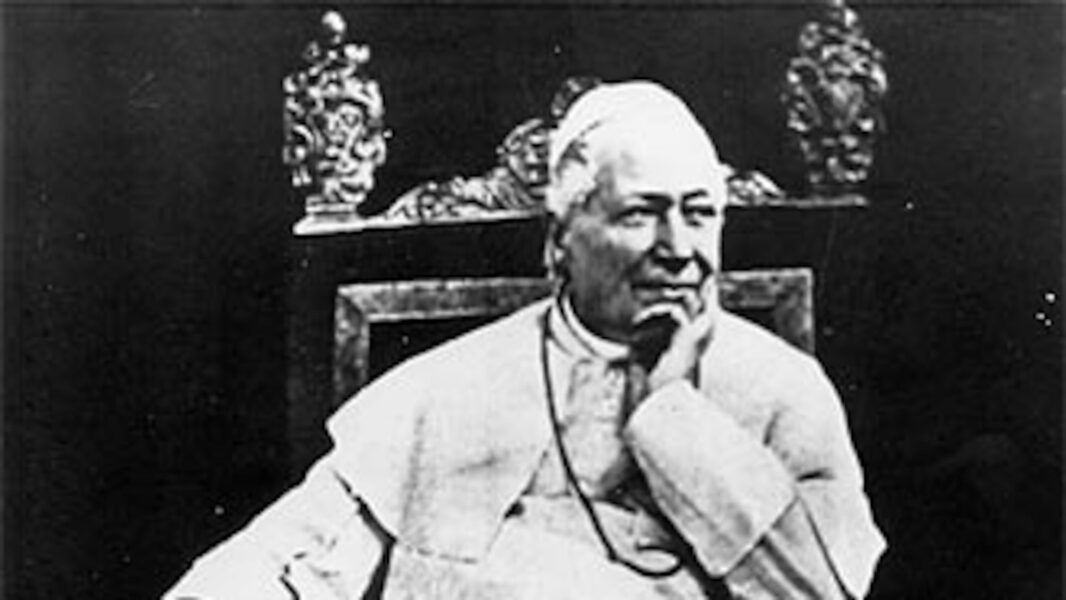
On September 20, 1870, 156 years ago, the troops of the Kingdom of Italy breached the walls of Rome near Porta Pia and entered the city. The fall of Rome ended the temporal power that the Popes had exercised for centuries over the Papal States and opened a conflict between the Holy See and the new Italian State that would not be definitively resolved until the Lateran Pacts of 1929.
That episode, known as the Capture of Rome or the Breach of Porta Pia, made Pius IX the last sovereign Pope of the ancient Papal States. For the Pontiff, the annexation was not a simple territorial reorganization: he considered the temporal independence of the Holy See a necessary guarantee to freely exercise his spiritual mission.
A resistance intended to record the violence
Italian unification had progressively reduced the pontifical territories until the Pope was practically limited to Rome and its surroundings.
The situation changed definitively in 1870. The Franco-Prussian War forced France to withdraw the troops protecting Rome, and the Kingdom of Italy found the opportunity open to complete the unification of the peninsula.
Italian troops arrived before Rome in September. Pius IX refused to hand over the city voluntarily, but neither did he want its defense to cause a prolonged bloodshed.
On September 19, he wrote to General Hermann Kanzler, commander of the pontifical forces, ordering him that the resistance should serve only to demonstrate that the occupation was taking place by force and that surrender should be negotiated after the first artillery shots.
“It must never be said that the Vicar of Jesus Christ, although unjustly attacked, has consented to any shedding of blood,” the Pontiff wrote, according to a historical reconstruction preserved by L’Osservatore Romano.
The Breach of Porta Pia
On the morning of September 20, the bombardment of the walls began. Italian artillery managed to open a breach near Porta Pia and the troops entered Rome.
The pontifical resistance ceased shortly afterward, in accordance with Pius IX’s instructions.
Rome was incorporated into the Kingdom of Italy and the following year formally became its capital. With this, the Papal States disappeared, but the question of the Holy See’s independence remained unresolved.
Pius IX refused to recognize the legitimacy of the annexation. In the encyclical Respicientes ea, published on November 1 of that year, he described the entry of Italian troops as an occupation carried out “with violence and with arms” and denounced the loss of the territories that remained under his authority.
The “Roman Question”
Thus began the so-called Roman Question: the confrontation over the legal and political position of the Pope within the new Italian State.
Pius IX and his successors considered themselves deprived of the territorial independence necessary to fully exercise their sovereignty. For decades the Popes remained within the Vatican and refused to recognize the situation created in 1870, giving rise to the well-known expression of the Pontiff as “prisoner in the Vatican.”
The problem survived Pius IX, Leo XIII, St. Pius X, and Benedict XV and reached the pontificate of Pius XI.
Only on February 11, 1929, almost six decades after Porta Pia, did the Holy See and the Kingdom of Italy sign the Lateran Pacts. Italy then recognized the sovereignty of the Holy See over the new State of Vatican City.
The loss of the extensive Papal States thus led, 59 years later, to a very different territorial solution: a small State intended to legally guarantee the Pope’s independence from any civil power.