


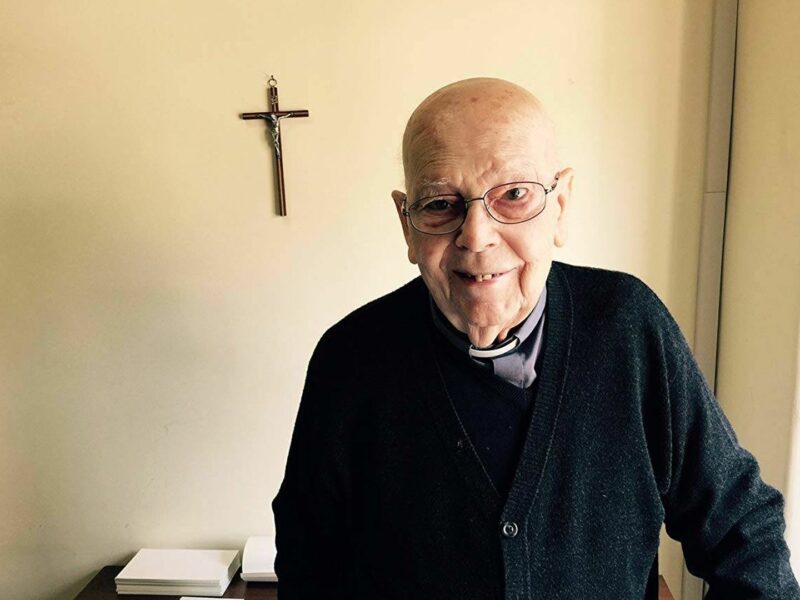
Ten years after the death of Father Gabriele Amorth, one of the best-known exorcists of recent decades, his nephew Giovanni recalled a lesser-known side of the Pauline priest: behind the man who for years fought directly against the action of the devil was a joyful priest, deeply Marian and convinced that the Christian’s fundamental protection lay in the sacramental life.
Amorth died in Rome on 16 September 2016, at the age of 91. On the occasion of the tenth anniversary, the Society of St. Paul celebrated a Mass and a gathering dedicated to his memory at the Shrine of Mary Queen of the Apostles in Rome. In that setting, Giovanni Amorth, 54, shared with Famiglia Cristiana his personal memories and the spiritual legacy he received from his uncle.
“The devil can possess the body, but never the soul”
Gabriele Amorth was appointed exorcist in 1986. Giovanni was then about fifteen and admits that his uncle’s new mission raised questions in him about the devil, possession and eternal salvation.
One of those questions was especially simple and distressing: if a person could become possessed by the devil, did that mean they were damned?
Amorth’s answer left a deep impression on his nephew: “The devil can possess the body, but never the soul”. A person suffering from possession, he taught, could remain fully in God’s grace through confession, prayer, works of charity and the sacraments. Giovanni says that in the years that followed he often turned to his uncle to resolve doubts related to faith and the action of evil.
The memory also contrasts with the image of the exorcist so often portrayed in cinema. Within the family, Amorth was not a sombre figure. His nephew describes him as a “wonderful, cheerful, optimistic” man, fond of jokes and gifted with an especially affectionate character.
When they spoke on the phone, Giovanni recalls, his uncle would encourage him to enjoy the present day and trust that the next would be even better. For his family, his ministry was never a cause for fear: they saw it as a priestly mission aimed at combating evil.
Mass, confession and the Rosary
Giovanni lived especially close to his uncle between 2000 and 2004, when he was studying at the Pontifical Lateran University and frequently stayed at the community of the Society of St. Paul. His room was opposite Amorth’s: while the priest spent his days attending to those who came to him for exorcisms, his nephew attended university classes, and the two met for lunch and dinner.
From those years he especially remembers the priest’s spiritual teaching. Giovanni sums up Amorth’s legacy in two inseparable dimensions: his teachings on the occult, satanism and the action of the devil, and his insistence on the ordinary means of Christian life.
For the well-known exorcist, the fundamental response to evil lay in remaining united to Jesus Christ through the Holy Mass, confession and the Holy Rosary.
His nephew also recalls Amorth’s intense Marian devotion. The priest prayed the complete Rosary every day—the four sets of mysteries—and had passed that practice on to Giovanni. Amorth himself had consecrated him to the Immaculate Heart of Mary when he was a child.
Amorth’s spiritual life was also closely linked to St. Pio of Pietrelcina, whom he knew personally and visited for 26 years, from 1942 until the Capuchin’s death in 1968. From that relationship later came Padre Pio: A Brief History of a Saint, a work in which the exorcist gathered his personal memories and traced the life of the man he called his “beloved spiritual father.” The book, published in Spanish by Homo Legens, is now in its fifth edition.
Ten years after his death, Giovanni says the absence of his uncle is still enormous, yet he does not experience it with sadness. The memory he keeps of the priest is not dominated by the exorcisms that made his name known throughout the world, but by a conviction Amorth repeated for much of his ministry: in the face of evil, sacramental life, prayer and union with Christ come first.