


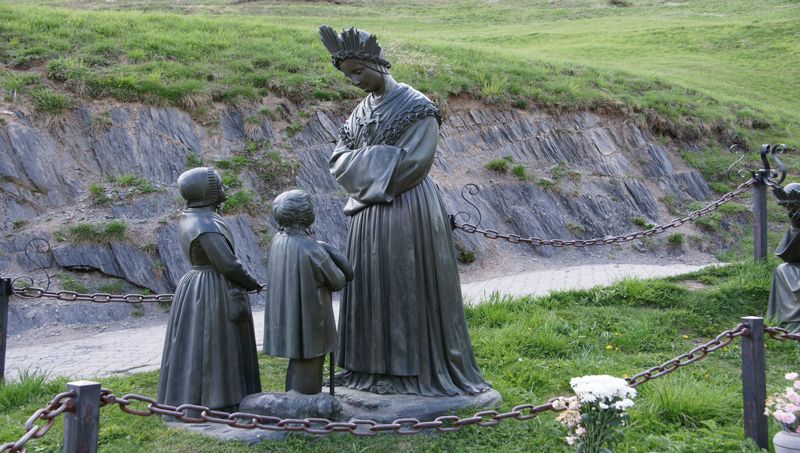
Today marks the 180th anniversary of the apparition of Our Lady of La Salette, one of the great Marian events of the 19th century. In 1846, two young French shepherds, Maximin Giraud and Mélanie Calvat, claimed to have encountered a “Beautiful Lady” weeping in the Alps who entrusted them with a message of conversion addressed to “all her people.”
The apparition was recognized five years later by the Bishop of Grenoble, Bishop Philibert de Bruillard, following a canonical investigation. Since then, La Salette has become an important Marian shrine, and its message has been particularly associated with penance, the sanctification of Sunday, and reverence for the name of God.
The Sanctuary of Our Lady of La Salette, located about 1,800 meters above sea level in the French department of Isère, commemorates this Saturday the 180th anniversary of the apparition.
A Virgin Who Wept
On September 19, 1846, Maximin, aged 11, and Mélanie, aged 14, were tending cattle in the mountains near La Salette-Fallavaux.
According to the account later examined by ecclesiastical authority, both first saw an intense light and then a woman seated with her face in her hands, weeping. The “Beautiful Lady,” as the children initially called her, rose and began to speak to them.
The message was not centered on extraordinary predictions but on very concrete sins of the Christian life of the time.
The Virgin especially lamented the profanation of Sunday and the irreverent use of her Son’s name. She also called for prayer, conversion, and penance.
The reference to Sunday had a particularly concrete dimension at the time. The progressive economic and social transformation of 19th-century France had contributed to the abandonment of Sunday rest and attendance at Mass among sectors of the population.
At La Salette, both issues—the Sunday and blasphemy—are presented not as mere disciplinary failures but as signs of humanity’s distance from God.
“Make it known to all my people”
The apparition concluded with a commission that would become one of the characteristic phrases of La Salette: the message had to be transmitted.
The children recounted what had happened, and the news spread rapidly. Pilgrims began to come to the site, while the diocese opened an investigation to determine the credibility of the events.
On September 19, 1851, exactly five years after the apparition, Bishop de Bruillard declared that the apparition of the Blessed Virgin to the two shepherds bore the signs of truth and that the faithful could consider it certain.
The ecclesiastical approval refers to the apparition and the public message jointly transmitted by Maximin and Mélanie. It should be distinguished from the so-called “secrets of La Salette,” later texts whose history and various versions gave rise to controversies and which do not form part, in the same sense, of the approved message of the apparition.
Penance, Prayer, and Return to Sunday Mass
The strength of the message of La Salette lies precisely in its simplicity. The Virgin asks for a return to the elementary practices of Christian life: to respect the Lord’s day, to avoid blasphemy, to pray, to do penance, and to be converted.
She also asks the children if they pray well and exhorts them to do so at least in the morning and at night, even if only briefly when they cannot do more.
It is not, therefore, a spirituality built around the extraordinary. The call of La Salette leads to the commandments, prayer, and sacramental life.
The image of Mary weeping adds to the message a feature that has profoundly marked the iconography of the sanctuary: the Mother who shows sorrow at the sin of her children and calls them back to Christ.
180 Years Later
The sanctuary celebrates the anniversary this Saturday with a solemn Mass and various acts of prayer. A celebration is scheduled for 10:30 a.m., presided over by Cardinal Jean-Marc Aveline, Archbishop of Marseille, followed throughout the day by prayer, a Marian procession, and Eucharistic adoration.
One hundred eighty years have passed since that September 19, 1846. The social context known to Maximin and Mélanie has changed radically; the call they heard, however, remains extraordinarily simple: to return to God, to sanctify Sunday, to abandon blasphemy, to pray, and to do penance.