


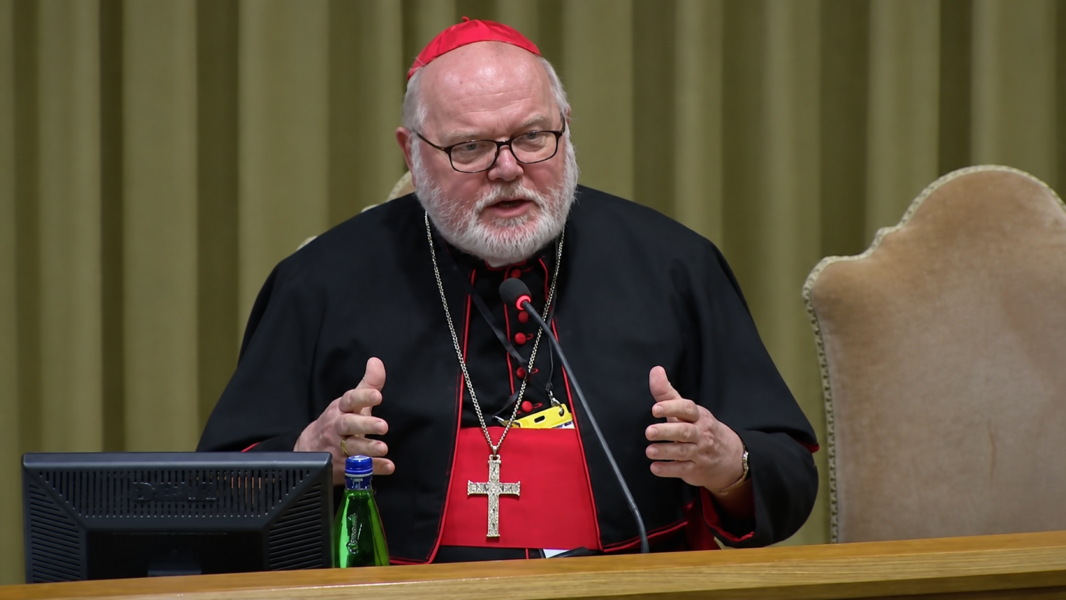
The Catholic Academy of Bavaria and the Archdiocese of Munich and Freising inaugurated this Friday, September 18, in Munich a two-day congress dedicated to rethinking the exercise of episcopal ministry from the perspective of synodality. The meeting, titled Der synodale Bischof —“The Synodal Bishop”—is being held on the occasion of the 30th anniversary of the episcopal consecration of Cardinal Reinhard Marx and will feature this afternoon one of its central moments with an address by the cardinal himself on “synodality as a program for the future.”
The official presentation openly states that “a synodal Church needs a synodal bishop” and maintains that the episcopal ministry “will change” when it is integrated in a binding way, both within dioceses and beyond them, into structures of participation. The organizers also speak of a “clear increase in democratic culture,” although they specify that this would not involve introducing parliamentary votes, “much less on matters of faith.”
Reconsidering the potestas of the Bishop
The congress is not limited to a generic reflection on pastoral styles. The questions raised by its organizers go directly to the exercise of episcopal authority: how to place the potestas of the bishop in a “constructive relationship” with the dignity and rights of all the baptized, what models would allow a “synodal reformulation of episcopal authority,” what would need to be changed to achieve it, and what transformations can already be introduced within existing possibilities.
A first part of the program examines the issue from the tradition and origins of the episcopate. Thomas Söding, professor in Bochum, addresses the biblical lines of governing power and the “innovative potential” of the New Testament theology of ministries, while Christian Hornung studies how and why the episcopal ministry acquired its first forms.
Another block seeks to determine which elements constitute the essence of the episcopate and which functions should be maintained even under a “modified profile.” The program itself introduces a comparison with Protestant communities and asks what answers they gave to these questions “when they reformed the ministry.”
Michael Seewald, professor of Dogmatic Theology in Munich, speaks on the place of the diocesan bishop within the “synodal framework,” while Protestant theologian Friederike Nüssel analyzes the reconstitution and understanding of the episcopal ministry during the Reformation.
Marx: “Synodality as a Program for the Future”
The section expressly dedicated to “innovation” begins with a direct question: “What to do differently in the future?” The organizers maintain that, following the conclusion of the Synod on Synodality and the German Synodal Way, the Catholic Church intends to “permanently implement new synodal structures” and ask what “new contours” should derive from this for the episcopal ministry.
The program even formulates the questions of what it means to “become a synodal bishop” and what it entails to “be a synodal bishop.” The panel will discuss various ideas and proposals for the development of the episcopal ministry.
Marx will speak at 19:30 with the lecture “Synodality as a Program for the Future.” Also participating in the discussion are Charlotte Kreuter-Kirchhof, professor at the University of Düsseldorf and member of the Vatican Council for the Economy, and Annette Schavan, former Federal Minister of Education and former German Ambassador to the Holy See.
The choice of topic is directly linked to the cardinal’s episcopal anniversary. The Catholic Academy of Bavaria has organized the days on the occasion of his three decades as a bishop and has chosen to celebrate them precisely with a reflection on how the exercise of episcopal authority could be modified within synodal structures.
From the Synodal Way to New Permanent Structures
The second day will broaden the discussion from a supradiocesan perspective. The program proposes confronting the reflections arising in Munich with the experience of a diocese in another country, with the German Bishops’ Conference, and with the Synodal Way.
Among the participants are the Bishop of Antwerp, Johan Bonny; sociologist and social philosopher Hans Joas; and Frank Ronge, organizer of the Synodal Way on behalf of the German Bishops’ Conference and the Central Committee of German Catholics (ZdK).
The final part of the meeting aims to draw concrete pastoral and ecclesiological conclusions. Among the questions raised is explicitly “how should leadership be shared?” A group made up of pastoral leaders from Munich, the German Bishops’ Conference, and the Diocesan Council of Catholics will present the conclusions, advances, and open questions that emerged during the days.
From Wels to Munich
The congress begins just one day after the conclusion in Wels (Austria) of the European symposium Shaping Synodality in Europe: From Vision to Roadmap, which brought together from September 14 to 17 ecclesial representatives from 31 countries to address the practical application of synodality. Among the issues discussed were precisely the structures, ministries, and decision-making processes in the Church.
During the Austrian meeting, canonist Myriam Wijlens, consultant to the General Secretariat of the Synod, maintained that diocesan bishops and episcopal conferences do not need to “wait for Rome” to use the margins already offered by canon law. Wijlens noted that it is now up to them to take advantage of those spaces during the implementation phase of the Synod.
Munich now takes up some of those same questions, but focusing them specifically on the episcopal ministry: from the exercise of potestas and the integration of the bishop into participatory structures to the possibility of sharing leadership and permanently establishing new forms of synodal functioning. The congress program itself formulates the question that will run through the two days: what it means, in practice, to “become a synodal bishop” and to “be a synodal bishop.”