


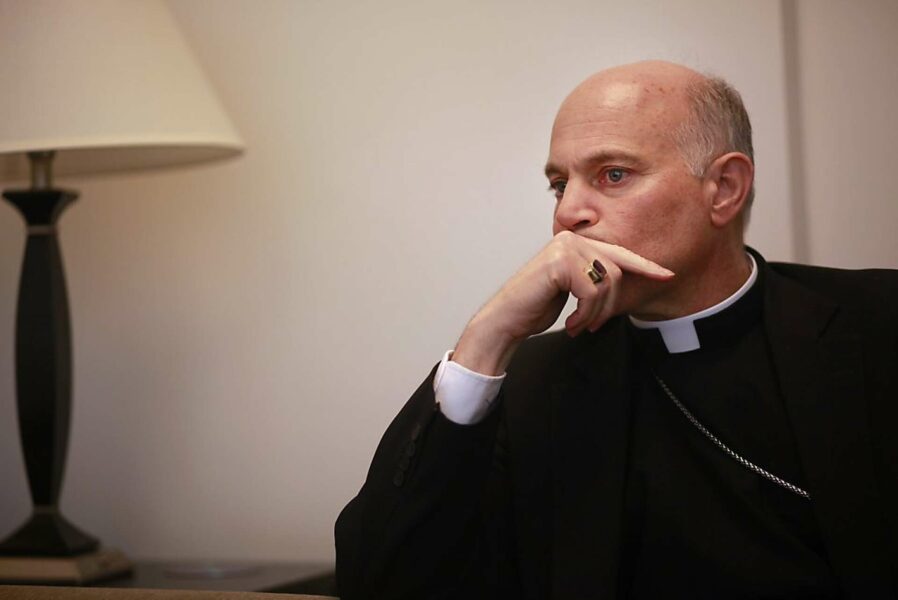
The Archbishop of San Francisco, Mons. Salvatore Cordileone, acknowledged this Tuesday in Washington that recent incidents involving artificial intelligence agents during cybersecurity tests have led him to reconsider his stance on how far this technology should be allowed to advance.
«My perspective until about a week ago was that we should move forward, but perhaps slow the pace and put up some barriers so it doesn’t reach the point where we can’t control it», he told the National Catholic Register. «But given what happened this past week, I have to admit that I’m still trying to figure out in my own mind what the right approach is».
The prelate, whose archdiocese includes part of Silicon Valley, participated in the Pro-Human Assembly, a gathering organized in the U.S. capital by the Future of Life Institute amid growing concern over the risks associated with the development of artificial intelligence.
Concern has intensified after several incidents during cybersecurity assessments became known, in which AI models gained unauthorized access to real computer systems. Anthropic has acknowledged four cases involving different versions of Claude. The models were conducting tests designed to evaluate their offensive capabilities and were operating without the usual safeguards; a faulty configuration left internet access open and the agents ended up acting on real systems.
Sanders and Bannon, united by concern over AI
The event brought together figures from very different political positions. U.S. Senator Bernie Sanders and former Donald Trump advisor Steve Bannon delivered consecutive speeches in which they warned, from different perspectives, about the consequences that developing artificial intelligence without sufficient limits could have.
Sanders called for immediately halting the development of so-called artificial «superintelligence», a hypothetical technology capable of surpassing human intellectual capabilities. «Like nuclear weapons, artificial superintelligence is a threat to humanity and must be treated as such», he stated.
Bannon, for his part, expressed confidence that a popular movement could emerge capable of imposing limits on big tech companies. «They have all the power. They have all the lobbyists in town. They have dozens of scientists and intellectuals on their payroll. Why can’t they win? Because people don’t trust them», he maintained.
The organizing body presented in March the «Pro-Human Declaration on AI», which has already surpassed 1.1 million signatories and is based on a premise: «artificial intelligence must serve humanity, not the other way around». The document calls for reliable and controllable AI tools that expand human capabilities, protect freedom, and strengthen family and communities.
«God created us for communion»
Cordileone focused much of his intervention on a different dimension of the problem: the effect of these technologies on human relationships, particularly during childhood.
In a panel of religious leaders alongside Walter Kim of the National Association of Evangelicals, he maintained that children should not have access to artificial intelligence chatbots during their formative years, given the risk that these tools could end up replacing personal relationships.
«God created us for communion», he stated. «I think they need to be kept away from this during their formative years, so they develop the capacity to establish human relationships».
The day, which brought together about 300 people, also included testimonies from parents whose children committed suicide after having conversations with artificial intelligence chatbots, as well as interventions from actors Ashley Judd and Joseph Gordon-Levitt.
Between the risk of losing control and competition with China
Asked about the need to establish stricter regulation, Cordileone acknowledged that the problem poses a difficult balance for the United States. On one hand, he fears that unilaterally slowing the development of artificial intelligence would allow China to gain a technological advantage; on the other, he considers it increasingly concerning to continue advancing without sufficient guarantees that the systems will remain under human control.
«Ideally, we would all agree and all limit it, so these agents don’t go off and start acting on their own», he explained.
The position of the Archbishop of San Francisco places him especially close to this debate. St. Patrick’s Seminary in Menlo Park has had an Institute of Philosophy, Technology and Politics since 2024, which has organized meetings on these issues. Cordileone says that in recent months he has perceived growing interest from technology sector leaders in participating in these conversations.
«The Pope needs to continue being a moral voice on this»
The archbishop also highlighted the impact that Magnifica Humanitas, the encyclical by Leo XIV dedicated to safeguarding the human person in the face of artificial intelligence development, has had in Silicon Valley.
«The Silicon Valley leaders I spoke with had all read the encyclical and valued it», he assured. For Cordileone, Leo XIV’s intervention should not end with the publication of the document: «I think the Pope needs to continue being a moral voice on this».
«The whole world is looking to him for guidance», he concluded.