


Pope Leo XIV has explained this Wednesday who the «witnesses of the faith» are whose memory the Vatican collects alongside that of the new martyrs: Christians who remained faithful to Christ until death, even in situations where it cannot be expressly established that their executioners acted out of «hatred of the faith.»
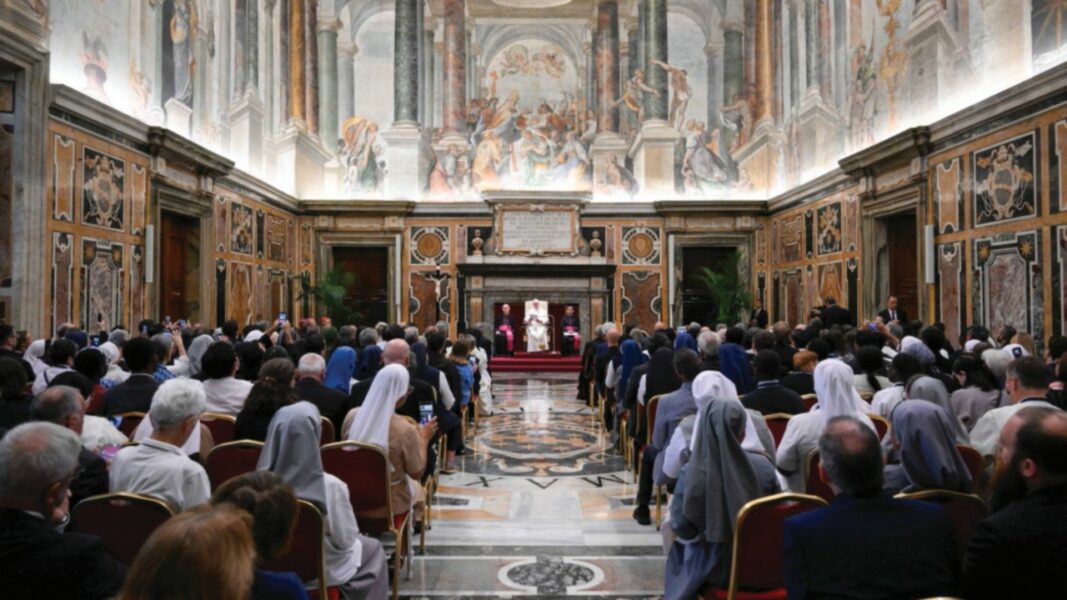
The Pontiff received participants in the congress The 21st Century: A New Time of Martyrs? at the Apostolic Palace, promoted by the Dicastery for the Causes of Saints and the New Martyrs–Witnesses of the Faith Commission. The meeting continues the work of documenting a memory that also has an ecumenical character and includes Catholics and Christians belonging to other Churches and ecclesial communities.
During the presentation of the congress, it was announced that the Commission had received between 100 and 150 new notifications over the past year of Christians killed because of the Gospel, adding to the approximately 1,700 testimonies previously collected.
In his address to the participants, Leo XIV has now clarified the scope of the expression «witnesses of the faith» and its difference from the canonical recognition of martyrdom.
A broader category than that of recognized martyrs
Leo XIV explained that the designation used by the Commission aims to encompass «a broader category,» distinct both from martyrs who currently have a cause for beatification and from those already officially listed in the Church’s catalogue of blesseds and saints.
The Commission was created by Francis in 2023 to collect testimonies about those who have lost their lives for Christ «regardless of the canonical process», with the aim of preventing their example from falling into oblivion.
These are, as the Pope pointed out, Christians who have given their lives for the Gospel in very different geographical, historical, and political contexts.
Many of them, he explained, «are killed by abuse of power or by criminal organizations» because, precisely as Christians, they confront certain injustices «in the name of the Gospel.»
When «hatred of the faith» cannot be proven
It is in these situations that the expression «witness of the faith» becomes important.
«The concept of ‘witness of the faith’ has been formulated precisely to welcome and honor complex historical situations in which the motivation of the executioners cannot be explicitly traced back to ‘hatred of the faith'», Leo XIV explained.
The distinction is relevant because the work of this Commission is not equivalent to that carried out within a canonical cause of martyrdom.
The Pope himself clarified that the activity of the New Martyrs–Witnesses of the Faith Commission, supported by the Dicastery for the Causes of Saints, has a «historiographical and educational, not juridical» character.
The focus is therefore directed more toward the disposition of the victim than toward the concrete motivation of the persecutor.
«What is considered, that is, is the fact that the victim remained faithful to Christ in fulfilling their evangelical commitment and did so until death,» he stated.
The inclusion of a person in this memory does not mean that they have been canonically recognized as a martyr, nor does it equate to a beatification or canonization.
This distinction had already been explained by Cardinal Marcello Semeraro, prefect of the Dicastery for the Causes of Saints, during the presentation of the congress. Semeraro then noted that the inclusion of a name in the catalogue does not automatically imply the opening of a future cause.
A memory that includes Christians from other denominations
The memory compiled by the Commission also has an ecumenical dimension. Its work is not limited to Catholics, but also preserves the testimonies of Christians belonging to other Churches and ecclesial communities who have lost their lives for their fidelity to Christ.
The initiative continues the work promoted by Saint John Paul II to preserve the memory of Christians killed during the 20th century.
According to the data presented before the congress by Monsignor Fabio Fabene, secretary of the Dicastery for the Causes of Saints and president of the Commission, the approximately 1,700 testimonies collected until last year have been joined by between 100 and 150 new notifications.
The cases come through dioceses, episcopal conferences, nunciatures, religious congregations, movements, and lay associations, although the Commission itself also identifies possible testimonies through information published in the media.
This ecumenical dimension was especially reflected in September 2025, when Leo XIV presided over a commemoration of the martyrs and witnesses of the faith of the 21st century at the Basilica of Saint Paul Outside the Walls, together with representatives of other Churches and Christian communities.
«The witnesses of the faith do not propose an ideology»
During Wednesday’s audience, Leo XIV especially highlighted the evangelizing dimension of these testimonies.
The Pope noted that the present time as well, which he described as dominated by «the culture of power, of unlimited force, and of the incessant development of armaments systems,» continues to witness the heroism of these new witnesses.
He also emphasized that the Christian style manifested in them «never seeks confrontation,» but rather seeks to defuse it «with the efficacy of meekness.»
«The witnesses of the faith do not propose an ideology, but show a faith lived in daily life», the Pontiff stated.
Their credibility, he added, comes from the «coherence between words and actions,» a coherence carried in some cases «to the supreme sacrifice.»
Leo XIV recalled in this context the well-known statement of Saint Paul VI in Evangelii nuntiandi: «Contemporary man listens more willingly to witnesses than to teachers, […] or if he listens to teachers, he does so because they are witnesses.»
In societies marked by indifference, the Pope added, both the «holiness next door» and «silent heroism» can become testimonies capable of challenging even those who appear most distant.
Christians who gave their lives «for justice, truth, peace, and freedom»
The congress held in Rome addressed precisely the persistence of martyrdom and Christian witness until death during the 21st century, with attention to situations in Africa, the Holy Land, Asia, America, and Europe.
Leo XIV described these Christians as «stars that shine in the darkness of selfishness and oppression» and noted that they help the Church to reflect the light of Christ before the contemporary world.
The Pope concluded by remembering the witnesses of the faith who have given their lives «for justice, truth, peace, and freedom» and thanking the Commission for the work dedicated to preserving their memory.