


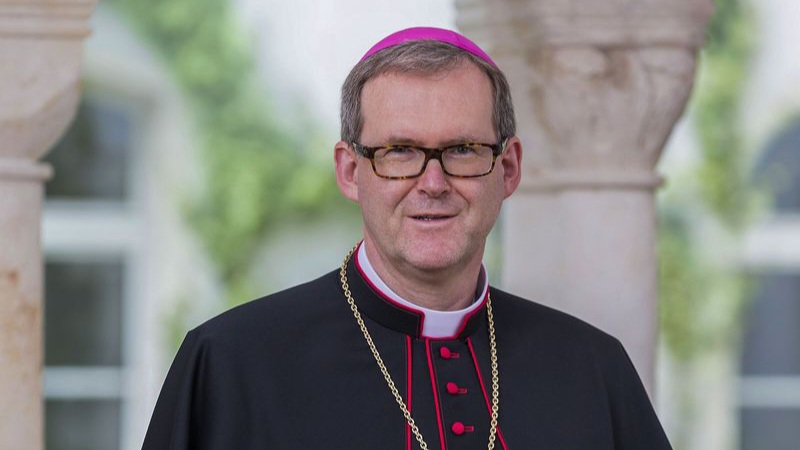
The auxiliary bishop of Regensburg, Josef Graf, has shown himself willing to admit the priestly ordination of married men of proven virtue —the so-called viri probati—, although at the same time he has acknowledged that modifying the discipline of celibacy would not solve the vocations crisis, whose true root he identifies with “the loss of faith”.
“Personally, I believe the Church could allow the viri probati,” Graf stated in an interview with the newspaper of the Italian diocese of Bolzano-Bressanone.
Celibacy would not be, for Graf, an indispensable requirement
Graf, 69 years old and auxiliary of Regensburg since 2015, expressly recognized the value of priestly celibacy, which he described as an important tradition and a charism that helps the priest in the exercise of his ministry.
However, he maintained that he does not consider it a conditio sine qua non for receiving priestly ordination.
His proposal would entail maintaining celibacy as the general discipline of the Latin priesthood, but admitting exceptions for certain married candidates.
The Latin Church has preserved celibacy for centuries as the ordinary discipline for those who receive the presbyterate, although there are married Catholic priests in the Eastern Churches and specific exceptions for ministers coming from other Christian confessions.
He admits that the viri probati would not solve the crisis
The prelate, who for about 26 years was spiritual director of the Regensburg seminary, acknowledges that the problem is much deeper than the discipline of celibacy.
Graf mentioned secularization, the climate hostile to the Church existing in certain sectors of Germany, and the consequences of the abuse scandals. But he ultimately identified a fundamental cause: the decline of faith.
To illustrate this, he turned precisely to the German Protestant communities. In them there is no obligation of celibacy and women can access the pastoral ministry and, despite this, they continue to suffer from a lack of personnel and a sustained loss of faithful.
“It is clear that the root of the problems lies elsewhere. It is the loss of faith,” Graf acknowledged.
In this way, the auxiliary of Regensburg himself rules out that the openness he proposes could solve the problem that is usually invoked to justify it.
No to the priestly ordination of women
Graf did close the door to another of the main demands of the reformist sector of the German Church: women’s priesthood.
The auxiliary assured that he does not consider it possible to ordain women as priests and pointed out that it is not only a matter of tradition, but that there are “theological reasons of great weight” against that possibility.
For Graf, the recovery of vocations ultimately depends on something prior to any structural reform: that the future priest be truly “rooted in God” and able to transmit the faith in a credible way.