


By: Msgr. Alberto José González Chaves
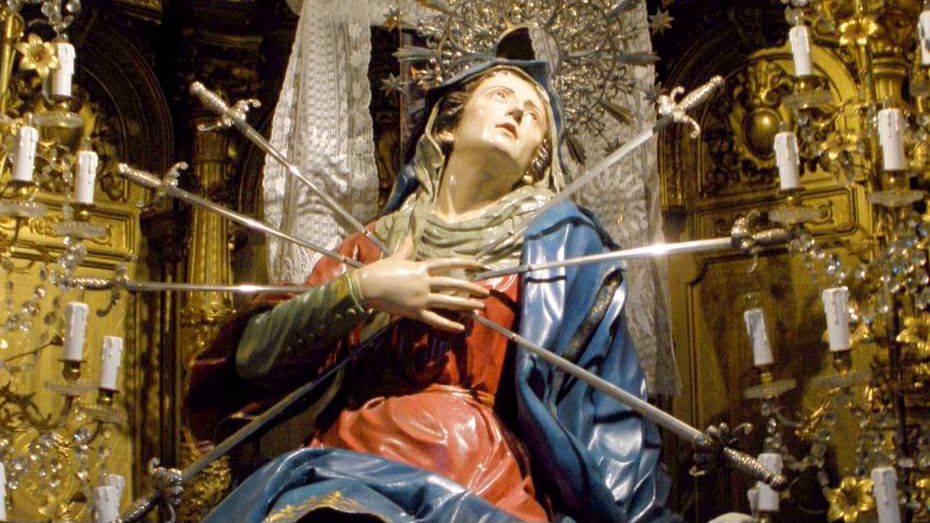
When the Church savors a mystery, unhurriedly, she surrounds it with psalms, antiphons, lessons, and responsories, contemplating the jewel and slowly turning it beneath the light. Thus she displays this wisdom with the Seven Sorrows of the Blessed Virgin Mary on September 15, a feast popularly called in Spain the “Glorious Sorrows.”
The expression is not the official Latin title—the Breviary says Septem Dolorum Beatæ Mariæ Virginis—but it distinguishes the September celebration from the ancient feast of the Sorrows placed in Passiontide. And the adjective is more beautiful: they are sorrows, yes; but contemplated after Easter, illumined by Christ’s victory; tears that have entered into glory; seven participations of Mary in the redemptive mission of the Son. The feast was granted to the Servites in the seventeenth century, extended by Pius VII to the whole Latin Church in 1814, and definitively fixed by St. Pius X on September 15, immediately after the Exaltation of the Holy Cross.
I would like to look into the old Matins of this feast as it stood in the last traditional Roman Breviary, under the rubrics promulgated by St. John XXIII in 1960, with its three nocturns: nine antiphons, nine lessons, and eight responsories.
Already the invitatory seems to summon us physically to enter the scene: Stemus iuxta crucem cum María Matre Iesu—“let us remain beside the Cross with Mary, Mother of Jesus”—cuius ánimam dolóris gládius pertransívit: “whose soul the sword of sorrow has pierced.” We are not invited merely to look; we are commanded to be there. Stemus: let us stay, let us remain.
A sword that began to wound long before Calvary
The invitatory places the one praying beside Mary and the crucified Jesus and immediately recalls the sword foretold by Simeon. The responsories unfold, one after another, the seven sorrows of Mary’s life: Simeon’s prophecy, the flight into Egypt, the loss of the Child in Jerusalem, the meeting with Jesus carrying the Cross, the Crucifixion, the dead body received in her arms, and finally the burial. It is not only the sorrow of one afternoon; it is an entire motherhood pierced by the Redemption.
Simeon’s sword does not merely announce that Mary will suffer greatly, but that the destiny of the Son will also, mysteriously, be that of the Mother. From that moment, Nazareth lies under the shadow of the Cross. The sword does not fall suddenly on Good Friday: it remains suspended for thirty years over the maternal Heart.
First nocturn: the Daughter of Zion learns to weep
The first three lessons are taken from the Lamentations of Jeremiah. It is a liturgical choice of extraordinary force. The same accents that resounded over devastated Jerusalem are now placed around Mary. The ancient Daughter of Zion, alone, afflicted, and without consolation, is a figure of that Woman upon Whose Heart will fall all the contradiction raised against her Son. The liturgy lends her the inspired words of Israel, overwhelming: Plorans plorávit in nocte, et lácrimæ eius in maxíllis eius—“weeping, she wept through the night, and her tears remained upon her cheeks”; or that immensity of suffering: Magna est enim velut mare contrítio tua: “great as the sea is your affliction.”
The three antiphons also prepare that interior landscape. The first contemplates how those who afflict the Just have multiplied: Multiplicáti sunt qui tríbulant me, multi insúrgunt advérsum me. Mary begins to suffer because she sees the circle of contradiction growing around Jesus. The second speaks of arrows prepared in the darkness against the upright of heart: Paravérunt sagíttas suas in pháretra, ut sagíttent in obscúro rectos corde. Before the nails, the invisible shafts of hatred. The third confesses a life consumed in sorrow and years spent in groans: Defécit in dolóre vita mea, et anni mei in gemítibus. A chilling expression applied to that outwardly so silent existence that was Nazareth.
And then come the first three responsories. The first lets Simeon speak directly: Tuam ipsíus ánimam pertransíbit gládius—“a sword shall pierce your own soul.” It is the sorrow announced before it is suffered, perhaps one of the deepest forms of suffering. And the liturgy adds a word taken from biblical desolation: Ne vocétis me pulchram, sed amáram; call me not beautiful, but bitter. The second hurls the Holy Family toward Egypt: Surge, et áccipe Púerum et Matrem eius, et fuge in Ægýptum: arise, take the Child and His Mother, and flee. The Mother of the Messiah begins her motherhood as a refugee, saving the Savior of the world from Herod. The third brings us to Jerusalem: “Son, why have you done this to us?” The Latin preserves the heartrending simplicity of the maternal question: Fili, quid fecísti nobis sic? Ego et pater tuus doléntes quærebámus te. “Your father and I, sorrowing, sought you.” Here there is no persecutor, no sword, no blood; only three days without Jesus. That is enough. For one who truly loves, losing Christ is already a Calvary.
Second nocturn: to die with Him without being able to die
In the second nocturn the antiphons penetrate still deeper. The fourth compares the heart to wax melting within the breast: Factum est cor meum tamquam cera liquéscens in médio ventris mei. It does not break from without; it dissolves from within. The fifth recalls that God has every tear before Him: posuísti lácrimas meas in conspéctu tuo—“you have placed my tears before your sight”; no tear of Mary fell outside the Father’s gaze. The sixth says that the tears have become bread day and night: Fuérunt mihi lácrimæ meæ panes die ac nocte. The sorrow is no longer an episode; it has become food, atmosphere, companionship.
The lessons are from St. Bernard and contain one of the loftiest pages in the whole tradition on Mary’s compassion. The abbot of Clairvaux calls her a martyr not in body but in soul: María Martyr in ánima. Christ could die bodily; Mary—says with daring—could “die with Him in the heart”: ista cómmori corde non pótuit? The lance found the Son’s body already dead, but it found the Mother’s heart still alive. And there it penetrated. St. Bernard goes so far as to say that in her the affection of compassion—compassiónis afféctus—surpassed the sensation that bodily martyrdom would have produced.
The responsories advance the Passion. The fourth sorrow sees Jesus carrying the Cross: Iesum baiulántem sibi crucem; and the women who follow Him weeping: quæ plangébant et lamentabántur eum. Among them, tradition contemplates the Mother meeting the Son on the way to Calvary. She cannot take the beam from Him: she accompanies Him while He carries it.
The fifth responsory reaches Golgotha. They crucified Jesus there; His Mother remained beside the Cross: Stabat autem iuxta crucem Iesu Mater eius. It does not say that she spoke, that she cried out, or that she fainted. Stabat. Standing, upright, erect, regal, majestic, she stood. Mary’s great action is to remain. The whole theology of compassion fits into that verb.
The sixth lowers the Cross into the maternal lap: Joseph of Arimathea asks for the body and the Mother receives it in her arms. The responsory says it with almost plastic tenderness: Suo compléxu Mater excépit—“the Mother received Him in her embrace.” Bethlehem is turned inside out: those most pure hands that on Christmas night received the newborn Body now receive it disfigured and dead. The first and the last cradle are Mary’s arms.
From the Fiat to the Cross: the mystery of Mary’s cooperation
Here appears the theological question that these texts do not formulate in scholastic terminology, but which they do contain in germ: Mary’s utterly singular cooperation in the Redemption.
It does not begin at Calvary. It begins in Nazareth. The Fiat of the Annunciation was not merely permission for God to dwell nine months in her womb; it was the acceptance of a messianic motherhood whose term was the Paschal Mystery. She who said fiat mihi secundum verbum tuum accepted the very Christ of the manger, of Egypt, of the Temple, of Nazareth, of the Way of the Cross, and of Calvary. The yes was not withdrawn when Simeon’s prophecy began to be fulfilled.
In that precise sense, dependent and absolutely subordinate to the one Redemption wrought by Christ, one understands why a long theological tradition applied to Mary the title of Co-redemptrix. There are not two redeemers, nor equality, nor any insufficiency in Christ’s sacrifice. It means that God willed to associate in an entirely singular way the New Eve with the New Adam: first by giving Him the flesh in which He was to be immolated, and then by uniting her will, her faith, her love, and her sorrow to the sacrifice of the Son.
Benedict XV wrote in 1918 that Mary suffered with her Son and almost died with Him, renounced her maternal rights for our salvation, and offered Him, insofar as it depended on her, to the point of saying that with Christ she cooperated in the redemption of the human race. Pius XII, in Mystici Corporis, described the new Eve offering the Son to the Father on Golgotha together with the holocaust of her love and her maternal rights.
If the surprising and much-contested doctrinal note Mater Populi Fidelis of 2025, while expressly reaffirming Mary’s real, singular, and active cooperation from the Annunciation to the Cross, discouraged the use of the title Co-redemptrix because of the danger of understanding it as a duplication of Christ’s unique saving mediation, it cannot, however, erase the reality that those old liturgical texts express with a force hardly to be surpassed: Mary is not a spectator beside the Cross; she is the believing Mother who consents, offers, suffers with, and remains, always receiving everything from Christ and, entirely dependent on Him, co-redeeming with Him.
Third nocturn: from the wound to hope
The last three antiphons carry the sorrow to its extreme point, without preventing the entrance of light. The seventh returns to the image of the bow drawn against the innocent: Intendérunt arcum rem amáram, ut sagíttent in occúltis immaculátum. Mary contemplates how all the malice accumulated against Christ reaches its mark. The eighth places on her lips the soul’s turmoil and that question known to everyone who has suffered: Ánima mea turbáta est valde: sed tu, Dómine, úsquequo?—“my soul is deeply troubled; but You, O Lord, how long?” It is not despair; precisely because she questions God, she continues to believe in Him. And the ninth gives the answer: Deus adiútor in tribulatiónibus quæ invenérunt nos nimis: God is help in the tribulations that have surrounded us. The final psalmic accent is trust.
Between the psalmody and the lessons there appears, moreover, a small jewel that could summarize an entire mariology of compassion: it asks that through Mary we may drink salvation from the wounds of Christ. The original is beautiful for its concision: Per te salútem hauriámus, Virgo María. — Ex vulnéribus Christi. “Through you may we drink salvation, Virgin Mary. — From the wounds of Christ.” From the wounds of Christ, but through Mary. Everything is admirably ordered: the one source, Christ; the maternal association, Mary.
The last three lessons start from the Gospel of St. John and have recourse to St. Ambrose. The holy bishop also fixes his attention on the decisive verb: Mary was standing. Stabat iuxta crucem Mater, et, fugiéntibus viris, stabat intrépida: “the Mother stood beside the Cross and, while the men fled, remained fearless.” She looks upon the wounds of her Son and knows—says Ambrose—that through them redemption will come to all: Spectábat piis óculis Fílii vúlnera, per quæ sciébat ómnibus futúram redemptiónem. Her maternal eyes contemplate the wounds through which we are to be saved.
The seventh responsory asks the Mother what she felt when Joseph wrapped her Son in the shroud and laid Him in the tomb: Quis tibi sensus fuit, o Mater dolórum? It is the last of the seven sorrows: there is not even a body left to embrace. The stone closes and Mary is left with naked faith.
But there remains still an eighth responsory which, after traversing all the sorrows, asks that we not forget the Mother’s groans—In toto corde tuo gémitus Matris tuæ ne obliviscáris—so that propitiation and blessing may be fulfilled in us, and hails her as the first rose of martyrs and lily of virgins: Martyrúmque prima rosa, Virginúmque lílium. It is the spiritual fruit of all these Matins: the sorrows of Mary are not contemplated in order to cultivate sentimentality, but to introduce us more deeply into the effects of Christ’s Passion.
And then, surprisingly, the Te Deum, the final secret of these “Glorious Sorrows.” After Jeremiah, after Simeon, after Egypt, after the anguished search, after the way of the Cross, after the nails, after the Pietà and the tomb, the Church does not end by weeping. She sings: Te Deum laudamus! Christian sorrow, pierced by faith, ends in doxology.
A silenced liturgical treasure
The present Liturgy of the Hours preserves, thanks be to God, for September 15 the extraordinary reading from St. Bernard on Mary’s spiritual martyrdom. But it squandered the monumental construction of the ancient Matins: the nine antiphons chosen expressly to illumine the mystery, the succession of responsories that traverse one by one the seven sorrows, the Lamentations, the extensive Bernardine reading, and the final triptych from St. Ambrose. The present Office of Readings is incomparably shorter, poorer, more insipid.
One may legitimately discuss the general principles that inspired the liturgical reform; but it is difficult to deny that there was an immense loss of biblical, patristic, theological, and contemplative material. Not only quantity of text was lost, but a pedagogy. The old Breviary obliged the priest, the religious, the nun, to linger at length before the mystery. It did not hand them an idea about the Sorrows of Mary: it made them walk with her from Simeon’s sword to the stone of the tomb.
Those pages must be returned to, not out of archaeology or nostalgia, but because the Church prayed with them for generations and because they continue to teach us something that our spiritual haste easily forgets: great mysteries are not dispatched; they are contemplated slowly.
On September 15 Mary does not ask us to count her tears, but to learn her Fiat. That of Nazareth and that of Calvary are the same. Between them fit Egypt, Jerusalem, thirty years of silences, the bitter street, three hours beside the Cross, a Son dead upon her knees, and a stone closing a tomb. Seven swords: a single yes.
Her Sorrows are glorious because no sword succeeded in separating her Heart from Christ’s. Mary suffered with Him to the end and when everyone else seemed to have reasons to leave, she remained. Stabat. And the morning of Easter discovered that each one of those seven swords had opened in the Heart of the Co-redemptrix Mother a path through which the Redemption of Jesus Christ, the only Redeemer, reached us.