


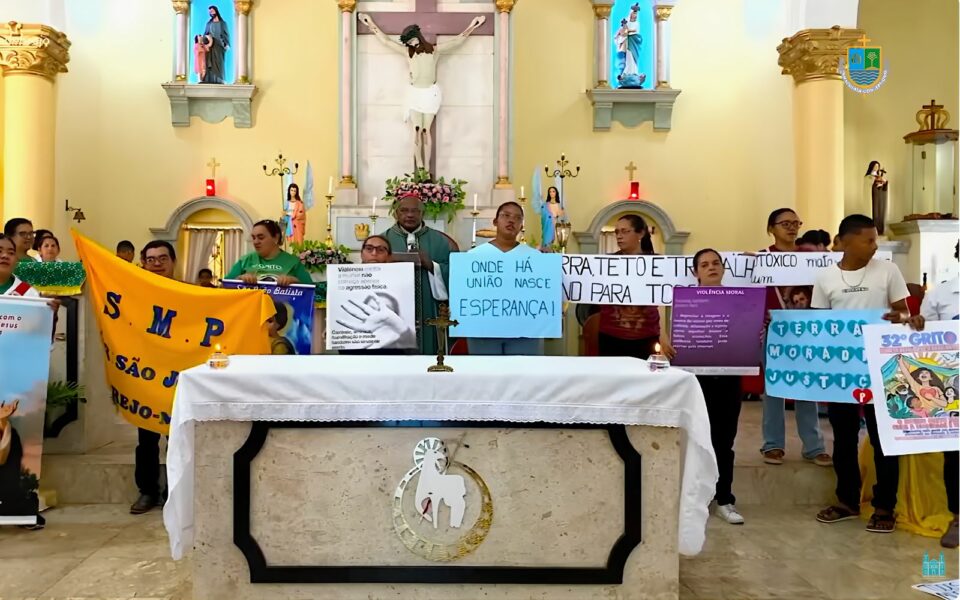
Bishop José Valdeci Santos Mendes of Brejo allowed two young people to recite a so-called “Youth Creed” during a Mass celebrated on September 7 in the Cathedral of Our Lady of the Conception in the Brazilian state of Maranhão. The text states that it does not believe in a “patriarchal, clerical, and hierarchical” Church, refers to a “God/Goddess,” and calls for a society “without norms for loving” that includes “all sexual diversity.”
It was not a statement made outside the liturgy or a document distributed afterward. The bishop himself, who presided over the Mass, presented the text to the faithful and invited its reading during the celebration, as documented by ACI Digital.
Santos Mendes is also president of the Episcopal Commission for Socio-Transformative Action (CEPAST) of the National Conference of Bishops of Brazil (CNBB), a circumstance especially relevant because the celebration was part of the 32nd Grito dos Excluídos e Excluídas, a mobilization in which Church-linked organizations and pastoral ministries participate alongside social movements.
The bishop presented the “creed” and two young people recited it
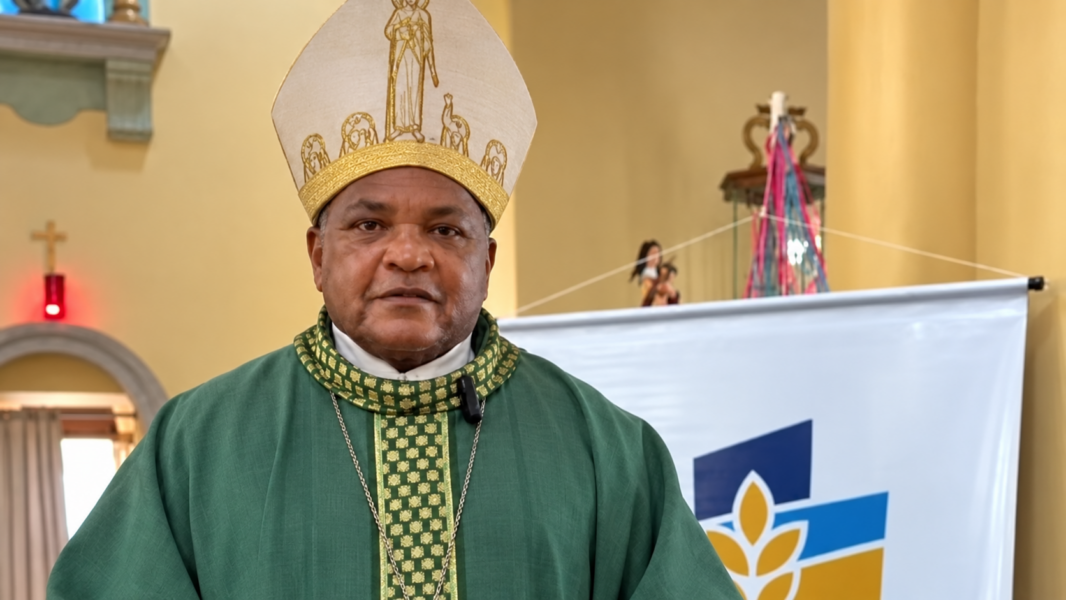
Before its reading, Santos Mendes presented the text as a “supplication of the young people of Latin America who place themselves before God, asking that He come to meet us.” He then entrusted two young people with its proclamation.
The so-called “Youth Creed” was then recited during the Mass presided over by the bishop.
One of its passages declares:
“We do not believe in a static, patriarchal, clerical, and hierarchical Church.”
In contrast, the text professes belief in an “integrative, intergenerational community with its own voice” and in a Church “in struggle” against a “dominant capitalist system.”
The formulation does not end there. At another point it proclaims:
“We believe that we are daughters and sons of a Great Homeland without racism, without norms for loving.”
The text then explicitly includes “all sexual diversity” among the realities that must be welcomed.
The so-called creed also refers to a “God/Goddess,” described as “liberating and revolutionary” and “a member of the CEBs.”
This text was not composed specifically for this celebration. It originates from the 10th Continental Meeting of the Ecclesial Base Communities (CEBs), held in Paraguay in 2016, and remains published by the CEBs themselves.
Santos Mendes presides over a commission of the Episcopal Conference
José Valdeci Santos Mendes is not only the bishop of Brejo. He also presides over the Episcopal Commission for Socio-Transformative Action of the National Conference of Bishops of Brazil.
CEPAST had officially called on dioceses, pastoral ministries, ecclesial organizations, and popular movements to participate in the 32nd edition of the Cry of the Excluded.
The call bore Santos Mendes’s own signature and gave particular importance to this year’s mobilization because it coincided with the Brazilian electoral process.
In addition, the CEPAST page dedicated to the day offered, among the materials for organizing it, a “celebration script,” along with the poster, newspaper, hymn, and other resources.
The episcopal commission distances itself from the preparation of the script
Consulted by ACI Digital, CEPAST distanced itself from authorship of the script. Its communications officer, Juce Rocha, stated that the Cry of the Excluded is coordinated by different organizations and affirmed that the Episcopal Commission “did not participate in the preparation of the celebratory script.”
The clarification limits institutional responsibility for the document’s preparation, but it does not change what occurred in the cathedral of Brejo.
References to the elections during the Mass
The “creed” was not the only controversial element of the celebration presided over by Santos Mendes.
The script also introduced explicit references to the Brazilian political scenario. In the penitential act, forgiveness was asked for the times when people do not take “seriously the destiny of the country in the elections” and for failing to denounce certain candidacies linked to “economic power.”
During the prayer of the faithful, discernment was also requested so as not to vote for those who would put “Brazil’s sovereignty at stake,” have a “coup plan,” or intend to turn the common good “into an object of profit.”
The response provided for the assembly was:
“Deliver us, Lord, from all those who use politics to betray the Brazilian people!”
The electoral dimension was not foreign to CEPAST’s call either. In its mobilization message, the commission presided over by Santos Mendes described Brazil’s political moment as “decisive” and called for the promotion of spaces for community discussion and mobilization.
A mobilization born in the CNBB environment
The Cry of the Excluded dates back to the II Brazilian Social Week of 1993 and 1994 and held its first national day on September 7, 1995. The following year it was incorporated by the CNBB into its initiatives within the Rumo ao Novo Milênio project.
The mobilization is deliberately celebrated on Brazil’s Independence Day. Its own organization presents it as a “counterpoint” to official commemorations and as a space for mobilization and “political awareness.”
It involves Church organizations and pastoral ministries, including Cáritas Brasileira, the Pastoral Land Commission, the Workers’ Pastoral, and the Ecclesial Base Communities, together with social organizations and movements such as the Landless Rural Workers’ Movement (MST).
Although the Brazilian Episcopal Conference exempts itself as the author of the so-called “Youth Creed,” and its “socio-transformative” commission denies having prepared the script, this does not alter the central fact of what occurred in Brejo. Santos Mendes, a Catholic bishop and president of an episcopal commission of the CNBB, presented the so-called “Youth Creed” and allowed it to be recited during the Mass over which he himself presided.