


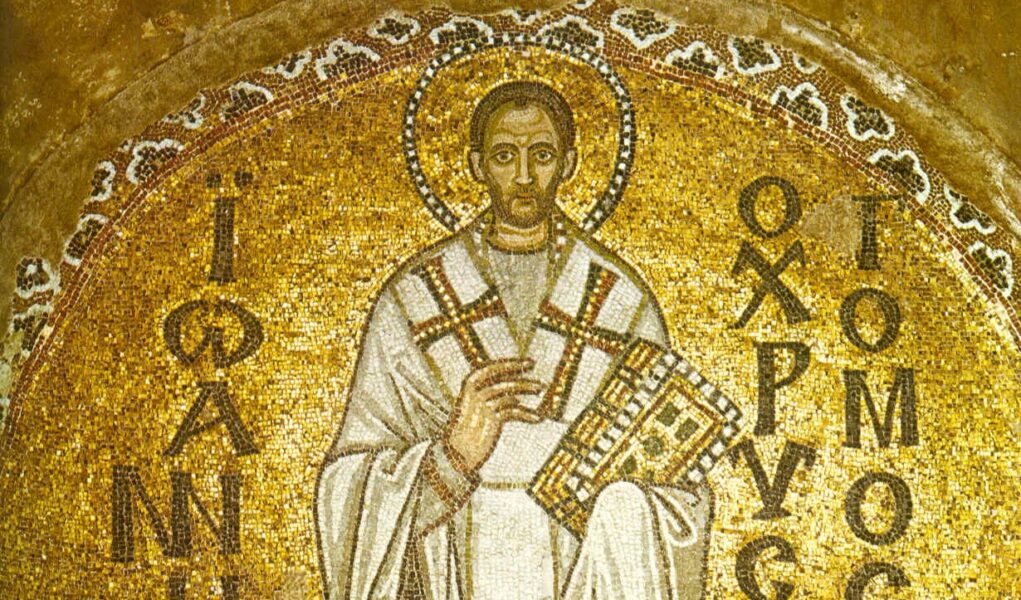
Every September 13 the Church commemorates Saint John Chrysostom, bishop of Constantinople and Doctor of the Church, one of the great Fathers and preachers of Christian antiquity. His efforts to reform the clergy, the austerity of his life, his care for the poor, and the freedom with which he preached before the powerful earned him numerous adversaries and preceded the two exiles that marked his final years.
The “golden mouth” of the ancient Church
John was born in Antioch around the mid-fourth century and received a solid rhetorical education. After receiving baptism, he embraced an intense ascetic life that included several years of retreat before returning to Antioch. He was ordained deacon and later priest.
It was precisely during his years of priestly ministry that he achieved extraordinary fame as a preacher. His homilies, deeply rooted in Sacred Scripture and aimed at the concrete conversion of his listeners, eventually earned him the Greek nickname Chrysóstomos, “golden mouth”.
In 2007 Benedict XVI devoted two general audiences to Saint John Chrysostom and highlighted the extraordinary breadth of his surviving works: 17 treatises, more than 700 authentic homilies, commentaries on the Gospels of Matthew and John and on the letters of Paul, as well as 241 letters.
His preaching did not separate doctrine from Christian life. Benedict XVI stressed that Chrysostom conveyed “the traditional and sure doctrine of the Church” and sought to ensure that the thought expressed in words corresponded to life.
At the end of 397 he was called to the see of Constantinople, and in 398 he began his episcopal ministry in the capital of the Eastern Roman Empire.
An austere episcopal palace as an example for the clergy
His arrival at one of the most important sees of Christendom did not mean abandoning the austerity that had characterized his life.
John undertook a reform of the Church of Constantinople that especially affected the clergy. As Benedict XVI recalled, he believed that “the austerity of the episcopal palace should serve as an example” to the clergy, widows, monks, courtiers, and the wealthy.
It was not merely a personal preference for a simple life. Chrysostom demanded consistency between preaching and conduct, combated abuses and luxury among the clergy, and devoted significant efforts and resources to those in need.
His charitable activity was so intense that, as Benedict XVI noted, he also received the title “the Almsgiver”. During his episcopate he promoted institutions for the poor and the sick and placed charity among the fundamental responsibilities of his pastoral ministry.
For Chrysostom, care for the poor sprang directly from the Christian life. His homilies frequently denounced the contradiction between the abundance of some and the misery of others and called for recognizing Christ in the needy.
A preaching that eventually brought him into conflict with the court
The same consistency he demanded of his faithful he required of the clergy and those in power. His reforms and preaching increasingly aroused opposition among ecclesiastical circles, wealthy families, and members of the imperial court.
This was compounded by complex ecclesiastical disputes in which Theophilus, patriarch of Alexandria, an adversary of Chrysostom, played a decisive role.
In 403 the so-called Synod of the Oak deposed the bishop of Constantinople and led to his first exile. Chrysostom was able to return shortly afterward, but tensions continued, especially with the entourage of Empress Eudoxia.
In 404 he was expelled again from Constantinople and sent to Cucusus in Roman Armenia. Even exile did not silence him: from there he maintained extensive correspondence with his faithful and friends.
Later it was ordered that he be taken even farther, to Pityus on the eastern coast of the Black Sea. Benedict XVI described that decision as a veritable “death sentence”.
John never reached his destination. Weakened by illness and the harsh conditions of the journey, he died in Comana on September 14, 407. Tradition has preserved a final profession of abandonment to Providence from his last moments: “Glory to God for all things”.