


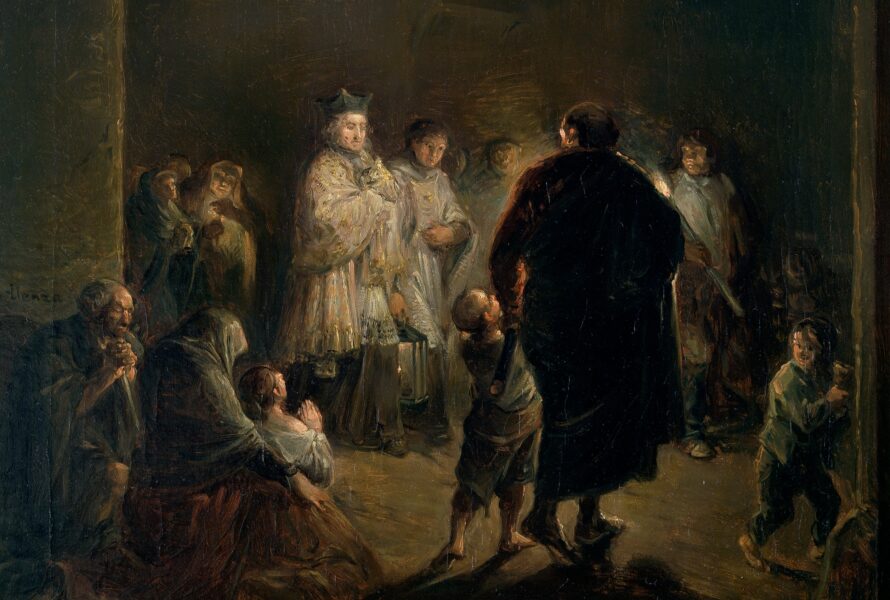
When a Christian is approaching death, the Church accompanies him with the sacraments that prepare him to conclude his earthly pilgrimage. Along with Penance and the Anointing of the Sick, a particular place is occupied by the viaticum: the Holy Eucharist received as food for the passage from this life to eternity.
The Church asks that its reception not be left until the final moments. The Code of Canon Law expressly establishes that the viaticum “should not be delayed too long” and entrusts pastors with ensuring that the sick receive it while they still retain “full use of their faculties.”
The viaticum, the Christian’s last sacrament
The viaticum is not a sacrament distinct from the Eucharist. It is Holy Communion received by someone nearing the end of life, with a particular meaning in view of the final passage.
This is how the Catechism of the Catholic Church presents it in numbers 1524 and 1525, under the heading “The Viaticum, the Last Sacrament of the Christian”: “To those who are about to leave this life, the Church offers, in addition to the Anointing of the Sick, the Eucharist as viaticum.”
In this context, the Catechism recalls Christ’s words recorded by Saint John: “Whoever eats my flesh and drinks my blood has eternal life, and I will raise him up on the last day” (Jn 6:54). Received in the face of approaching death, the Eucharist is presented as the sacrament of the passage “from death to life, from this world to the Father.”
The very name viaticum has been linked in Christian tradition to provision for the journey. In this case, the final journey: Christ received sacramentally before the passage to eternity.
It is not the same as the Last Rites
The viaticum must not be confused with the Anointing of the Sick, traditionally also called Extreme Unction. They are distinct sacraments, although both may be received when a Christian is approaching death.
The Anointing of the Sick is not reserved exclusively for the deathbed. It may be administered when the faithful begin to be in danger due to illness or old age and may be repeated if, after recovering, they fall gravely ill again or if their condition worsens during the same illness. This is stated both in the Catechism and in the Code of Canon Law.
The Catechism also preserves the historical explanation of the term Extreme Unction. Over the centuries, it notes, the sacrament came to be administered more and more exclusively to those on the point of death, from which this name originated. The Church’s current discipline insists that the time to receive it begins before the death agony, when there is already a serious danger arising from illness or old age.
Its effects are not limited to the consolation of the sick person. The Anointing of the Sick grants a particular grace of strength, peace, and courage; unites the sick person more intimately with the Passion of Christ; may grant the forgiveness of sins when this has not been obtained through Penance; and prepares the Christian for the final passage.
Referring to this last effect, the Catechism uses an especially graphic expression: the Anointing constitutes a “shield to defend oneself in the final struggles before entering the Father’s House”.
Confession, Anointing of the Sick, and viaticum
The Church has traditionally surrounded the Christian’s death with these sacramental aids. When circumstances allow them to be received, Penance, the Anointing of the Sick, and the viaticum accompany the preparation for eternity.
The Catechism draws an analogy with the beginning of sacramental life. Just as Baptism, Confirmation, and the Eucharist form the sacraments of Christian initiation, Penance, the Anointing, and the Eucharist as viaticum are the sacraments that “prepare for entering the Homeland” and “close the pilgrimage.”
This is the reality behind the traditional expression “last sacraments”, although each retains its own proper nature.
Whenever possible, the sick person may first be reconciled with God through sacramental confession. The Anointing of the Sick strengthens and disposes him for the final passage, and the Eucharist received as viaticum constitutes the food for that passage.
The Catechism itself states that when the Anointing is administered to someone near death, the Eucharist should also be offered and affirms that it “should always be the last sacrament of the earthly pilgrimage”.
Benedict XVI returned to this relationship in the apostolic exhortation Sacramentum Caritatis. Addressing the sick whose condition is worsening, he recalled that the Church offers them, in addition to the Anointing, the Eucharist as viaticum and noted that “it is necessary to ensure its reception”.
“The Viaticum should not be delayed too long”
The importance of receiving it in time is expressly set forth in the Church’s legislation.
Canon 921 of the Code of Canon Law establishes that “the holy Viaticum is to be administered to the faithful who, for any reason, are in danger of death.”
The importance attached to this final Communion is such that, even if the faithful have already received the Eucharist that same day, the Code considers it “very advisable” that they receive Communion again if the danger of death arises. If the danger is prolonged, it recommends receiving Communion again on different days.
Canon 922 adds an even more explicit indication: “The Viaticum for the sick is not to be delayed too long”.
It specifies the reason for this diligence: those entrusted with the care of souls must ensure that the faithful are comforted with the viaticum “while they still have full use of their faculties”.
This provision prevents the call to the priest from being reserved necessarily for the moment when the sick person has already entered the death agony, has lost consciousness, or cannot receive Holy Communion.
Calling the priest before the death agony
This is not merely a conclusion drawn from the canonical norms. In explaining who should receive the Anointing, the Catechism asks pastors and the entire Christian community to assist the sick and expressly states that family members should encourage them to call the priest to receive the sacrament.
Notifying the priest while the sick person still retains his faculties also allows, when circumstances make it possible, that he may confess and consciously receive the sacraments with which the Church prepares him for death.
The issue became especially visible in Spain at the beginning of this year after the train accident in Adamuz, Andalusia. Priests who went to the scene to attend to the victims encountered difficulties in reaching some of the seriously injured.
The bishop of Córdoba, Jesús Fernández, later lamented that the “confusion” among the authorities had in some cases prevented the administration of the last sacraments.
Hence the Church insists on not leaving these sacraments until the sick person has already lost consciousness. Received in time, he can confess, be strengthened by the Anointing of the Sick, and finally receive Christ in the Eucharist as viaticum for the passage to eternal life.