


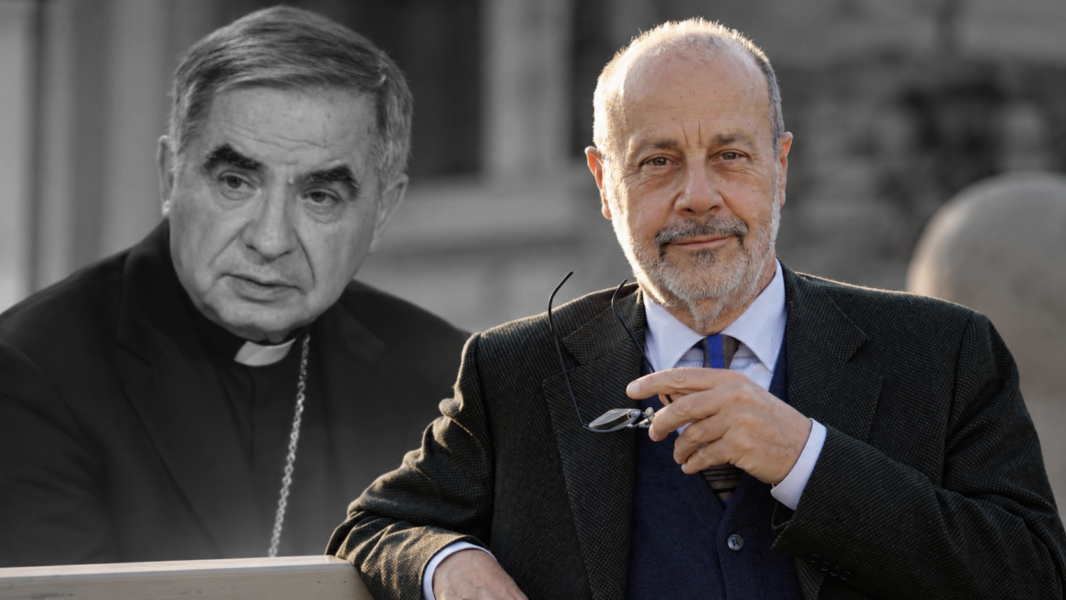
Giovanni Maria Vian, director of L’Osservatore Romano from 2007 to 2018, has openly defended the innocence of Cardinal Angelo Becciu and has offered a harsh assessment of Pope Francis’s pontificate, which he sums up in a single word: “misgovernment.” In contrast to his critical view of Jorge Mario Bergoglio’s reign, the Italian historian and philologist maintains that Leo XIV is governing “calmly, yet decisively” and has begun to restore confidence in the permanent institutions of the Holy See.
Vian made these remarks in an extensive interview granted to Stefano Lorenzetto and published on 8 September by Il Nord Est. In it, he discusses his eleven-year tenure at the Vatican newspaper, his dismissal in 2018, the Becciu case, and the pontificates of Benedict XVI, Francis, and Leo XIV.
“No, certainly innocent”
When Lorenzetto asked him directly whether he considered Cardinal Becciu guilty, Vian replied: “No, certainly innocent.”
The former director of L’Osservatore Romano describes the cardinal’s removal as a “true calvary” and calls it “an enigma in which personal character and jealousy are intertwined.”
Vian also recalls that, according to Becciu himself, Francis told him after stripping him of his cardinalatial prerogatives: “Someone wishes you ill.”
For Vian, however, personal rivalries alone do not explain what happened. The historian links the case to Francis’s style of governance and his desire to reduce the weight of the Secretariat of State.
“In this matter, one of Bergoglio’s peculiarities also comes into play: his wish to show that he looked no one in the face. Add to that the will to minimize the Secretariat of State. It is no secret that he detested the Curia. The Becciu case served that purpose,” Vian states.
This is the former Vatican newspaper director’s interpretation of the origins and consequences of the case, not a judicial conclusion.
Becciu was convicted in the first instance in December 2023 to five years and six months in prison for financial crimes. The cardinal appealed the sentence, and the proceedings remain open.
Last March, the Vatican Court of Appeal declared the “relative nullity” of the first-instance trial due to procedural deficiencies and ordered a retrial, while also requiring the prosecution to hand over the complete documentation of the investigation. The decision does not, therefore, amount to an acquittal of Becciu.
Read also: The Becciu Case Collapses: the Vatican Annuls the Trial and Orders It to Start Over
Vian believes the proceedings constitute “a complicated web that has been heavily criticized from a legal standpoint” and cites the objections raised by Cardinal Julián Herranz, jurist and former president of the Pontifical Council for Legislative Texts, in his book Due papi.
Regarding how the case might end, Vian points precisely to the formal problems of the proceedings and recalls a teaching from his mentor, the philologist Manlio Simonetti: “The only way to blow up a competition is through a procedural flaw.”
Francis: “The result, misgovernment”
The interview also contains an especially critical assessment of Francis’s pontificate.
Vian describes it as a reign “with lights and shadows,” but draws a distinction between its early years and its final phase.
“Clear until 2018. Afterwards Bergoglio, so to speak, withdrew into himself. After Ratzinger’s death he began to lose his way,” he maintains.
According to the historian, Benedict XVI’s presence exerted an indirect influence on Francis for years. In his interpretation, Bergoglio “restrained himself” because “he recognized the greatness of the German Pope and held him in devotion,” although Vian adds: “I think he could not bear the comparison.”
The main problem, according to the former director of L’Osservatore Romano, lay in governance.
“It would have sufficed for him to govern, but he did not, just as the two non-Italian predecessors after 1978 did not. He trusted no one. He relied on, so to speak, extravagant collaborators. He used them and then set them aside. Result: misgovernment,” he asserts.
This is once again Vian’s personal assessment of how the Holy See functioned during the previous pontificate.
Santa Marta and the End of “Institutional Filters”
Vian links this style of governance to Francis’s decision to live in Casa Santa Marta rather than take up residence in the Apostolic Palace.
For the former director, the issue was not merely residential.
“The Pope’s residence in Santa Marta meant the disappearance of the institutional filters that had been tested for centuries in the Apostolic Palace,” he maintains.
Vian recalls a phrase that, he explains, circulated at the time among those who closely followed Vatican affairs: “He wanted to close the court and did not realize he had opened a courtyard.”
According to Vian’s interpretation, the disappearance of those filters favored a more personal style of government and weakened the role of the Curia’s institutional structures.
The historian places in this context the figure of Francesca Immacolata Chaouqui, a central figure in Vatileaks 2 and later one of Becciu’s accusers. Vian recounts that he met with her at L’Osservatore Romano at the request of “an influential person,” when Chaouqui claimed that Francis was in danger.
“I replied: look, in my opinion the Pope is not in any danger at all and, in any case, he knows perfectly well how to defend himself alone,” he recalls.
Vian considers her appointment to COSEA—the commission created to study the economic and administrative organization of the Holy See—as “one of the unclear aspects of Bergoglio’s governance.”
“They dismissed me in a few minutes”
The interview also addresses Vian’s departure from L’Osservatore Romano in December 2018, after eleven years at the helm.
According to his account, Paolo Ruffini, then newly arrived at the Dicastery for Communication, came to the newspaper one afternoon. Vian thought they were going to discuss the relaunch of L’Osservatore Romano, and indeed they began by talking about that.
“But in the end he blurted out: ‘I came here to tell you that tomorrow a new director will be appointed,’” he recalls.
Vian says he had to ask himself who would take his place. His successor was Andrea Monda.
The historian maintains that he still does not know why Francis decided to replace him. According to his account, two weeks later he had a one-hour telephone conversation with the Secretary of State, Cardinal Pietro Parolin.
“I knew nothing,” Vian says Parolin told him.
According to his narrative, Becciu, who had been Substitute for General Affairs of the Secretariat of State, told him the same thing. “I believed both of them,” he asserts.
Asked about the reasons Francis might have had for dismissing him, Vian replies: “I do not know.”
He recalls, however, that Bergoglio himself had previously said of him to the Argentine journalist and writer Jorge Milia: “He is hardworking, has good Spanish, and does not cause trouble.” Vian concludes that someone must have convinced the Pope that the change was necessary.
“Like Aldo Moro held prisoner by the Red Brigades”
Vian also resorts to a provocative comparison when recalling certain editorial rules he encountered during his time at the Vatican newspaper.
The historian explains that he was required to write the word “Pope” always with a capital letter, at the instruction of the then Secretary of State, Cardinal Tarcisio Bertone.
“It was like Aldo Moro held prisoner by the Red Brigades, si parva licet. But only in terms of vocabulary,” he states ironically.
The comparison, therefore, refers specifically to that linguistic “prison” and does not constitute a general description of his situation during the eleven years he directed L’Osservatore Romano.
“The Popes pass, but the Curia remains”
Vian contrasts his criticism of Francis with a very favorable assessment of the first months of Leo XIV’s pontificate.
According to the historian, Prevost has marked from the outset a substantial difference from his predecessor in his relationship with the Curia.
“In the Vatican it will never happen that a deceased pontiff is disavowed. Leo XIV, clearly against the current of his predecessor, has made it clear from the beginning that ‘the Popes pass, but the Curia remains,’ thereby restoring its confidence,” he states.
Vian links this orientation to the appointment of Paolo Rudelli as Substitute for General Affairs of the Secretariat of State, whom he describes as “a first-rate diplomat, solid and prudent.”
For the former director of the Vatican newspaper, Leo XIV would thus be recovering the institutional role of the Curia as a permanent structure at the service of the universal government of the Church.
“He found a minefield and is clearing it”
When asked directly whether he has great confidence in Leo XIV, Vian answers affirmatively.
“He is the first non-Italian Pope to govern. And he is doing it very well, calmly but decisively. He found a minefield and is clearing it with the necessary caution,” he maintains.
The statement stems from Vian’s assessment that, since 1978, the non-Italian pontiffs who preceded Prevost would not have sufficiently exercised the function of governance. It is, therefore, his personal judgment on the most recent pontificates.
In the case of Leo XIV, Vian interprets his first decisions as a recovery of the balance between the personal authority of the Pontiff and the institutions of the Holy See.
“The gates of hell shall not prevail”
Despite the harshness of his criticisms and a dismissal whose motives he claims still to be unaware of, Vian concludes the interview by reaffirming his confidence in the Church.
Recalling that in his first editorial as director of L’Osservatore Romano he had written that “evil will not have the last word,” Lorenzetto asks him whether he remains convinced of that.
“Yes, otherwise I would not have accepted to direct a newspaper that carries in its masthead the motto Non praevalebunt. The gates of hell shall not prevail. Jesus promised us that,” he replies.