


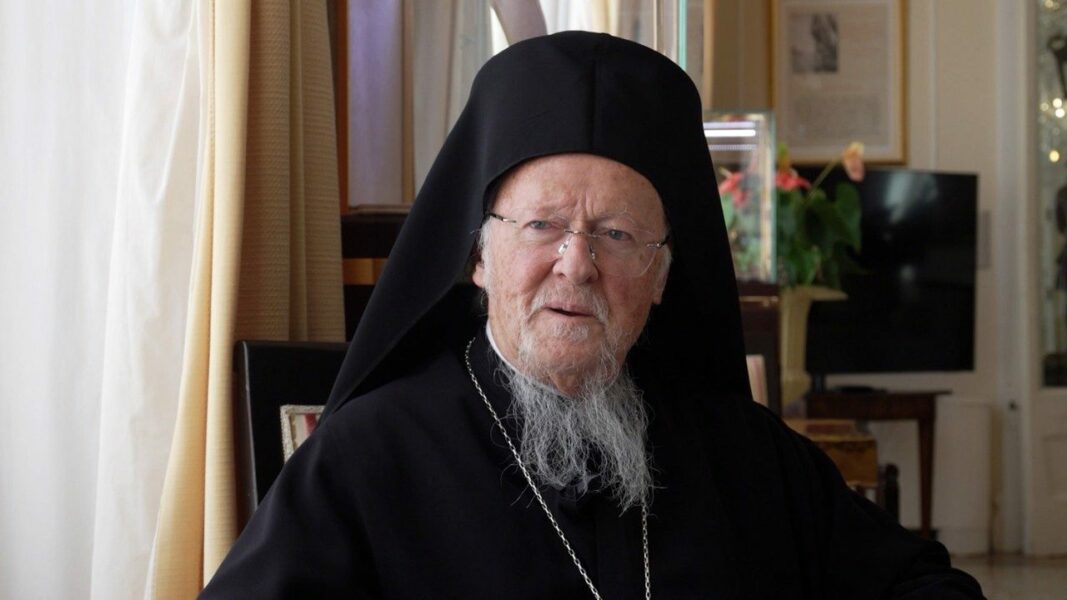
The Ecumenical Patriarch of Constantinople, Bartholomew I, has expressed his hope that Catholics and Orthodox may recover full communion, broken for nearly a millennium. “We hope, by the grace and help from on high, for the restoration of full communion with the Church of Rome within the one Body of the one, holy, catholic, and apostolic Church,” he stated.
The Patriarch delivered these words on Friday, September 4, in Budapest, at the conclusion of the 27th International Congress of the Society for the Law of the Eastern Churches, dedicated precisely to The Bishop of Rome: Future Horizons from Ancient Traditions for Catholics and Orthodox. His address was published the following day by the Ecumenical Patriarchate.
Bartholomew linked this aspiration to the ancient Pentarchy, formed during the first millennium by the sees of Rome, Constantinople, Alexandria, Antioch, and Jerusalem. According to him, the communion and concelebration of their patriarchs constituted “the most visible sign of the unity of the universal Church.”
The Patriarch acknowledged the profound impact of the rupture between Rome and Constantinople, describing it as a separation that “tore the seamless garment of the Lord.” In his view, the four ancient Eastern patriarchates—Constantinople, Alexandria, Antioch, and Jerusalem—now bear a particular pastoral responsibility to preserve the continuity of the apostolic faith and bear witness to orthodoxy.
Nevertheless, Bartholomew insisted that this pain of separation “is inseparable from hope” and expressed his desire that, with the recovery of communion with Rome, “the Pentarchy may once again be complete” and the “five-stringed lyre” of the universal Church may once more resound “in the fullness of its ancient harmony.”
A Primate “Within, and Never Above” the Churches
A central part of the address was devoted to the question of the primacy of the Bishop of Rome, one of the principal issues in the theological dialogue between Catholics and Orthodox. Bartholomew recalled a well-known formulation by Joseph Ratzinger, prior to his election as Benedict XVI, according to which Rome could not demand of the East, in matters of primacy, more than what had been “formulated and lived in the first millennium.”
He also evoked the words with which Patriarch Athenagoras received Paul VI at the Phanar in 1967, when he addressed the Pontiff as “successor of Peter, first in honor among us, the one who presides in love.”
Bartholomew maintained that this expression encapsulates the Orthodox conception of Roman primacy: “a primacy of loving service, exercised within, and never above, the communion of the sister Churches”. He added that Athenagoras linked this interpretation to the Pentarchy, in which the Pope of Rome was recognized as primus inter pares, “first among equals,” as “Patriarch of the West.”
At the same time, the Patriarch made clear the distance that remains between the two ecclesiological conceptions. Referring to the title “Patriarch of the West,” he argued that it corresponds to concrete patriarchal rights, but does not constitute, from the Orthodox perspective, the expression of a “universal and immediate” jurisdiction.
The Recovery of the Title “Patriarch of the West”
Bartholomew also addressed the decision of Benedict XVI to remove in 2006 the title “Patriarch of the West” from the Annuario Pontificio. As he recalled, the Ecumenical Patriarchate received that decision “with great sorrow,” considering that this title, unlike others attributed to the Pope, had its origin and acceptance in the undivided Church of the first millennium and was linked to the ecclesiology of the Pentarchy.
The Patriarch revealed that he later raised the matter personally with Francis, who, according to his testimony, received his concerns and assured him of his intention to restore the title “at the appropriate and opportune moment.”
The title reappeared in the Annuario Pontificio of 2024. Bartholomew described the decision as “a small step, but far from insignificant”, and stated that Constantinople regards it as a “positive and hopeful” sign for the continuation of theological dialogue with Rome.
A New Center for Dialogue with Catholics
The address coincided with the inauguration in Budapest of the new Orthodox Christian Dialogue Center “Fanarion”, promoted by the Ecumenical Patriarchate as a permanent meeting place for Orthodox, other Christians, and representatives of various religions.
Bartholomew expressed his hope that the center would become a “workshop of juridical ecumenism” and place the work of canonists and theologians at the service of the Joint International Commission for Theological Dialogue between the Catholic Church and the Orthodox Church.
The ultimate goal, the Patriarch affirmed, is to serve “the sacred cause of the restoration of full communion between our Churches”.