


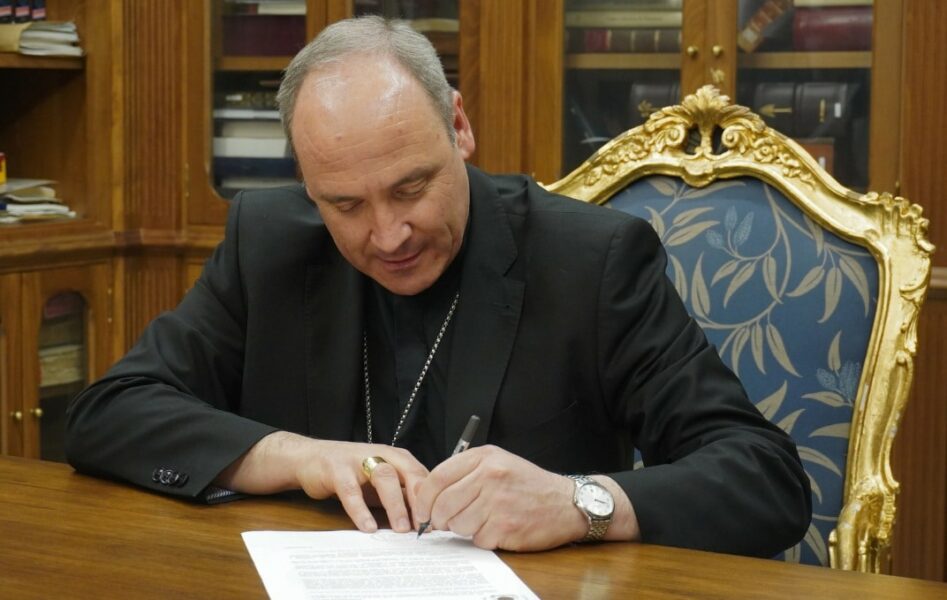
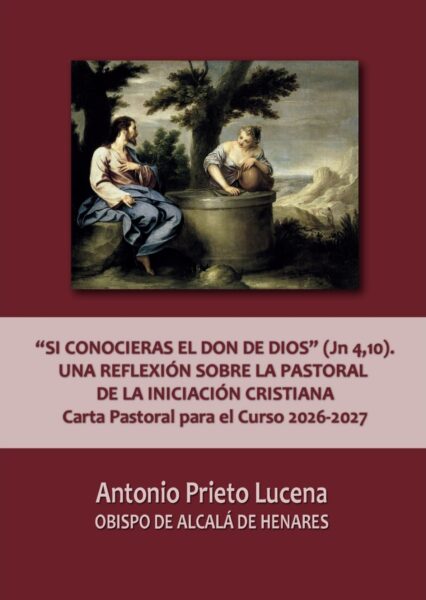
The Bishop of Alcalá de Henares, Antonio Prieto Lucena, has dedicated his pastoral letter for the 2026-2027 academic year to a review of Christian initiation in the face of advancing secularization and the weakening of faith transmission. The prelate warns of the existence of numerous Catholics with a “weak and vulnerable” Christian identity and proposes a renewal of catechesis so that the reception of the sacraments does not end up becoming the final point of the ecclesial life of children and adolescents.
The letter, titled “If you knew the gift of God.” A reflection on the pastoral care of Christian initiation, draws on the missionary impulse left by Leo XIV during his visit to Spain last June and devotes a large part of its pages to diagnosing the difficulties currently facing the transmission of the faith.
Catholics with a “weak and vulnerable” identity
Prieto Lucena places the problem in a European context marked by secularization and religious indifference. Although he acknowledges that in recent times there has been talk of a certain “Catholic turn” and an increase in the number of adults requesting baptism, he believes that a “religious cooling” still predominates, affecting the whole of Christian life.
“We have a high percentage of Catholics without awareness of their mission to be the salt of the earth, with a weak and vulnerable Christian identity,” writes the bishop, who links this situation to the fact that more and more parents are not requesting baptism for their children.
The prelate pays special attention to the way some families approach First Communion and other sacraments. In his view, on numerous occasions “they are not lived as true encounters with Christ, but as mere family and social events,” in which the children’s attention is diverted toward clothes, gifts, and the subsequent celebration.
Prieto even points out that there are families who go into debt to organize parties beyond their means and warns of a mentality that seeks to receive the sacrament “with the least possible investment of time and with the minimum commitment.” After the celebration, he adds, “everything ends, like a stage of life that has already been covered in anticipation of the next one.”
Drawing on an expression used by Francis to refer to the lack of perseverance after Confirmation, the letter recalls the image of the “sacrament of farewell.” It also cites the “rescue operation” for First Communion proposed by the president of the Spanish Episcopal Conference, Luis Argüello, to restore to this celebration its properly Christian dimension in the face of the predominance of its external aspects.
“The discussion revolves around the definition of man”
The letter broadens the diagnosis beyond secularization. Prieto Lucena addresses what he calls “the dissolution of the human” and points to scientism, posthumanism, transhumanism, the metaverse, artificial intelligence, and cancel culture among contemporary challenges.
The bishop maintains that anthropological realities that for centuries had been considered constants are currently being questioned, among them “the bodily form received, marked by the difference between man and woman.” He adds a culture that, according to his writing, seeks to erase “even the deepest memory engraved in our flesh, which is sexual difference.”
Prieto recalls at this point a comparison of the great doctrinal crises of Christianity: Arianism would have called into question the divinity of Christ; the Protestant Reformation, the Church; while “in our days, the discussion revolves around the definition of man.”
Faced with this scenario, he considers that catechesis must show how “the mystery of Christ continues to illuminate the mystery of man, preventing his dissolution.”
Criticism of immanentism and the “ritualization” of the sacraments
Prieto Lucena also devotes a section to some deviations in catechesis that emerged in the period after the Second Vatican Council. Specifically, he maintains that the so-called “Catechesis of Experience,” despite starting with the intention of relating the Christian message to human experience, “ended up drifting toward an immanentism” that ended up blurring “the very foundation of catechesis, which is the free gift of God.”
The bishop warns that an excessive focus on subjective experience can also lead to undervaluing the liturgy and the sacraments, shifting the emphasis from God’s action to the experience of the community and causing the sacraments to lose their “character of mystery.”
But he also alerts against the opposite error: the “ritualization of the sacraments,” which consists in insisting on their objective efficacy to the point of neglecting the dispositions of those who receive them, especially faith and conversion. “The sacraments are not mere rites, nor mere priestly acts,” he recalls.
The Frassati Groups, a proposal from post-Communion to adulthood
In response to this diagnosis, Prieto Lucena presents the Frassati parish groups, created in the diocese to offer a unified formation itinerary from post-Communion to adulthood, as one of the main pastoral proposals for the new academic year.
The initiative takes its name from St. Pier Giorgio Frassati and uses the image of mountain ascent as the guiding thread of spiritual formation. The itinerary is divided into five stages—Moriah, Horeb, Zion, Tabor, and Golgotha—corresponding to different ages, from 4th grade of Primary School to 2nd year of Baccalaureate. The formation progressively addresses friendship with Christ, moral conscience, holiness, vocation, affective relationships, sexuality, and the decisions proper to entering adult life.
The objective is that the young person does not end the process having simply received doctrinal formation, but rooted “in the Word of God, nourished by the sacraments, and sustained by the ecclesial community,” capable of discerning their vocation and consciously assuming their place in the Church.
The proposal is completed with a call to rebuild the alliance between family, Catholic school, parish, and ecclesial movements. Prieto especially recalls the responsibility of parents in the transmission of the faith and maintains that, without their participation, other forms of catechesis can hardly produce the expected fruits.
At the conclusion of the letter, the bishop of Alcalá explains that the purpose of this new impetus is precisely to ensure that First Communion and Confirmation do not end up being “the sacraments of farewell,” but stages within a Christian life that continues into adulthood.