


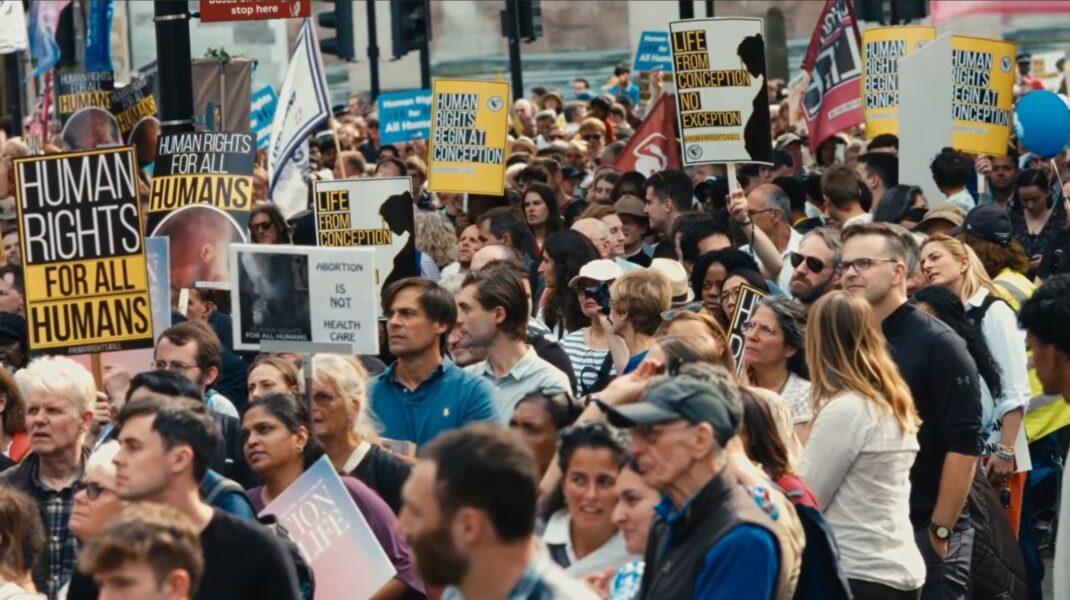
London, September 5, 2026. Thousands of people marched this Saturday through central London, from the Emmanuel Centre in Westminster to Parliament Square, in the annual United Kingdom March for Life, held under the slogan “Abortion harms the family.” The day was marked by unprecedented episcopal participation—fifteen Catholic bishops accompanied the demonstrators, following the opening Mass at Westminster Cathedral—and by harassment from pro-abortion counter-protesters, who even stormed into the Mass to protest.
The number of prelates exceeds even the figure announced in June, when organizers confirmed the attendance of fourteen bishops, double the seven who participated in 2025. Among them, and for the first time, the Archbishop of Westminster and President of the Catholic Bishops’ Conference of England and Wales, the Most Reverend Richard Moth, who presided over the opening Mass, together with Archbishops Bernard Longley (Birmingham) and John Wilson (Southwark). Completing the list are Bishops Philip Egan (Portsmouth), Peter Collins (East Anglia), Paul Swarbrick (Lancaster), John Arnold (Salford), Bosco MacDonald (Clifton), David Waller (Ordinariate of Our Lady of Walsingham), Paul Mason (Military), Frank Dougan (Galloway), John Keenan (Paisley), and Auxiliary Bishops David Evans (Birmingham) and Paul Hendricks (Southwark).
“I am here because I believe in the beauty and dignity of human life,” Archbishop Wilson told EWTN during the march. “We are united in a beautiful, peaceful, and joyful spirit to say that human life matters, that every life matters, from conception to natural death. In a difficult culture where so many people view life as disposable, one wants to stand up and be a voice for the voiceless.”
They storm the Mass to protest
The hostile climate from counter-protesters was evident from early morning. A group of pro-abortion activists stormed inside Westminster Cathedral during the opening Mass to protest in front of the faithful, as shown in videos shared on social media by attendees. “Pro-abortion protesters interrupting Holy Mass at Westminster Cathedral this morning. Despicable behavior,” wrote one of those present while sharing the images recorded inside the church.
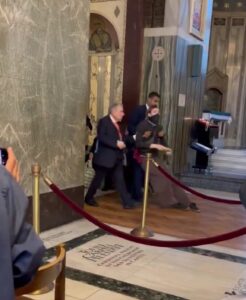
Outside, EWTN Great Britain described an “hostile and intimidating” atmosphere at the doors of the cathedral and the Emmanuel Centre while the Eucharist was being celebrated inside: several hundred activists heckled participants with megaphones, accusing them of a “violent campaign against bodily autonomy,” with banners reading “fascists, you shall not pass” and chants such as “Christian fascists, get out of here” or “take your rosaries off our ovaries.” “They are described as violent for peacefully opposing abortion, while the physical destruction of an unborn child is presented as healthcare: an inversion that borders on parody,” wrote the Catholic network in its day’s report.
The numbers of a growing march
Pending official confirmation of the final attendance figure, all indications point to the 2025 record being surpassed, when more than ten thousand people participated in the march, according to the organizers themselves. The event’s trajectory reflects the growth of the British pro-life movement: it began in Birmingham in 2012 as a modest walk of witness with barely seventy people, held its first formal edition in 2013 at St. Chad’s Cathedral with around four hundred participants, and since moving to London in 2018 has continued to grow, with an increasing presence of young families and a notable ecumenical dimension.
The day began with a pro-life festival at the Emmanuel Centre—with the novelty this year of a “Pro-Life Family Summit” aimed at young people aged 18 to 35—before the march set off in the early afternoon toward Parliament, accompanied by Christian hymns and the Salve Regina. Isabel Vaughan-Spruce, co-director of the march—internationally known for having been arrested for praying silently outside an abortion clinic—described the bishops’ support in June as “a powerful sign of unity and hope” that “underscores the central role of the Catholic Church in defending the most vulnerable with truth and compassion.”
An adverse legislative context
The march comes at a critical moment for the pro-life cause in Britain. Parliament has voted to effectively decriminalize abortion up to birth for the woman herself; “buffer zones” around abortion clinics remain in force—under which several pro-life activists, including Vaughan-Spruce herself, have been arrested for praying silently—abortion pills continue to be sent by mail, and the assisted suicide bill, which the Bishops’ Conference strongly opposes, is advancing in the Commons. Official figures illustrate the scale of the problem: 277,970 abortions in England and Wales in 2023, the highest number since the Abortion Act of 1967.
“Every human life is made in the image and likeness of God. Abortion ends that life, and we are facing a great tragedy, something that affects not only that person, but their family and the society and culture in which we live,” summarized organizer Ben Thatcher to EWTN. “It is an absolute atrocity that a human life made in the image of God can be eliminated and that this is disguised with the slogan that abortion is healthcare.”
Sources: EWTN News, EWTN Great Britain, The Catholic Herald, National Catholic Register, LifeSiteNews and March for Life UK.