


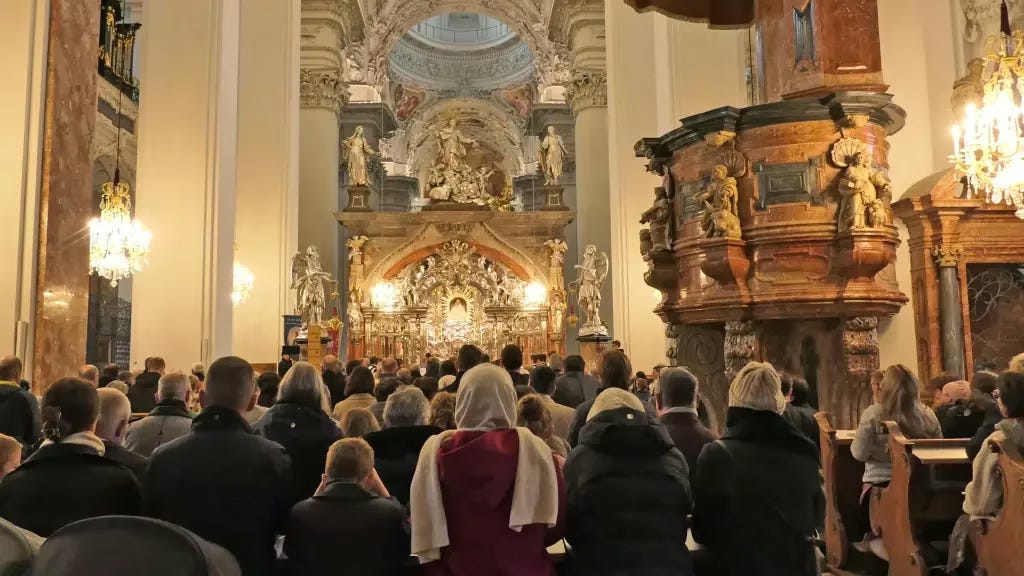
The Austrian diocese of Graz-Seckau has denied the Priestly Fraternity of Saint Pius X (FSSPX) access to the Mariazell basilica this year to celebrate its traditional public rosary event, scheduled for October 4. Unlike other restrictions recently imposed on the Fraternity, this occasion did not involve the celebration of Mass or the administration of sacraments.
This was communicated by Father Johannes Regele, superior of the Austrian district of the FSSPX, in a note dated August 27. The event, which was to take place at Austria’s main Marian shrine, included the recitation of the rosary, the Litany of Loreto, Marian hymns, and a blessing. “We are not allowed to enter the basilica to pray,” Regele stated.
The Fraternity has announced that it will maintain the pilgrimage on October 4, although it will have to modify its program. Details will be communicated in due course.
An annual pilgrimage since 1996
The FSSPX’s relationship with Mariazell dates back to 1975, when Marcel Lefebvre led a pilgrimage of around 600 Austrian faithful to the shrine of the Magna Mater Austriae. Even then, the celebration of the traditional Mass inside the basilica was not authorized, although the pilgrims were able to hold a procession and other events there.
Since 1996, the Austrian district has organized an annual pilgrimage to Mariazell on the Sunday of the Rosary. Last year, nearly 400 people took part, and they were able to enter the basilica, pray the rosary, and renew their consecration to the Virgin.
The situation changes in 2026. According to Regele’s communication, the refusal now affects the very act of public prayer that the Fraternity used to hold inside the shrine.
The Austrian superior specifically highlights this circumstance, noting that granting the request submitted to the diocese “would not have constituted any act of disobedience toward Rome,” since the FSSPX did not intend to celebrate Mass or administer any sacrament in the basilica.
Regele has asked his faithful to receive the decision “with courage” and to pray for those who, in his words, “persecute” Catholic Tradition. “We will find a good solution,” he assures.
The diocese has hosted interreligious events and celebrations linked to Pride
The decision comes in a diocese that in recent years has authorized or supported initiatives of a very different nature.
In July 2021, a Catholic parish in Graz hosted a Christian-Muslim prayer service. The diocesan information about that event stated that Christians and Muslims had prayed together and maintained that “common prayer is possible.”
That same year, the bishop of Graz-Seckau, Wilhelm Krautwaschl, expressed his “disappointment” after the Congregation for the Doctrine of the Faith responded negatively to the possibility of blessing same-sex unions. Following the publication of Fiducia supplicans in December 2023, Krautwaschl welcomed the new document on blessings for couples in irregular situations and same-sex couples.
In 2024, the diocesan website also promoted an ecumenical celebration linked to Christopher Street Day, Graz’s Pride march, inviting both “queer and non-queer” people. A similar event was held in June of this year with the participation of a local Catholic pastoral structure.
In 2025, two Catholic parishes in Graz, Christkönig and Schutzengel, also received certification for their involvement in the so-called “rainbow pastoral.” The program included activities related to Out in Church and a “queer Way of the Cross,” and received financial support from the diocese, according to documentation collected by the FSSPX.
The contrast has been highlighted by the Fraternity itself in reporting the prohibition of its rosary at Mariazell. The diocese of Graz-Seckau has not yet issued a detailed public explanation of the decision.
After Lourdes, Mariazell
The Austrian measure comes just weeks after the bishop of Tarbes and Lourdes, Jean-Marc Micas, withdrew the FSSPX’s authorization to publicly celebrate Mass, administer sacraments, and organize public prayer events at the French shrine.
In that case, Micas explicitly explained the reasons for his decision. He linked it to the episcopal consecrations carried out by the Fraternity in Écône, Switzerland, on July 1 without a pontifical mandate, and to the canonical consequences subsequently declared by the Holy See.
The Lourdes prohibition does not prevent priests and faithful linked to the Fraternity from entering the shrine individually or visiting the Grotto of Massabielle to pray in private. What is excluded are public events organized by the FSSPX.
The Fraternity responded by announcing that it would maintain its international pilgrimage scheduled for October 23–26. In doing so, it contrasted the prohibition with a Christian-Muslim pilgrimage hosted by Lourdes in 2025 and expressed its “sorrow” and “incomprehension” at Micas’s decision.
Now, in Austria, the FSSPX finds itself facing a second restriction in one of Europe’s great Marian shrines. In Mariazell, however, the request was more limited: it did not intend to celebrate Mass or administer sacraments, but only to enter the basilica to publicly pray the rosary, the litanies, and to renew the annual Marian consecration.
Regele has asked the faithful to maintain the pilgrimage and to pray especially during the coming weeks “for the Church and for our countries.” On October 4, he assures, they will carry out the pilgrimage with an adapted program and will solemnly renew the consecration of the countries of their district to the Virgin Mary.