


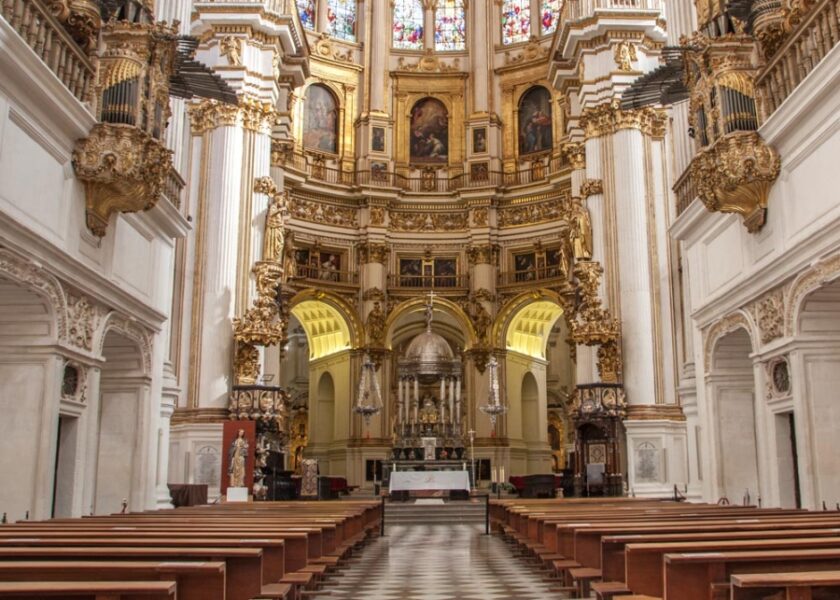
Granada Cathedral will reopen this Sunday, September 6, for the celebration of Sunday Masses, after remaining closed since August due to damage caused by the earthquakes that affected the city and its metropolitan area. The reopening will, for the time being, be partial and does not include tourist visits or other liturgical celebrations.
According to the Archdiocese of Granada, the cathedral will host two Eucharists this Sunday, at 11:00 and 12:30. The latter will be presided over by the archbishop, José María Gil Tamayo. Outside of these Sunday Masses, the Cathedral will remain closed until further notice while the necessary work progresses to progressively restore normal operations.
A still partial reopening
The 9:00 a.m. Mass, Monday through Saturday, will continue to be celebrated at the parish church of the Sagrario-Cathedral, located next to the cathedral. The celebrations were moved there after the temple closed its doors to assess possible damage caused by seismic activity.
Cultural visits to the Cathedral will also remain suspended, and the exhibition Kerygma, the art of evangelizing will stay closed to the public. The Archdiocese hopes that the building will progressively resume its activities in the coming days, although no schedule has yet been set for a full reopening.
The closure of the cathedral occurred in the context of the earthquakes recorded in Granada since mid-August. The Archdiocese then ordered the preventive closure of some of its main churches to check the extent of the damage before allowing the faithful to access them again.
Read also: Earthquakes in Granada: the Archdiocese closes five major churches preventively
The situation evolved as inspections progressed. The Sagrario-Cathedral, the Royal Chapel, the Charterhouse, and the Abbey of Sacromonte were able to reopen, while the Cathedral remained closed. In the latest diocesan update on August 27, the cathedral and eleven other churches in Granada capital and its metropolitan area were still listed as closed.
Granada’s patron saint also had to be moved
The earthquakes have also disrupted the traditional September devotions to Our Lady of Sorrows, patron saint of Granada and its Archdiocese. The basilica where she is usually venerated had to close for technical work, so the image was temporarily transferred to the Sagrario-Cathedral.
There, on September 1, the devotions for the month dedicated to the patron saint began, celebrated daily at 12:00 and 19:45. The image had been moved from its basilica on Sunday, August 30, and was received at the Sagrario by Gil Tamayo and other diocesan priests, accompanied by faithful from Granada.
The rogation procession with the Christ of San Agustín
Amid the seismic activity, Gil Tamayo also called for a rogation procession in September with the Most Holy Christ of San Agustín to pray for those affected and for the protection of Granada. The image is currently in the Cathedral for the Kerygma exhibition, and the procession is scheduled to depart from the cathedral toward the Basilica of Our Lady of Sorrows.
Read also: Granada will hold a rogation procession with the Christ of San Agustín for the earthquakes
The call revives a practice deeply rooted in Granada’s religious history. The city has previously turned to the Christ of San Agustín in rogations during earthquakes and other calamities in past centuries. The image was declared Sacred Protector of Granada, and each September 14 the city renews its vow in his honor.
The archbishop’s decision also provoked a critical reaction from Mario Sixto Picazo Robles, parish priest of Santa María Micaela and diocesan chaplain of the Young Christian Workers, who publicly questioned the timing and meaning of the procession called by his own archbishop.
Thus, this Sunday’s reopening will mark the first step toward restoring the Cathedral’s regular activities, although access will remain limited to the two Sunday Masses while work resulting from the earthquakes continues.