


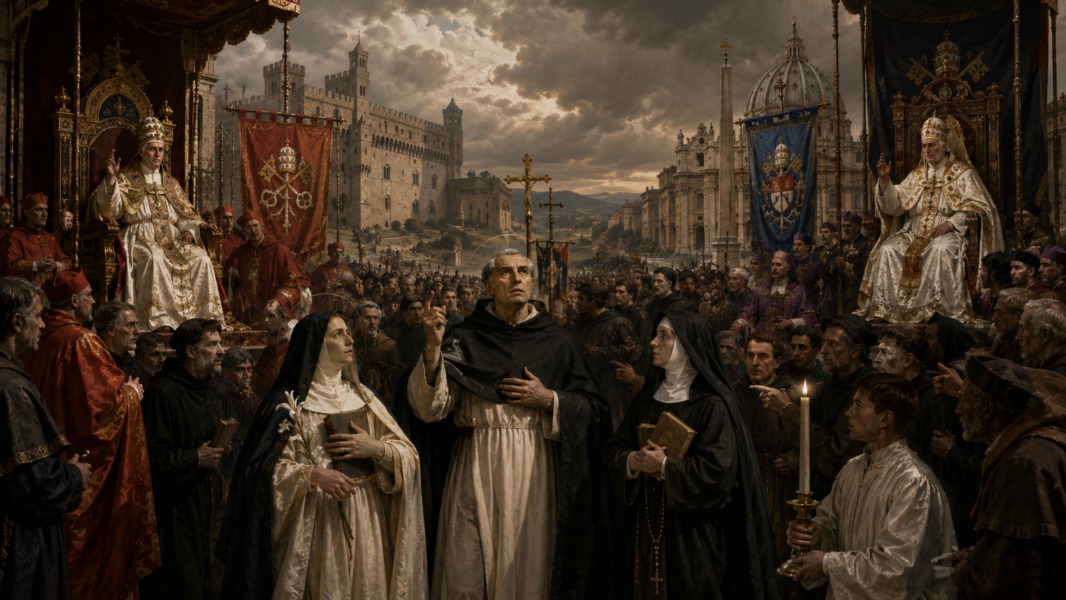
In April 1378 the Romans surrounded the conclave with a demand very much their own, of caput mundi: either a Roman pope would emerge, or at least an Italian one, or they would not answer for the cardinals’ safety. Sixteen electors, eleven of them French, voted with the square howling below and chose a Neapolitan of the curia, Bartolomeo Prignano, who took the name Urban VI and to whom the tiara so soured his character that his contemporaries described it in clinical terms.
Before summer the French cardinals had withdrawn to Anagni; in August they declared the election null on grounds of coercion; on 20 September, in Fondi, they elected Robert of Geneva, who called himself Clement VII and installed himself in Avignon. Christendom awoke with two heads.
No dogma was in dispute. The faith was the same, the sacraments the same, the Mass the same: what was disputed was the validity of an election, a matter for canon lawyers, and over it Europe split along political seams. France, Scotland, Naples and, after scrupulous inquiries—Castile even held a formal process in Medina del Campo, with witnesses from the conclave testifying under oath before deciding—the peninsular kingdoms, Portugal excepted, sided with Avignon; England, the Empire, Hungary and almost all Italy with Rome. The University of Paris placed a chest so that each master could deposit in writing his solution to the schism, and from the count emerged three ways: resignation, compromise, council. The kings tried a fourth, the withdrawal of obedience; and when in 1409 a council gathered in Pisa sought to settle the matter by deposing both popes and electing a third, the result was three. The affair lasted forty years. Whole generations were born, received communion and died under a pope whom half of Christendom regarded as an intruder.
The legitimate pope, Urban, had six of his own cardinals tortured in Nocera; five were never seen again. The illegitimate one, Clement, had carried since his time as legate the nickname Butcher of Cesena, earned outright in 1377. Legitimacy, history tells us, was in Rome; exemplary conduct, certainly, was in neither of the two thrones. Holiness, by contrast, was in the ranks, and distributed: Catherine of Siena literally consumed herself defending Urban, died in 1380 calling the Clementists demons, and is a Doctor of the Church.
Vincent Ferrer spent thirty-eight years in the wrong obedience, and not through inertia: in 1380 he wrote a treatise defending the validity of the Avignon election, became confessor to Pedro de Luna when the latter became Benedict XIII, and his reputation as a thaumaturge was Avignon’s chief asset on the peninsula. The friar who filled squares preaching the Judgment upheld with his visible holiness the cause that history would declare lost. On 6 January 1416, in Perpignan, he preached before the multitude that Benedict XIII was the legitimate pope but that, by refusing to resign to give peace to the Church, Ferdinand of Aragon withdrew the obedience of his kingdoms from him. Note the fineness of the gesture: he did not deny legitimacy; he withdrew obedience. He sacrificed his own thesis, maintained for four decades, to the higher good of unity. Without that withdrawal, Constance could not have ended the schism. He was canonized in 1455 by Callixtus III, the Borgia who a quarter-century earlier had negotiated the surrender of the last Avignon redoubt. Thirty-eight years in the losing camp were no obstacle: they were not even part of the dossier.
Colette of Corbie did not even know the dilemma: she was born in 1381, inside the schism, and her pope was always the one of Avignon. Benedict XIII received her in Nice, gave her the habit of Saint Clare and empowered her through successive bulls to reform the Order. Seventeen monasteries founded or reformed, an entire branch of the Poor Clares still alive today, rest juridically on the seal of a man the Church calls antipope. No one later redid the paperwork. Canonized in 1807.
And Peter of Luxembourg, the limiting case: bishop of Metz at fifteen, cardinal at fifteen also, by appointment of the antipope and at the request of the French court; dead at seventeen, consumed by penances that frightened his confessors; buried, at his own request, in the paupers’ pit of Villeneuve-lès-Avignon. Miracles began at once. Devout accounting came to credit him with two thousand prodigies and thirteen resurrections in a few months; the figure is piety, not statistics, but the fervor was real, and Clement VII exploited it: he raised a monastery beside the tomb and arranged for his own remains to rest beside it, in the shadow of the holy youth who accredited his cause. The canonization process died with its promoter. He was beatified in 1527 by the other Clement VII, the Medici, who by reusing the number was already passing sentence on the first.
For thus, by way of facts, the Church resolved what it never defined by way of dogma. Constance deposed some, accepted the resignation of another, elected Martin V on Saint Martin’s day 1417; Pedro de Luna shut himself in Peñíscola and died at ninety-something convinced he was the pope, with the sea for his court. Afterwards, the numbering did silent justice: the numbers of the Avignon popes remained free and other popes reused them, until in 1958 Roncalli, by calling himself John XXIII, liquidated with a gesture the last doubt pending since Pisa. But the substantive verdict was not the numbering: it was the canonizations.
The Church raised to the altars faithful of both obediences, and thereby taught a doctrine no treatise formulates better: when confusion is objective, good faith saves; Saint Antoninus of Florence came to conclude that if even the saints could not agree, it was a sign that the question exceeded men. God did not examine them on ecclesiology. He examined them on the usual: charity, penance and the duties of their state.
Today there are, once again, declared schisms, excommunications, opposing obediences and a war in which each side administers its certainty. For that landscape, the fourteenth century leaves a central warning: political-ecclesial correctness is not the currency with which holiness is bought. One could be holy preaching for the wrong pope, reforming an order with bulls of an antipope, dying an adolescent with an invalid red hat.
But the warning has two flanks, because there are two ways of sparing oneself the search, and neither appears on the altars. The first is to shrug: the it-doesn’t-matter-which-side, the indifferentism of one who decides the question does not concern him. Against it Ferrer suffices: he wrote a treatise, took sides with all his intelligence, risked his prestige; to be mistaken after seeking is not the same as not seeking. The second is finer and more modern: to delegate. To declare true whatever emanates from power at each moment, so that truth changes content with each change of office without the delegator having to think anything. Applied to the fourteenth century, that stance would have produced truth by geography: Urban pope in London, Clement pope in Paris, and the traveler changing vicars of Christ when crossing the Channel. Applied to ours, it produces truth by chronology: what was holy becomes harmful and what was harmful becomes holy without anything having changed except the office-holder, and assent is asked for both things with the same interior fervor. In logic that is called denying the principle of non-contradiction. In theology it cannot be called faith, because faith assents to what God has revealed, not to what the day’s bulletin publishes. And to call it obedience is an abuse: the obedience that never costs anything, that never obliges one to maintain an uncomfortable thesis or to sacrifice it later, is not virtue; it is convenience in uniform, even if it has a program on Radio Maria.
Those of the fourteenth century did not delegate. They questioned witnesses under oath, filled chests with opinions, wrote treatises, excommunicated one another by name and surname, and therefore their good faith was good: because it was the good faith of those who seek, not the good conscience of those who spare themselves the question. Moralists have long distinguished invincible ignorance, which excuses, from affected ignorance, which aggravates: that of one who could know and prefers not to know. Colette, born inside the schism, had the first. The fourteenth century canonized the first. On the second there are no bulls.
And Ferrer keeps the final lesson, the one that disarms at once the indifferent and the delegate: he maintained his thesis for thirty-eight years and sacrificed it in one morning, not because he ceased to believe it, but because he thought the peace of the Church was worth more than his being right. He sought, committed himself and remained free enough that his conviction did not become an idol.
One can today be holy as a father of a family, as an uncomfortable preacher, as a nun who reforms, being right or wrong on the great question of the century, because the great question of the century is almost never the question of the examination. But the examination has a condition of admission: having presented oneself.
It is worth noting that during forty years of schism, with two and even three popes cursing one another’s obediences, in Rome and in Avignon the same Mass was celebrated, with the same canon, word for word. That century had two popes and a single altar. Ours has a single pope and war at the altar. From that came saints on both sides. Ours remains to be seen.