


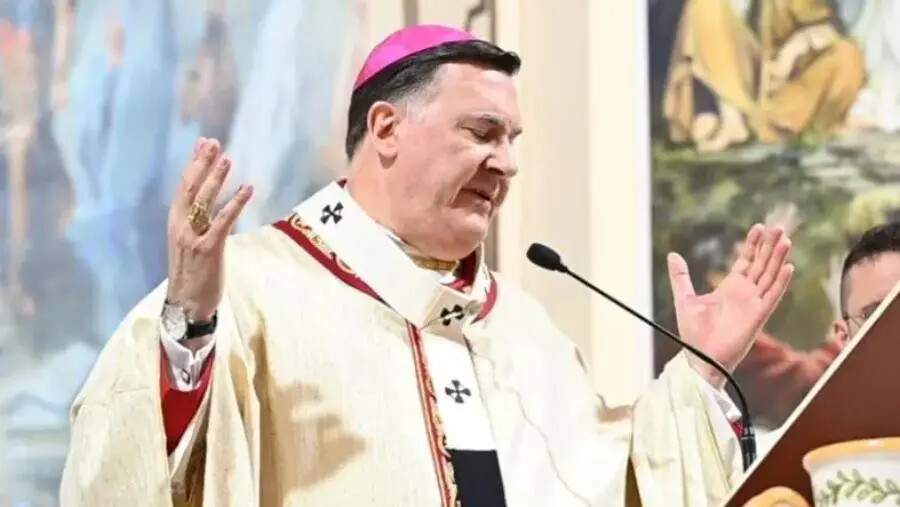
More than six decades after the approval of Sacrosanctum Concilium and the liturgical reform that followed the Second Vatican Council, the archbishop of Catanzaro-Squillace, Claudio Maniago, president of the Episcopal Commission for the Liturgy of the Italian Episcopal Conference (CEI), has acknowledged that “we still do not know how to celebrate in a way that brings forth the splendor of the liturgy”.
Maniago made this observation at the conclusion of the 76th National Liturgical Week, held from August 24 to 27 in Catania, Sicily, under the theme “A Church that generates. Liturgy and Christian initiation.” The prelate, who also presides over the Center for Liturgical Action (CAL), was responsible for closing four days of work dedicated to examining the relationship between liturgy and the transmission of faith.
“We still do not know how to celebrate”
In his concluding remarks, Maniago placed the assessment of the sessions under the category of “wonder,” taking up one of the central concepts of Pope Francis’s apostolic letter Desiderio desideravi.
“I believe that the reflection and also the evaluation of this week must be made in light of an important category for the liturgy, which is wonder, which consists in realizing and becoming aware, and thus being able, with greater reason, to engage and participate,” he stated, according to the report published by the Archdiocese of Catania.
It was in his reflection on the manner of celebrating that Maniago acknowledged that a path still lies ahead: “We still do not know how to celebrate in a way that brings forth the splendor of the liturgy”.
The statement gains special significance due to the position held by the prelate and the context in which it was delivered. Maniago not only directs the Center for Liturgical Action, organizer of the National Liturgical Week, but also presides over the CEI commission specifically responsible for this matter.
His words come more than 60 years after the promulgation of Sacrosanctum Concilium, approved by the Second Vatican Council on December 4, 1963. The conciliar constitution established the principles that later led to the reform of liturgical books and celebration.
Leo XIV and liturgical formation
Just one day before the closing of the Catania meeting, Leo XIV had dedicated his general audience on August 26 to the motivations of the liturgical reform promoted by Vatican II.
The Pope then defended that the reform is situated “in the furrow of the living tradition of the Church” and recalled that its correct understanding allows the rejection of abuses that arose during the post-conciliar period which, he warned, “unfortunately, still occur today at times”.
Leo XIV especially asked bishops and priests to “safeguard and promote” a liturgy that respects the norms and “shines with noble simplicity.”
The Pontiff was also present, through a message, at the National Liturgical Week. According to the Archdiocese of Catania, the papal greeting and blessing were conveyed to the participants by the Secretary of State, Cardinal Pietro Parolin.
Maniago interpreted that message as support for the work being carried out in this field. For the archbishop, the Pope’s words were a gesture of “encouragement and blessing” and, above all, a “confirmation of the importance of the path we are taking at the level of liturgical formation”.
The president of the CAL pointed out that the sessions had made it possible to highlight the “difficulties and struggles” existing in pastoral work, but also its possibilities and perspectives. “Here solutions are never given, but stimuli, indications, paths to work on in the local Churches,” he explained.
A “serious rethinking” of Christian initiation
A large part of the work was dedicated to Christian initiation and the difficulties in transmitting the faith in the current context. Maniago ruled out that the response could be limited to superficial modifications and called for a “serious rethinking” of the way Christian communities accompany those who approach the faith.
The archbishop expressly rejected limiting oneself to a “lift to fix some wrinkles” and advocated a deeper review. In this regard, he proposed that the reflections arising during the Liturgical Week also reach the synodal path of the Churches in Italy and the work of the Italian Episcopal Conference.
The issue was also addressed by Giuliano Zanchi, professor at the Catholic University of Milan, who delivered one of the concluding reflections. The theologian advocated moving beyond a conception of Christian initiation narrowly linked to childhood and the school model.
“It is the whole community that is initiatory,” Zanchi maintained, for whom it is up to the Christian community to make it possible for those who wish, “great or small,” to encounter Jesus Christ.
For his part, the secretary of the Center for Liturgical Action, Mauro Dibenedetto, described the interventions of the sessions as “intense and provocative” and noted that the work will have to continue later in the dioceses and parishes.
The next Liturgical Week will be in Albano
The Liturgical Week also counted on the participation of the general secretary of the CEI, Giuseppe Baturi, and the secretary of the Dicastery for Divine Worship and the Discipline of the Sacraments, Vittorio Francesco Viola, who presided over the Eucharist of the final day.
Before concluding the work, Maniago asked the attendees not to let the reflections that emerged during the four days of the meeting be lost and to take them to their respective local Churches.
The 77th National Liturgical Week will be held from August 23 to 26, 2027, in the diocese of Albano, at the Mariapolis Center in Castel Gandolfo.