


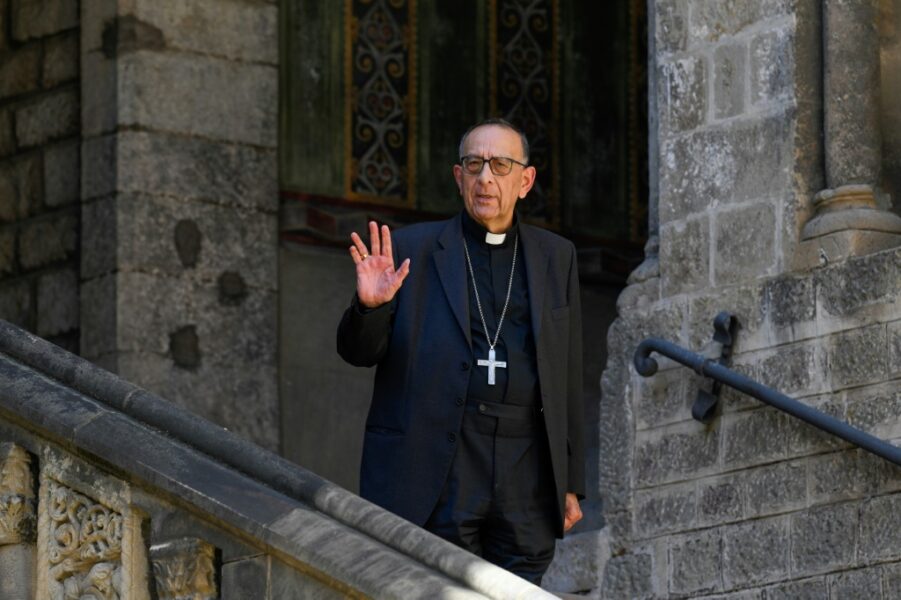
Juan José Omella is eighty years old and four months today and remains archbishop of Barcelona with all his faculties. He submitted his resignation in early April 2021, days before turning seventy-five; on 21 April last he turned eighty. Five years and five months later there is no coadjutor, no administrator, no date. The Church has withdrawn his vote to elect a Pope and keeps him in charge of more than two million baptized faithful, which clarifies which of the two tasks Rome considers truly delicate. Canon 401 has been waiting five years in Barcelona for someone to read it.
That Francis extended it made sense. Omella presided over the Episcopal Conference until March 2024, was his man in Spain and, as the cardinal himself recounted at the Sagrada Familia last July, the Argentine Pope had repeatedly told him that retirement would come at eighty. Francis set the date and did not live to see it. What makes no sense is that Leo XIV, elected with the aura of a canonist, doctor from the Angelicum, professor of canon law at the seminary of Trujillo, of whom it was said that on the very night of his election he asked two cardinals to help him restore law to the Church, let that date pass without a gesture. He let it pass. Then came the trip that Omella himself had gone to ask for in Rome: the tower of Jesus Christ, the Mass of 10 June, the nominal thanks to the cardinal in the homily. The archbishop’s circle had been announcing for a year that this would be his last milestone. It has turned out to be one more milestone. Almost three months have passed since the Pope took off from El Prat and in Barcelona the same man who presented his resignation when Leo XIV was bishop of Chiclayo is still in charge.
Canon 401 is, if one wishes, a gentle canon: it asks the bishop to resign and entrusts the Pope to provide “taking into account all circumstances.” Five years allow for many circumstances. But the norm is not a dead letter when Rome wants to apply it. Francis accepted Schönborn’s resignation on the exact day he turned eighty, appointed an apostolic administrator and Vienna waited for its archbishop without anything collapsing. Leo XIV accepted Zornoza’s in Cádiz in November and appointed an administrator the same day. There are formulas. They are known. They are used when one wants to use them.
What is happening in Barcelona is not a legal gap but a decision not to decide, and it has an explanation that is less legal than arithmetic. Barcelona is the only see in Spain in which every pole of ecclesiastical power has a candidate and none has a majority. Omella and Cobo have been pushing Roselló, the Mercedarian from Pamplona, since October; he publicly ruled himself out with faint conviction and was received in private audience in February. The ecclesial Catalanist movement, according to El Mundo, has been moving pieces in Rome for months for an identity-profile candidate, Planellas or the abbot of Montserrat. Those hoping for a shift recite Saiz Meneses and Conesa. And from the Dicastery for the Doctrine of the Faith, according to Roman sources this medium published in October, Jordi Bertomeu emerges, with the support he retains in Scicluna’s circle and that of Cardinal Barreto. A Pope whose Spanish appointments have so far consisted of combining sensibilities and not upsetting anyone finds himself in Barcelona with the fact that any name displeases three out of four. The elegant solution is not to appoint. And the most elegant way not to appoint is for the incumbent not to leave.
Allow me a hypothesis that aspires to nothing more. Appointing Bertomeu to Barcelona is, with the baggage he carries, little short of unthinkable; half the Curia would say so out loud if asked and the other half thinks it without being asked. But appointing someone else is to say no to Bertomeu, and saying no to the man who in a single cause has been investigator, drafter of the penal precept, spokesman and liquidating commissioner carries a price that no one in Rome has wanted to calculate. Between Bertomeu’s displeasure and the vacancy in Barcelona, someone has concluded that the vacancy is cheaper. In Rome saying no always costs more than saying nothing. Hence the see is governed by the Curia’s most ancient method, which is to let time do its work: while Omella holds on, no one has said no to anyone. A Pope who came to restore law to the Church should not fear the anger of a dicastery official. Unless he does fear it.
Meanwhile, Omella does not govern as an interim. In July he dismissed the directors of the priestly residence for mismanagement, according to Crónica Global; he continues to appoint, sign and preside. He is eighty years old and four months, with one Pope who told him to leave at eighty and another who came to restore the law. Canon 401 applies throughout the Church. It only remains for it to reach Barcelona.