


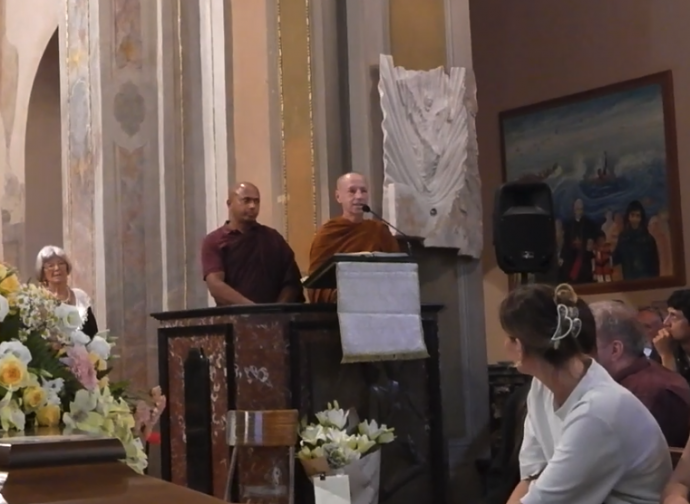
Two Buddhist monks chanted a mantra from the ambo of a Catholic church during the funeral of a Buddhist woman held on August 20 in Como, northern Italy. The parish priest participated wearing an alb and stole and stated during his intervention that the deceased had found her search for God in “Buddha, the Enlightened One.” After the case became public, the Diocese of Como clarified that the commemoration should have taken place elsewhere and that it was held without the authorization of the diocesan Ordinary.
The ceremony was held at the church of San Martino, in the Rebbio neighborhood, and was convened following the death on August 17 of Marta Pezzati, aged 59. President of the association Como Accoglie, Pezzati was known in the city for her work in support of immigrants and other people in vulnerable situations. The announcement circulated after her death explicitly stated her “funeral” for the morning of the 20th in the Catholic church.
During the event, two Buddhist monks intervened, reciting a mantra from the ambo. Videos later released also show the parish priest of San Martino, Giusto Della Valle, and another priest dressed in alb and stole.
One of the participating monks later offered a different interpretation of the nature of the ceremony. In statements to La Nuova Bussola Quotidiana, he asserted that “it was not a Mass nor a funeral,” but a remembrance of Pezzati’s generosity, and maintained that there was no liturgy or Catholic prayer.
“Buddha, the Enlightened One”
Della Valle devoted part of his intervention to the spiritual journey of the deceased. He presented her as a contemplative woman, “a seeker of God along every possible path,” and stated that she had found that search in “Buddha, the Enlightened One, who for centuries has continued to illuminate the path of many peoples.”
The priest also referred to different conceptions of life after death and spoke of “rebirth, regeneration, resurrection,” before evoking the biblical image of the peoples gathered on the holy mountain.
Della Valle likewise recalled Pezzati’s work in support of immigrants, especially during the crisis experienced in Como in 2016. The priest, known in the city for his involvement in reception initiatives, had collaborated with her in this area.
The relationship between the two explains, according to one of the Buddhist monks present, the choice of San Martino to hold the farewell. Pezzati had carried out intense social activity in Como for years through the association she presided over.
The diocese: “The church is not a neutral or multipurpose space”
The diocese published the following day a full note on the “correct celebration of the funeral rite.”
Piani begins by expressing respect for the mourning of family and friends and avoids passing judgment on Pezzati’s spiritual journey or social activity. He then, however, draws a clear distinction in the liturgical sphere.
“Liturgy is an expression of the faith of the Church and not a set of indistinct gestures,” the note states.
The diocese also recalls that the funeral rite must clearly preserve the proclamation of the death and resurrection of Christ and “cannot be confused with rites or symbols proper to other religious traditions”.
Piani further recalls a provision of the former bishop of Como Alessandro Maggiolini: “By its dedication and its function, the church is not a neutral or multipurpose space, but a place whose identity must be safeguarded and respected.”
The ceremony had no authorization from the Ordinary
Based on these principles, the Office for the Liturgy directly addresses what happened at San Martino.
The diocese maintains that “it would have been necessary to hold that moment of commemoration elsewhere” and rejects the mixing of elements proper to civil or interreligious commemorations with elements of liturgical prayer.
The note adds that what occurred was carried out without having consulted the competent authority and without authorization from the diocesan Ordinary.
The clarification acquires special relevance because it is not limited to establishing general criteria on interreligious dialogue, but confirms that the decision to hold that ceremony in the church and under those conditions had not previously received the approval of the diocesan authority.
A reminder to priests and deacons
After responding specifically to the case of Rebbio, the Office for the Liturgy issues a reminder to the entire diocese.
Piani asks all those involved in the liturgy, “beginning with presbyters and deacons,” to celebrate the funeral rite attentively in accordance with what is established in the liturgical books.
The note demands that one always start from the praenotanda —the norms and indications that precede the various rites in the liturgical books— and from the particular provisions promulgated for the diocese by its current bishop, Cardinal Oscar Cantoni.
It also recalls that, when doubtful cases arise, those responsible for the celebrations must consult the diocesan authorities and offers specific formation on funerals to priests and pastoral agents.
“A correct celebration of Christian funerals —Piani concludes, paraphrasing the ritual— brings the consolation of faith, comforts the Christian who believes and does not wound the man who weeps.”
The intervention of the Diocese of Como comes ten days after a ceremony in which, inside a Catholic church and without authorization from the Ordinary, two Buddhist monks were able to chant a mantra from the ambo while the parish priest praised Buddha as “the Enlightened One”.