


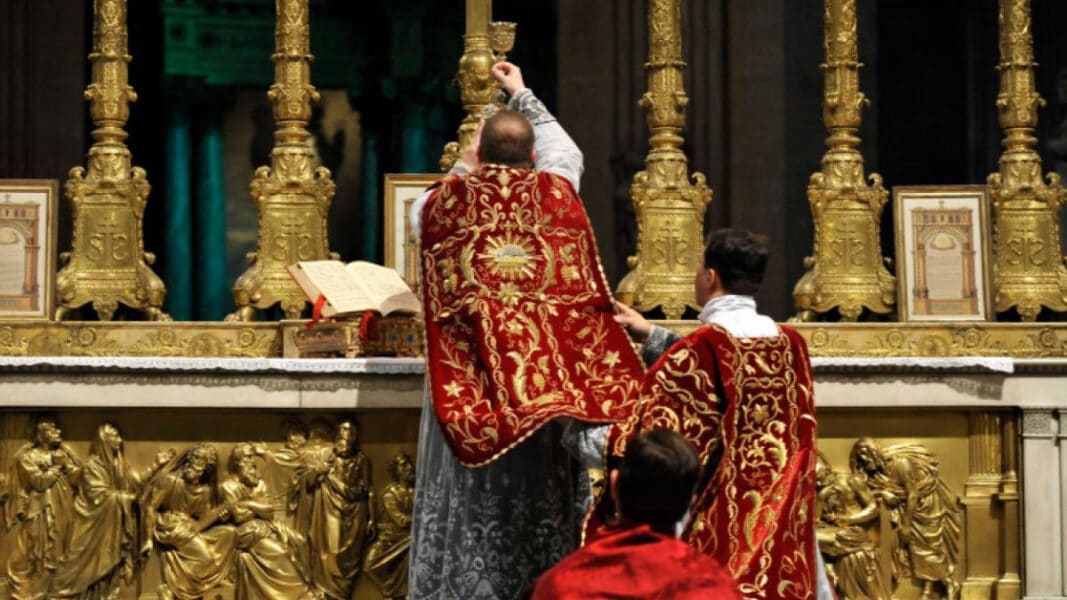
The Traditional Latin Mass is awakening growing interest among young Vietnamese Catholics, many of whom were born decades after the liturgical reform and have no prior experience of the pre-Vatican II liturgy. Alongside the Vetus Ordo, these small communities are recovering ancient prayers, catechisms, and forms of spirituality proper to Vietnamese Catholicism that had largely fallen outside their generation’s religious experience.
According to UCA News, the movement consists mainly of Catholics in their twenties and thirties who grew up attending Mass in Vietnamese according to the reformed rite. Some discovered the traditional liturgy while studying or working in Italy, France, Poland, or the United States; others came to it through books, conferences, and online content.
The phenomenon thus presents a particularity compared to traditional communities in some Western countries: these young people did not personally know the pre-reform liturgy and are not seeking to recover an experience lived during their childhood.
From Gregorian chant to the traditional liturgy
Joseph Christopher Nguyen Thien Tuan Hoang, head of one of the country’s traditional Catholic communities, explains that his first contact was related to Gregorian chant.
“The first thing that attracted me to the Traditional Latin Mass was Gregorian chant. Its ancient melodies taught me that sacred music is not only about sound, but also about silence,” he notes.
Over time, he found in the ancient liturgy elements he associated with the way earlier generations of Vietnamese Catholics lived their faith.
“I realized how much the ancient liturgy reflected the faith I had learned from the older Catholics in my parish when I was a child. It was like rediscovering the way my ancestors had lived their faith,” he explains.
This approach has led some young people to study Gregorian chant, read the Church Fathers, approach medieval spiritual authors, and recover classic catechisms. Some have also taught themselves enough liturgical Latin to follow the celebrations.
Ancient Vietnamese prayers and catechisms
The interest is not limited to the 1962 Missal. The recovery of the ancient liturgy has led these Catholics to seek out elements of the Vietnamese Catholic tradition that had fallen into disuse.
“Along with the Latin Mass, we rediscover a treasure of Vietnamese prayers and catechetical texts prepared by missionaries before the Second Vatican Council,” explains Hoang.
These materials were not simply translations of European texts; they had been adapted over generations to the language and culture of the country.
“They had already been adapted to Vietnamese culture and language. Few Catholic communities in Southeast Asia still preserve such a rich heritage,” he adds.
For members of these communities, recovering these texts is not merely a historical exercise. They also see them as instruments for transmitting doctrine through expressions that for generations formed part of the life of Vietnamese Catholics.
Interest in the Vetus Ordo thus also becomes a search for the roots of a specifically Vietnamese Catholic identity.
No parishes dedicated to the Traditional Mass
The movement currently lacks a stable structure. Unlike countries such as France or the United States, Vietnam does not have a network of parishes dedicated to celebrating the Traditional Mass.
The communities are small and maintain contact mainly through personal relationships, online groups, and connections formed by those who have studied abroad.
Opportunities to attend the Vetus Ordo are limited, and celebrations are organized when circumstances allow, sometimes thanks to foreign priests visiting the country.
One such Mass described by UCA News is celebrated in a private home in Hanoi, temporarily converted into a chapel. There, young people follow the prayers using bilingual missals while a visiting priest celebrates the liturgy in Latin.
“Our greatest challenge is not hostility, but misunderstanding”
The presence of these communities has also sparked discussions among Vietnamese Catholics, especially on social media. According to the report, some automatically associate attachment to the Traditional Mass with rejection of the Second Vatican Council or opposition to the pontificate of Francis.
Hoang considers this perception one of the main obstacles to the development of these communities.
“Our greatest challenge is not hostility, but misunderstanding,” he states.
“If more Church leaders understood why some young Catholics are drawn to the ancient liturgy, I believe more people would have the opportunity to experience this part of the Church’s tradition,” he adds.
The report also notes the existence of minority groups that use the concept of “tradition” to defend positions that go beyond or contradict the Church’s official teaching, making it harder to distinguish between these positions and Catholics whose interest centers on the traditional liturgy.
A generation in search of roots
The reasons these young people give for their approach to the Vetus Ordo focus less on the use of Latin than on concepts such as silence, beauty, and continuity.
Its members describe the ancient liturgy as a way to pray with greater concentration and to establish a bond with the generations of Catholics who preceded them, amid a society marked by rapid change and constant digital distractions.
The extent to which the phenomenon may grow within the Vietnamese Church remains open. For now, these are small communities with limited opportunities to celebrate regularly.