


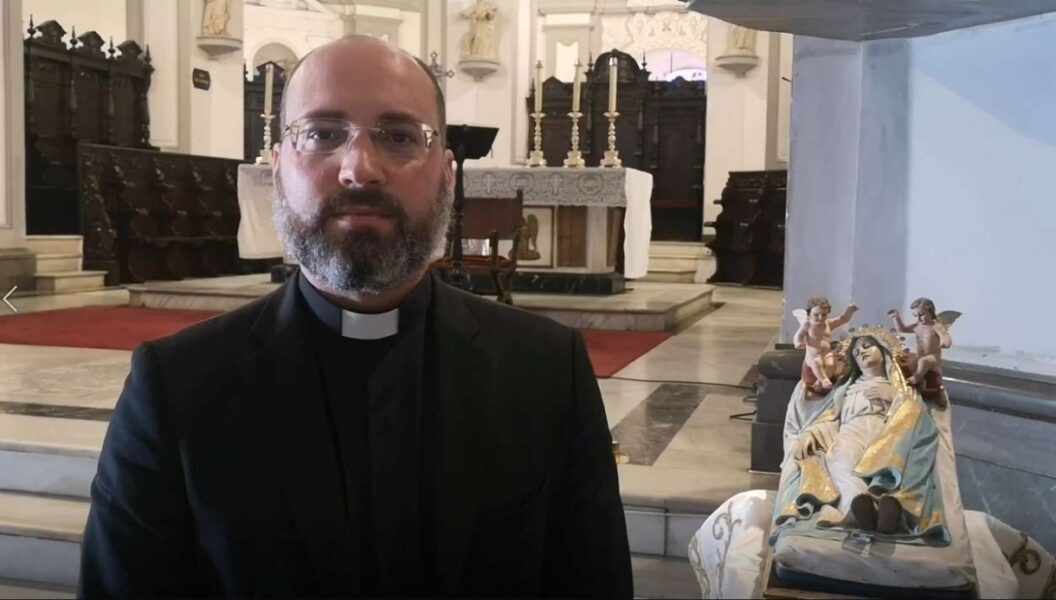
The vicar of Ceuta and parish priest of the Sanctuary of Santa María de África, Francisco Fernández Alcedo, has called for preserving coexistence among the different religious communities of the autonomous city in light of the situation generated after the invasion on July 30. “The Church is the guarantor of that coexistence and the guarantor that this will not escalate into another confrontation,” he stated.
Fernández Alcedo spoke on Monday on COPE, where he addressed the situation Ceuta is facing one month after the mass entry of illegal immigrants from Morocco. The priest acknowledged the suffering among the population and defended that the Church must maintain a close presence both through assistance and pastoral accompaniment.
“Right now, Ceuta is on edge and heartbroken, and in the face of that fact, the Church cannot remain indifferent,” he noted.
“The duty of the Church is to accompany”
The vicar highlighted the role played by the Sanctuary of Santa María de África, patroness of Ceuta, as a place of encounter and accompaniment for the city’s residents.
Fernández Alcedo acknowledged that the Church’s material resources are limited in a situation that has overwhelmed its usual capacity for care, and he emphasized pastoral work.
“The duty of the Church is to accompany and to see where the neighbor is whom, like the good Samaritan, we must attend to in a situation that overwhelms us,” he explained.
The ecclesial institutions of Ceuta have been participating since the end of July in meeting the needs arising from the mass entry from Morocco. Parishes, Cáritas, and other entities have provided assistance while the city faces the consequences of thousands of immigrants remaining.
The vicar of the Sanctuary of Santa María de África himself, Jesús Francisco Molina, explained last week that the Church was already attending to people in need before the invasion and that its resources were limited. Molina then defended the order of charity and the priority of attending to the nearest neighbor.
“One attends first to one’s neighbor, who is the closest, the one next to you, the Ceutan, before the one who is not,” he stated.
A call to preserve coexistence
Fernández Alcedo devoted much of his intervention to Ceuta’s social situation and the risk that tensions arising in recent weeks could spill over into relations among the different religious communities.
“Ceuta does not want tension, Ceuta knows how to coexist, Ceuta is a welcoming city that loves that coexistence,” he stated.
The vicar called for maintaining serenity and pointed to the responsibility of religious confessions in preventing the situation from leading to confrontations.
“The Church is the guarantor of that coexistence and the guarantor that this will not escalate into another confrontation,” he stressed.
The priest also claimed the interreligious dialogue existing in Ceuta as a daily reality of the city and not merely an institutional response in times of tension.
One month after the mass entry from Morocco
The statements come one month after the mass entry recorded between July 30 and 31, when tens of thousands of immigrants crossed illegally from Morocco into Ceuta. The magnitude of the events led the authorities of the autonomous city to suspend the patronal festivities scheduled for early August, although the religious acts in honor of Our Lady of Africa were maintained.
The crisis has been accompanied throughout August by security problems and growing tension among some residents over the presence of thousands of immigrants in the city. Last week, hundreds of people blocked a Red Cross truck for more than two hours as it was delivering food to immigrants camped on Trampolín beach.
In this context, Fernández Alcedo placed the Church’s mission in accompanying those who suffer and in preserving coexistence among the communities present in Ceuta.
“Ceuta is on edge and heartbroken,” the vicar summarized.