


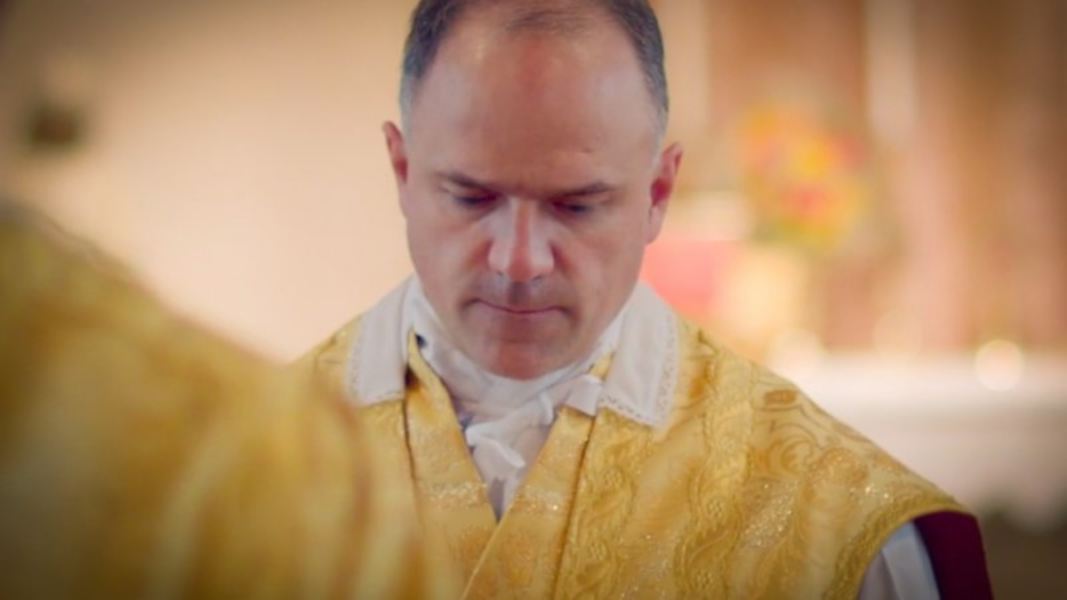
The harshest words spoken against the Écône consecrations have not been said in Religión Digital. They are being said these days in sacristies and WhatsApp groups, and they are said by daily-Mass Catholics who love the liturgy and do not forgive the pontificate for an ambiguity, often egged on by priests of good faith who have laid it on thick on social media: that the Pagliarani crowd are frighteningly arrogant; that they waited for Leo’s arrival to launch a trial balloon and test the waters; that one has to think a lot of oneself to set oneself up as guardian of the Church; that, deep down, they regard all the rest of us as heretics. Four distinct charges and one common premise: that the consecrations of 1 July were a message. They were not a message. They were logistics. And that, precisely, is where the drama begins.
The numbers first, because they are short. In 1988 Lefebvre consecrated four bishops. Williamson was expelled from the Fraternity in 2012 and died in January 2025. Tissier de Mallerais died in October 2024. Two remained, “the only two survivors” of that morning, as ACI Prensa wrote the week of Écône: Bernard Fellay, born in 1958, and Alfonso de Galarreta, born in 1957. Sixty-eight and sixty-nine years old. Beneath them, according to the Fraternity’s own data: 733 priests, 264 seminarians, 798 places where Mass is celebrated across 63 countries, and ordinations every June; ten new priests the weekend immediately before the consecrations, half of them in Zaitzkofen against the express prohibition of the bishop of Regensburg. The sacrament of Holy Orders and Confirmation require a bishop. Without bishops of their own, that entire sacramental structure is left, within a decade or a heart attack, at the discretionary mercy of the very authorities the Fraternity considers—its own word—“imbued with a spirit contrary to the faith.” To make this calculation one does not need an ecclesiology. One needs two birth certificates and a calendar.
Let the domestic analogy serve, which is less unworthy than it seems: a father of a grown family with two grandparents in the house does not arrange the succession when he buries the second grandfather; he arranges it when he buries the first. Pagliarani buried Tissier in October 2024. Everything that came afterwards—the letter to Leo in August 2025 requesting an audience, the second letter explaining that they needed bishops for Orders and Confirmation, the public announcement of 2 February with five months’ notice, the refusal of 19 February to a postponement whose conditions, in his judgment, prejudged the outcome—is the conduct of a man making a will. Not that of a strategist testing the waters.
And here falls only the second charge. A trial balloon is, by definition, cheap and reversible: it is launched, the reaction measured, and it is retrieved. This cost the Fraternity everything it had to lose: the latae sententiae excommunication of its only six bishops, declared by Rome within forty-eight hours; the ruin of a capital of thaw that had produced faculties to confess validly in 2015 and to assist at marriages in 2017; the early enmity of a pontificate that has not yet completed two years and that would have sufficed to wait sitting down. Whoever wants to test the waters grants an interview, leaks a rumor, publishes an article under a prudent pseudonym. He does not consecrate four bishops before the cameras, in the mother house, on the feast of the Most Precious Blood, repeating the exact gesture that in 1988 cost two decades of exposure. If it was a political calculation, it was a ruinous, incomprehensible calculation, the worst available. The alternative explanation is more humiliating for the analysts: there was no calculation. There was an actuarial table. The date was not set by the 2025 conclave. It was set by two obituaries.
The third charge—who do you think you are to set yourself up as guardian of the Church?—deserves that the communiqué be read before it is answered. What the Fraternity consecrated on 1 July were, literally, auxiliary bishops “without jurisdiction.” The same communiqué laments having done so without the Holy Father’s authorization and laments that its superior general has not been able to set out his reasons to him “filially.” He who believes himself guardian of the Church claims jurisdiction, sets up parallel hierarchies, or declares the See vacant. For half a century the Fraternity has done exactly the opposite: it names Leo in the canon of every Mass, claims for itself neither territory nor subjects, and grounds the validity of its ministry in supplied jurisdiction, a doctrine that presupposes emergency and provisionality—that is, the very negation of self-sufficiency. The arrogant version of this story exists, has a name—sedevacantism—and for fifty years has had no more constant adversary than Écône. Pagliarani does not claim the keys of the Church. He claims something much smaller and much more compromising: the right of a superior that his sons have someone to ordain and confirm them when he is no longer there.
And why not entrust everything to Rome, as any congregation does with the bishops Rome gives it? Because the guarantee is not offered by “Rome,” which is a convenient abstraction: it is offered by concrete men, and it is fitting to look at them one by one, which is what a father does before signing. The warning of 13 May that qualified the announced consecrations as a schismatic act bears the signature of Cardinal Víctor Manuel Fernández, prefect of the Dicastery for the Doctrine of the Faith and author, in 1995, of Heal Me with Your Mouth: The Art of Kissing. It is not an insult: it is a bibliographic card. The custodian of orthodoxy who threatens Menzingen under pain of excommunication is the same theologian whose printed work includes a treatise on the kiss. The Pope to whom Pagliarani asked to set out his reasons filially is the same one who on 1 October 2025, in Castel Gandolfo, flanked by Arnold Schwarzenegger, blessed a block of Greenland ice twenty thousand years old—“Lord of life, bless this water”—while representatives of several continents poured waters from their lands into a common bowl; the same one of whom photographs have circulated since March of that same year 1995, kneeling in what the minutes of an Augustinian symposium in São Paulo describe, with official caption, as “Celebration of the Rite of the Pachamama,” without any public clarification having yet arrived from the interested party—defenses from others are not lacking, from inculturation to agricultural custom; what is lacking is his own—; the same one, finally, whose 2026 episcopal appointments Religión Digital was celebrating this very week, asking, with evident satisfaction and with quite a bit of muddle in the data, whether we are before a Pope friendly with the LGBTQ collective. When the praise comes from the other shore, one is spared the suspicion of caricature.
Observe the asymmetry that a superior general is professionally obliged to observe: Munich promotes guidelines for blessings contrary to Rome’s declared criterion, twenty-six priests protest by letter, and Cardinal Marx is received in audience days later, without decree, without note, without deadline; among the appointments celebrated by Religión Digital is a bishop for Eichstätt who supported the Synodal Way’s resolutions on those same blessings. Écône consecrates, and the decree comes in forty-eight hours. One need not attribute bad faith to anyone to register the datum: operative doctrinal disobedience is administered with years of patience; canonical disobedience of a traditional sign, with hours. Pagliarani’s question was never whether Leo is a heretic, but whether that Rome, the Rome of this asymmetry, offers the stability that would make reasonable the risk of waiting for Galarreta to die. He answered no. He may have been mistaken. But to be mistaken in a judgment of risk is not arrogance: it is the servitude of everyone who is obliged to judge.
Because that is the bottom of the first charge, the one that drags the most good faith and the one that most deserves care. One must be very arrogant, it is said, to judge the moment yourself. It is the same logic as someone who boasts of having no enemies: enemies are not chosen, they choose you; and the hours of history, neither. There are generations of Catholics to whom falls the easy stretch of the road: orthodoxy comes ready-made, obedience and holiness point in the same direction, and it suffices to let oneself be carried to reach port. Blessed are they, and it is not irony. And there are generations to whom falls the stretch in which the signs contradict one another, and God requires of them a discernment, a judgment, and a taking of sides in which one gets dirty, risks one’s name, and can err. They are not better than the others; it fell to them. To reproach that man for judging is to reproach the sentinel for the war.
Arrogance, moreover, has a recognizable phenomenology: it seeks stage, applause, self-absolution. Pagliarani requested an audience in August 2025 and obtained silence; he asked to set out his reasons and obtained a decree. In his sermon he did not proclaim himself victor of anything: he rejected as false the dilemma of choosing between faith and the Church, admitted that Rome and the Fraternity “speak two distinct languages,” and said that God now asked them to be treated as rebels. The arrogant man absolves himself. This one accepted the penalty in advance.
There remains the fourth charge, the most intimate: deep down they regard all of us as heretics. The Fraternity’s declaration speaks of authorities “imbued” with a spirit contrary to the faith, and it has already been explained in these pages that “imbued” is not “heretic”: it describes an atmosphere one breathes by degrees, not a pertinacity that is sentenced; whoever broadens the subject to the last parish priest and hardens the predicate to formal heresy is reading a text that does not exist. But it is also true that the traditionalist cause has its hooligans, who treat as compromised any Catholic who receives Communion in his usual parish and who do Menzingen the same favor ultras do their club. Granted. Now look in the mirror: the Catholic who levels the charge presents himself as respectful of the liturgy and critical of the pontificate’s heterodoxies. That is: he shares the diagnosis. What he does not share is the consequence. That discrepancy is legitimate and serious—it concerns prudence, canon 1387, visible communion—and deserves to be discussed with arguments of prudence, of law, and of ecclesiology. What it does not deserve is to be dismissed with an adjective from someone else’s confessional.
There is, finally, a precedent that the four charges ignore and that is the most uncomfortable: Rome’s judgment on 1988 was not stable. John Paul II spoke of a schismatic act and excommunication in Ecclesia Dei; Benedict XVI lifted those excommunications in 2009; Francis granted those same priests faculties to confess in 2015 and to assist at marriages in 2017. In forty years, the qualification of the same act passed from consummated rupture to tolerated anomaly and sacramentally integrated, without the Fraternity moving a millimeter from the place where it was. It is not an argument of licitness: a crime does not become licit because it is later amnestied. It is an argument of perspective: whoever today pronounces definitive sentences on Écône would do well to remember that the last definitive sentence on Écône lasted twenty years.
What there was in Écône on 1 July was something older and simpler than so many letters spilled: a father who counted his bishops, counted his sons, looked at who was opening the door for him in Rome, and decided that the second could not be left orphans at the discretion of the third. In forty years we will know whether with that he saved the fortress or opened a breach in the wall; in 1988 it also took time to know, and Rome ended up lifting those excommunications and granting faculties to those rebels. In the meantime, dispute with Pagliarani the right, dispute with him the ecclesiology, dispute with him the prudence. The fatherhood, no. That is visible on him.