


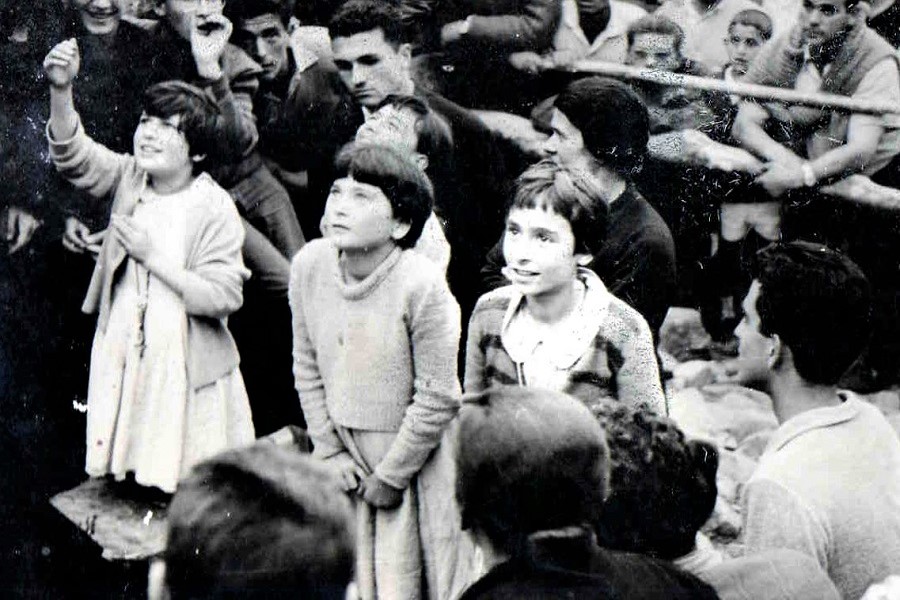
The editorial on Medjugorje published in these pages dismissed Garabandal in half a sentence, as the other case in which the Fatima pattern degenerates into a more spectacular than spiritual apocalyptic version. The phrase is accurate and deserves the article it never received, because Garabandal is not an appendix to Medjugorje but its source code. Before the Gospa handed out ten secrets and promised a permanent sign on the hill, the Pines of a village in Cantabria already had their Warning, their Miracle, their Chastisement and their permanent sign, with twenty years’ head start. And they also have their own pathology, which we shall call here physicalism: the substitution of the theological by the physical, of faith by the expectation of an event with a day of the week, an hour and television coverage. Sixty-five years after the first ecstasy, the Church continues to say “non constat” and the circus continues to say “this year.”
It is worth conceding first what must be conceded. The two Garabandal messages, that of 18 October 1961 and that of 18 June 1965, fit into ten lines and contain nothing censurable: sacrifice, penance, visiting the Blessed Sacrament, the cup that was filling and now overflows, many cardinals, bishops and priests on the road to perdition, the Eucharist to which less and less importance is given. Bishop Beitia acknowledged this in writing in July 1965: neither in the doctrine nor in the spiritual recommendations was there matter for censure. Of the four girls there is no record of scandal. There were conversions and there continue to be. If Garabandal were that, there would be nothing to write. But Garabandal is not that; that is the pretext. The propositional content of the messages is catechism; their pragmatic force is something else, and it can be summed up in two words: stay on the lookout. What fills the village every 18 June and feeds a bibliography of dozens of titles is not ten lines of catechism. It is physics.
Between June 1961 and November 1965 the girls claimed to see St Michael and the Virgin of Mount Carmel on some two thousand occasions, and what drew the crowds were not the messages but the bodies. The ecstatic marches, backwards, at night and at impossible speed along stone paths; the falls without injury; the insensitivity to the pins the doctors stuck into them and to the flashlights shone on them; the sudden weight that prevented several men from lifting a twelve-year-old girl; the objects kissed and returned without error to their owner; the recognition of priests in civilian clothes. And the “milagrucu” of the early hours of 18–19 July 1962, announced fifteen days in advance, when a white form appeared on Conchita’s tongue before a packed street and a Barcelona businessman who had never handled a movie camera shot the scant eighty frames that have circulated ever since as proof. Observe the type of discussion: on one side, a diocesan commission that pricks, measures and concludes in October 1962 that the phenomena lack every sign of supernaturalness and have a natural explanation; on the other, defenders who count frames and weigh girls. Both sides argue about physics. No one argues about theology, because there is none: two catechism messages do not sustain a dispute. And when the physics of the present had been examined and dismissed, the promoters did the only thing that could save the apparatus: they moved the physics to the future.
There begins the real Garabandal, the one that has not happened. According to what Conchita has been declaring since 1962 in letters and interviews, and which her apostles compile with the meticulousness of a technical data sheet, the Miracle will take place on a Thursday, at eight-thirty in the evening Spanish time, between 8 and 16 March, April or May (the sources waver a day up or down), on the feast of a martyr of the Eucharist, coinciding with a singular event of the Church which, in the visionary’s words, is nothing new or extraordinary, something rare like the definition of a dogma. It will last between ten minutes and a quarter of an hour. It will be seen from the village and from the surrounding mountains. It can be filmed and televised. The Pope will see it from wherever he is. The sick present will be healed and unbelievers will believe. A permanent sign will remain in the Pines. The following day, the body of Father Luis Andreu, the Jesuit who died in August 1961 after attending an ecstasy, will appear incorrupt. Conchita will announce it eight days before, and she herself explained in 1977 how: at midnight she would call Joey Lomangino, radio and television. All this in the twelve months following a Warning that every human being on the planet will experience within himself. It will be said that Fatima also announced a prodigy with a date, and it is true: it announced it in July 1917 for 13 October, and on 13 October tens of thousands of people saw something. Garabandal has spent sixty-four years announcing everything except the date, and its faithful calculate candidate Thursdays as one calculates eclipses. No approved apparition has ever produced a set of conditions like this. What Lourdes has of physics is a spring and a medical office that for almost a century and a half has been rejecting cures; Garabandal promises them in advance and on the hour.
The problem is not that all this is improbable, but that it is anti-Catholic in its structure, not for what it says but for what it promises. “There will remain not the slightest doubt that it comes from God,” Conchita summarises. A miracle that leaves no room for doubt is not a sign: it is coercion. Christ rejected exactly that miracle when the scribes asked him for it, and he rejected it with a phrase the promoters should frame: this generation asks for a sign and no sign will be given it except the sign of Jonah. Abraham explains it to the rich man in the parable of Lazarus: if they do not listen to Moses and the prophets, neither will they be convinced even if someone rises from the dead. Faith is, by definition in the letter to the Hebrews, the proof of what is not seen, and the Lord declared blessed those who have not seen and yet have believed. Garabandal reverses the entire sequence: it proposes a simultaneous illumination of all consciences on the planet and, just in case, a filmable sign that converts unbelievers; a grace with universal coverage and notarial verification. That is physicalism: not belief in prodigies, which is Catholic, but the claim that the supernatural resolves itself in a public physical phenomenon that makes faith unnecessary. It is the theology of a broadcast. And it has a clinical symptom anyone can check in Catholic internet forums: the reader who wrote in 2025 saying he has lined up a parish priest, a notary and an ophthalmology team to certify, on the day of the Miracle, the healing of his blind wife. No one has deceived him. He has perfectly understood the product.
Because the physics is in the future, devotion becomes waiting, and waiting requires maintenance. There the circus appears, which is not the tent or the souvenir shop but something more serious: a technique for absorbing denials perfected over six decades. In June 1963, on hearing the bells for John XXIII, Conchita said the Virgin had announced to her that after that Pope only three remained and then the end of the times. Paul VI died, John Paul I died, John Paul II died, and the prophecy grew with each funeral: there were four but one did not count; the end of the times is not the end of the world; “after” does not mean immediately, specifies Father Saavedra, author of the first doctoral thesis on the matter; with Francis that time would have begun; a Madrid daily buried it in May 2025 among the prophecies that failed with Leo XIV, and a medium sympathetic to the cause had decided in 2024 that the Great Tribulation began the day Benedict XVI resigned. Joey Lomangino, the blind New Yorker who founded one of the main Garabandalist associations, received a letter from Conchita in March 1964: the Virgin instructed her to tell him that he would receive new eyes on the day of the great Miracle. He died blind on 18 June 2014 and within forty-eight hours the exegesis was ready: the new eyes were those of eternity, Joey had offered his sight to God and, moreover, had died on the anniversary of the first apparition, which was a sign. The visionaries themselves declared before Bishop Puchol, in five sessions between August and October 1966, that they had not seen the Virgin, and the bishop recorded it in his note of March 1967 speaking of an innocent children’s game; the denials were absorbed because, according to the promoters, the Virgin had warned in 1961 that they would deny. Even the bishops are foreseen: it circulates among the faithful that before the Miracle the bishop of Santander will receive a personal proof and will withdraw the negative notes, so that every negative note is one step closer to the Miracle. The very message of 1965, which sends many cardinals and bishops on the road to perdition, functions as advance insurance against the judgment of any bishop. And Conchita left it said in December 1962 that before the Miracle many people would stop believing, so that disbelief also confirms. A system like this is not a prophecy; it is a machine with no exit. What is remarkable is the contradiction that sustains it: Garabandal promises physics, which is the only thing falsifiable, and the circus ensures that nothing ever falsifies it. It promises a stopwatch and delivers hermeneutics.
Faced with that machine, the ecclesiastical dossier is of unusual monotony. Doroteo Fernández, apostolic administrator, in August and October 1961: premature, non constat. Beitia, in October 1962 and July 1965: without sign of supernaturalness, natural explanation, nothing censurable in the doctrine, prohibition on priests ascending without licence. Puchol, in 1967: neither apparitions nor messages. Cirarda, against any cult. Del Val, in December 1977, and with an interdisciplinary study that concluded in 1991 with identical result. Vilaplana took that study to Rome and the Congregation for the Doctrine of the Faith replied on 28 November 1992 that it saw no reason to intervene and suggested reaffirming, if he judged it opportune, the unanimous non constat of his predecessors. Sánchez Monge, in October 2022, when a Garabandalist event attempted to be held at CEU Madrid and ended in the restaurant of a shooting club: Rome’s assessment remains in force, there are no signs of supernaturalness. And Cardinal Fernández, on 19 September 2024, in the same press conference in which he pastorally blessed Medjugorje: Garabandal has a non constat, which under the 2024 norms could correspond to a curatur, and the bishop of Santander has no interest in clarifying anything. The diocese, consulted: there will be no statements. Seven bishops, two commissions, three Roman letters, sixty-three years of the same phrase. Few unapproved devotions have such a clean dossier against them.
And yet. Pilgrimages grow, and the diocese already admitted as much in 2018, limiting itself to recalling that they must be approved by ecclesiastical authority. A 2018 film brought the story to cinemas in Spain and several American countries; a 2022 documentary boasted, as Hispanidad celebrated, of one hundred and seventy thousand views in thirty-six hours. A television programme on the paranormal devotes periodic specials to it, the latest with a socialite evoking her childhood experience in the village. A community linked to the Hogar de la Madre projected in 2024 a hermitage on rustic land and the diocese had to recall that without its authorisation it will be private worship. An infanta appeared that summer photographed beside one of the visionaries. A former Interior Minister who will probably end up in prison for serious crimes asked the Vatican in 2025 to open a new investigation. On YouTube, the videos of December 2025 and January 2026 announce the three possible dates and the prophecies of Garabandal for this year. The village, which was depopulating, lives off it, and the devotion has an online shop. None of this needs approval. It needs only that the word prohibetur not arrive, and the word does not arrive, because the Church of 2024, the same one that prefers to suspend judgment on Medjugorje, has invented for these cases a verb that says it all: curatur, it is taken care of. It is taken care of; it is not judged.
The most ironic thing is that the Church said in 1965 exactly what needed to be said, and said it well: in the doctrine there is nothing to censure; in the phenomena there is nothing supernatural. That distinction, made by a provincial bishop with a commission of doctors, is more theological than the entire Garabandalist bibliography put together, because it separates what faith affirms from what the bodies do. Garabandal inverted it: it turned doctrine into pretext, phenomena into proof and the future into product. And today’s Church, which had the distinction already made, prefers to take care of it rather than apply it. The picture is thus: in the Pines, a Virgin with a stopwatch, who knows the Thursday, the hour, the saint and the duration; in Santander and in Rome, a Church without a clock, which for sixty-five years has not found the moment to repeat what it already said.