


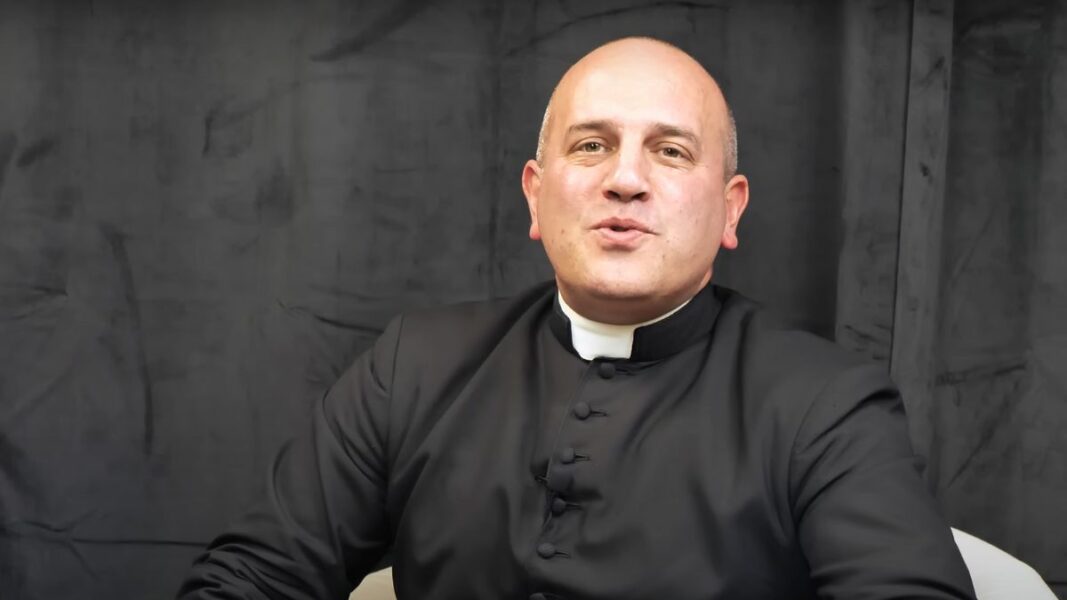
French priest Matthieu Raffray, a member of the Institute of the Good Shepherd (IBP), has lamented the treatment some faithful attached to the traditional liturgy receive and has warned bishops against the risk of alienating a generation of young people who, as he observes in his apostolate, are approaching the Church precisely in search of “the sacred” and a clear transmission of Catholic doctrine.
“They absolutely do not understand why those who appreciate it are treated as second-class Catholics, as barely tolerated, undesirable persons,” Raffray states in an interview given to Tribune Chrétienne on the occasion of the twentieth anniversary of the Institute of the Good Shepherd, which will be celebrated next September 5 in Courtalain, in the French department of Eure-et-Loir.
Raffray maintains that many of the young people who discover the traditional Mass today remain detached from the ecclesiastical disputes of recent decades. “All the young people I meet who are turning toward the faith are indifferent to these rearguard battles they do not understand,” he explains. When they attend the traditional liturgy, he adds, “many find it very beautiful and love the sacred that is manifestly present there.”
For the priest, this reality helps explain the vitality traditional communities maintain: “Young people are seeking the sacred, ritual, that which sanctified past generations and centuries.”
Hence his warning to pastors: “Some bishops should not be allowed, out of ideology, to separate themselves from these souls who thirst for God and reject them through incomprehensible obstacles.”
Trusts in the prudence of Leo XIV
Raffray nevertheless remains cautious regarding the possibility that Leo XIV might soon modify the discipline established during the pontificate of Francis for the celebration of the traditional Mass.
Faced with those who expected a swift decision from the new Pontiff, he believes that studying the situation carefully may prove beneficial. “On the contrary, I think that taking one’s time is a guarantee of prudence. The Pope is taking his time on this question and rightly so, because the problem is very complex,” he states.
He recalls that the circumstances are not identical for traditional communities, diocesan priests, monasteries, and the secular clergy, and therefore considers it unwise to attempt to resolve them through a hasty measure.
His aspiration, he explains, goes beyond a strictly juridical question: “For me, the main issue is to place Tradition—the ritual and sacral character of its rites, its doctrinal demands, and its pastoral wisdom—once again at the center and at the service of the whole Church.”
Raffray also assures that some French bishops have maintained a favorable attitude toward these faithful and that others have recently eased certain restrictions, once again allowing, for example, marriages or baptisms according to the traditional rite. “Unfortunately, others are somewhat entrenched, and it is not very clear why,” he adds.
A generation seeking clear answers
The priest links interest in the traditional liturgy to a broader phenomenon he observes among young people through his pastoral activity and his presence on social media.
In his view, there is “a genuine desire” to receive formation and to hear a presentation of the faith that responds directly to contemporary questions. “Young people are looking for a teaching and an affirmation of the faith that does not fear its own shadow and that answers their questions frankly, without beating around the bush.”
Raffray believes this search can begin along very different paths. Some young people approach the Church after a family loss or a personal crisis; others are initially drawn by “the history of Christian France, its values, and its Christian identity.”
In response to criticisms that label the latter as “identitarian” Catholics, Raffray acknowledges that excesses may exist that require accompaniment and correction, but he rejects disqualifying their approach to the faith on that account.
“All these paths must be welcomed and respected: there is no single path that is worth more than another for leading to Christ,” he affirms.
The Institute of the Good Shepherd turns 20
The statements come as the Institute of the Good Shepherd prepares to celebrate two decades since its canonical erection in 2006. The community was born with five founding priests—Philippe Laguérie, Paul Aulagnier, Guillaume de Tanoüarn, Christophe Héry, and Henri Forestier—and with the support of Benedict XVI.
Raffray summarizes that initiative as the possibility of being “traditional in full right within the Church,” preserving intact attachment to the liturgy and traditional pastoral forms without that calling into question membership in the Catholic Church.
Two decades later, the institute counts, according to figures provided by Raffray, 65 priests present in twelve countries. Its Saint-Vincent-de-Paul seminary in Courtalain currently has 45 seminarians from ten nationalities and expects to receive another twenty at the beginning of October, five of them French.
The twentieth anniversary will be celebrated on Saturday, September 5 in Courtalain with a solemn Mass in the church of Saint-Jean-Baptiste, conferences, and family activities. A Te Deum is subsequently planned in Rome, which, according to Raffray, several cardinals and bishops will attend.
The French celebration will take place three weeks before Pope Leo XIV’s apostolic journey to the country. Raffray has encouraged young people attached to the traditional liturgy to attend the Pontiff’s meeting and hopes his visit will help reduce existing tensions.
“I also hope that he will support, even if discreetly, all those who love the traditional liturgy, so that these divisions, which are too often useless sufferings and obstacles to the mission, may finally come to an end in France,” he concludes.