


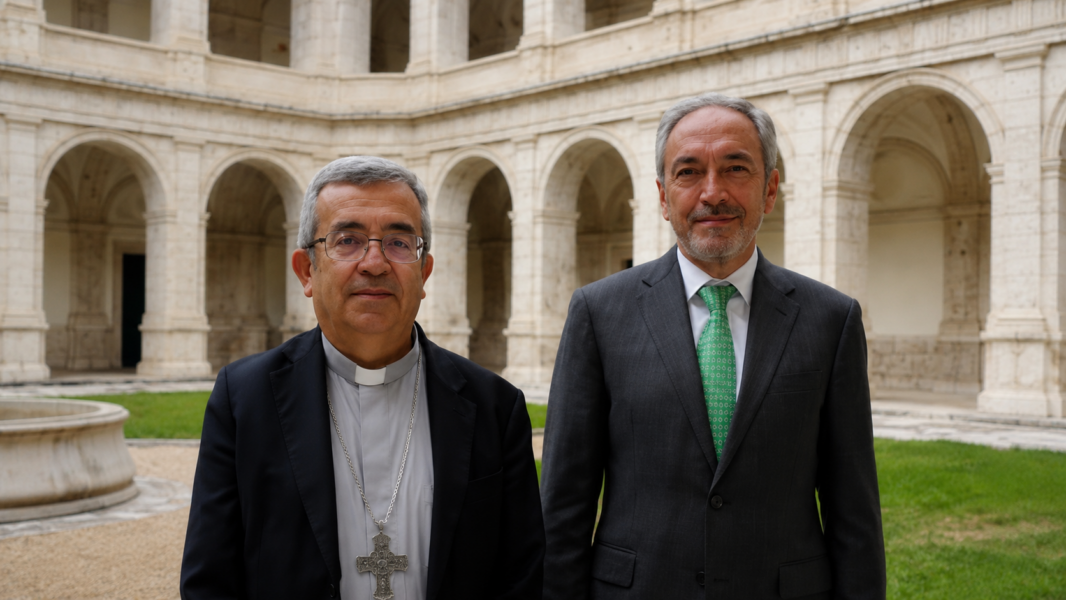
The cause for the beatification of Isabella the Catholic has been part of the agenda of the meeting between the Junta of Castilla y León and Mons. Luis Argüello. The Minister of Culture, Tourism and Sport, Alberto Díaz Pico, conveyed to the Archbishop of Valladolid and President of the Spanish Episcopal Conference on Wednesday, August 26, the Junta’s interest in paying attention to the cause of the Catholic Queen and to her historical and cultural dimension.
The meeting also addressed the commemoration of the V Centenary of the birth of Philip II, which will be celebrated in 2027, and the collaboration between the Junta and the Church to preserve the ecclesiastical heritage of Castilla y León. The encounter is of particular interest in the case of Isabella the Catholic: the Archdiocese of Valladolid is the acting diocese for her cause of beatification, and Argüello has publicly defended on numerous occasions the need to promote it.
A cause linked to Valladolid
The cause of Isabella the Catholic is closely linked to the Archdiocese of Valladolid. The queen died on November 26, 1504, in Medina del Campo, a town in the province of Valladolid, and it is this archdiocese that promotes her beatification process.
The cause formally began in 1958. After an extensive historical and documentary investigation, the diocesan phase concluded in 1972 and the documentation was sent to Rome. The queen subsequently received the title of Servant of God.
The process encountered difficulties years later. In 1991, the Secretariat of State of the Holy See considered that it was not appropriate for the cause to proceed at that time, in a context marked especially by objections related to the expulsion of the Jews from the kingdoms of Castile and Aragon in 1492.
Argüello has insisted that that decision did not mean the closure of the cause. The Archdiocese of Valladolid has continued working to promote it and to deepen the historical study of the queen.
Read also: Argüello sees hope for the beatification of Isabella the Catholic with the new papacy
The Archbishop of Valladolid has also explained that the Dicastery for the Causes of Saints has encouraged continuing to promote devotion to the Servant of God and to continue working on the historical aspects of her figure.
In recent years, the cause has also received new support in Spain and Latin America, while its promoters have insisted on the need to study the actions of Isabella I within her historical context and to clear the objections that have hindered the progress of the process in Rome.
Read also: Rome called her “Catholic” in 1496. Today it halts her beatification for “political prudence”
The fifth centenary of Philip II
Díaz Pico also conveyed to Argüello the Junta’s interest in promoting the commemoration of the V Centenary of the birth of Philip II, which will take place in 2027.
Philip II was born on May 21, 1527, in Valladolid, in the Palacio de Pimentel, and was baptized in the church of San Pablo. The city and the province are already preparing a commemorative program that will begin at the end of 2026 and will be carried out throughout 2027.
Among the initiatives announced by the City Council and the Provincial Council of Valladolid are exhibitions, conferences, concerts, educational activities, and historical reenactments. A reenactment of the monarch’s baptism and the procession from the Palacio de Pimentel to San Pablo is scheduled for June 5, 2027.
The commemoration has an evident religious and heritage dimension due to the close connection of Philip II and the Hispanic Monarchy of his time with the history of the Church and the numerous places related to the monarch that Castilla y León preserves.
Junta and Church will study strengthening the protection of heritage
The third matter addressed by Díaz Pico and Argüello was the conservation of the ecclesiastical heritage of Castilla y León, a region that concentrates a particularly important part of Spain’s religious heritage.
According to the Ministry of Culture, Tourism and Sport, both parties noted the good existing relationship and expressed their willingness to maintain close collaboration on matters related to the culture, heritage, and history of Castilla y León.
The Junta reaffirmed its commitment to collaborate with the Church in the conservation, protection, and enhancement of ecclesiastical heritage. The Ministry will also study formulas to expand and strengthen the current lines of support.