


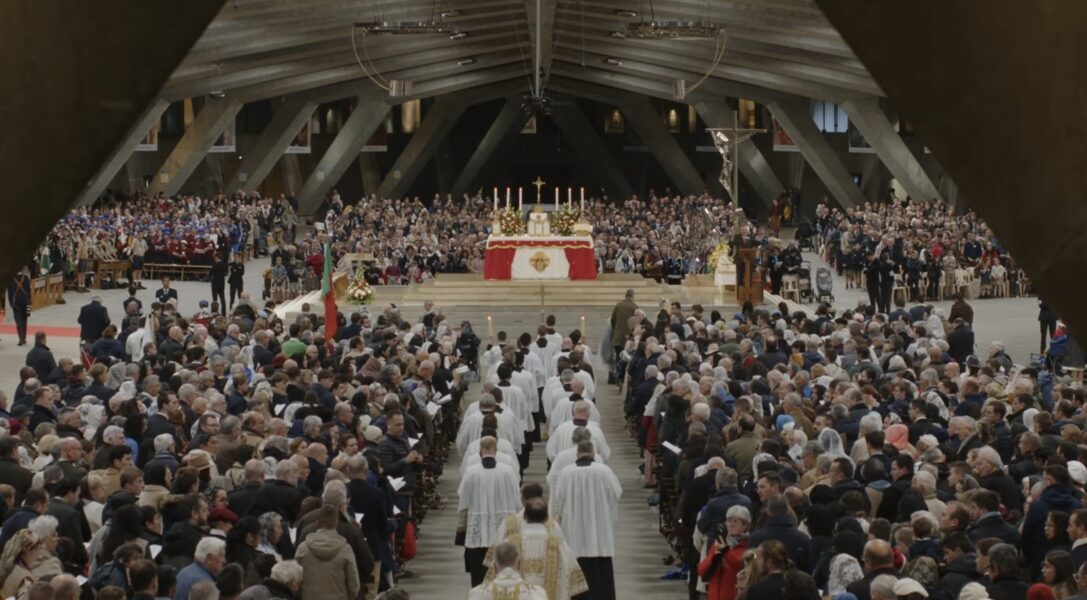
The district of France of the Priestly Fraternity of Saint Pius X (FSSPX) has announced that it will maintain its annual pilgrimage to Lourdes, France, despite the decision of the bishop of Tarbes and Lourdes, Msgr. Jean-Marc Micas, to prevent its priests and faithful from publicly celebrating Mass, the sacraments, and other acts of worship within the Sanctuary grounds.
The response is signed by the superior of the French district, Fr. Gonzague Peignot, who expresses the Fraternity’s “sorrow” and “incomprehension” at the measure announced by Micas on August 13. At the same time, the FSSPX states that it “fully recognizes the authority of the local bishop.”
The decision affects the international pilgrimage the Fraternity had planned in Lourdes from October 23 to 26, 2026. Micas linked the withdrawal of authorizations to the episcopal consecrations carried out by the FSSPX in Écône, Switzerland, on July 1 without a pontifical mandate, and to the canonical consequences subsequently declared by Rome.
The FSSPX recalls the pilgrimage of Christians and Muslims
One of the central arguments of the statement is the different treatment that, according to the Fraternity, the prohibition represents compared to other groups previously welcomed by the Sanctuary.
The FSSPX recalls that in October 2025, Lourdes hosted a four-day pilgrimage that brought together Christians and Muslims around the figure of Mary, with moments of prayer, a Mass, a torchlight procession, prayer at the Grotto, and interreligious encounters.
“How can one not be surprised—even indignant—that those who do not recognize either the divine Motherhood of the Blessed Virgin Mary, or the dogma of her Immaculate Conception, or the divinity of her Son, Our Lord Jesus Christ, were authorized where today a prohibition is issued against the faithful of the chapels of the Priestly Fraternity of Saint Pius X?” the statement asks.
The French district presents itself as composed of “simple sons of the Catholic Church” who do not intend “in any way to replace the Church” and whose sole aspiration, it assures, is to remain faithful to her.
The pilgrimage will go ahead
Micas’s provision allows priests and faithful of the FSSPX to enter the Sanctuary to visit the Grotto and other sites in Lourdes and to pray privately. What is excluded is the organization of public celebrations of the Fraternity within the grounds.
The French district has announced that it will avail itself of this possibility and will continue to travel to Lourdes each year.
“Our Lady does not deserve, in effect, to be abandoned despite the obstacles,” the statement maintains. “If the doors of the Sanctuary remain closed to a public pilgrimage, the door of the Heart of the Mother of God never closes to her children.”
The Fraternity also assures Micas of its “respect” and its prayers “without resentment,” and expresses the hope that the bishop will one day come to recognize in its members “not rebels, but sons desirous of living and serving in the Catholic Church.”
Gleize: “Is it really he who decides?”
Following the statement, Fr. Jean-Michel Gleize, a priest and theologian of the FSSPX, addressed the prohibition during a sermon delivered on Sunday, August 23, at Saint-Nicolas-du-Chardonnet in Paris (France).
Gleize directly mentioned Micas, though he introduced a doubt about the origin of the decision: “His Excellency the bishop of Tarbes—is it really he who decides? Above him is the Episcopal Conference, it is synodality—his Excellency the bishop of Tarbes denies us access to the Sanctuary of Lourdes.”
The priest did not develop this claim or provide evidence of any intervention by the French Episcopal Conference in Micas’s decision.
His sermon then focused on urging the faithful to face the restrictions without “bitterness” and from faith. To illustrate this, he recounted the story of a little girl who received new shoes and, after complaining that the right one hurt her, rejoiced because the left one did not.
“Let us learn to look with the eyes of a child and remain always in thanksgiving. The goodness of God is always at work in our souls,” he stated.
“We have the Virgin Mary”
Gleize acknowledged that this year the pilgrims might not enter the Sanctuary under the same conditions as before, but maintained that material restrictions cannot affect what they consider part of their faith.
“We believe that She is the Mother of God. We believe that She is the Immaculate Virgin. We believe that She is Co-Redemptrix. We believe that She is Mediatrix of all graces. And that no one, no excommunication, can ever take from us,” he declared.
The priest insisted that, although they may not have “those churches, those sanctuaries built by our ancestors to venerate the Virgin Mary,” they retain their devotion: “We have the Virgin Mary. She remains in our heart, she remains in the sanctuary of our soul.”
Gleize concluded his remarks by asking that the situation not generate resentment among the faithful. “This must banish from our heart every kind of bitterness,” he noted, before exhorting them to ask for “greater faith, greater hope, and greater charity.”
The official statement from the district, for its part, concludes by reaffirming the purpose for which the FSSPX was founded by Msgr. Marcel Lefebvre in 1970: to transmit doctrine, the sacraments, and the Christian life. Peignot cites a letter addressed by the superior general of the Fraternity, Fr. Davide Pagliarani, to Leo XIV on November 21, 2025, in which he stated that the FSSPX does not intend to preserve “a museum of old things,” but rather “the integral Tradition, fruitful, a source of spiritual life, embodied and lived in souls.”