


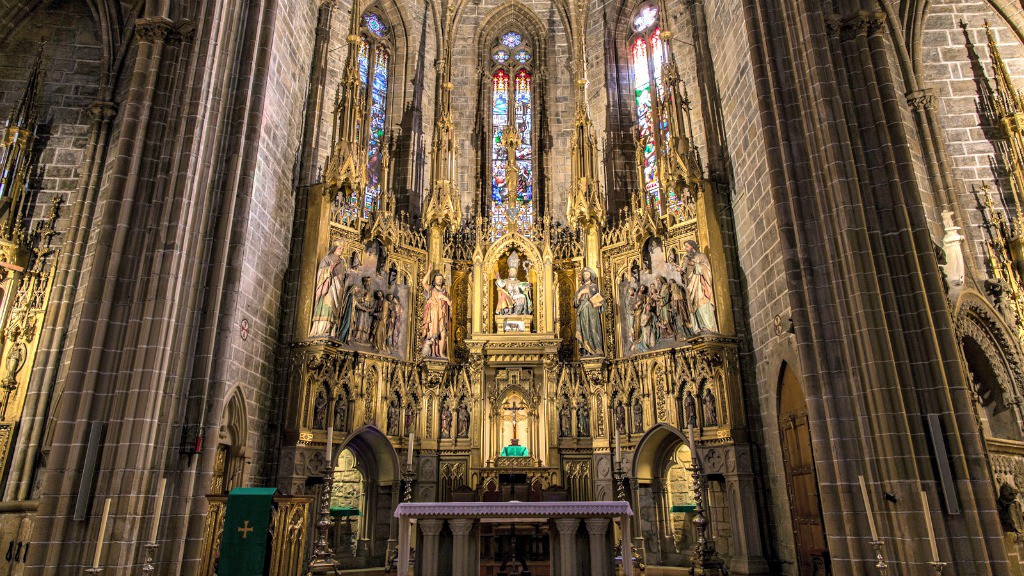
The parish of San Saturnino de Pamplona, in Navarra, celebrates this week the 250th anniversary of the Chapel of the Virgen del Camino, a historic Marian devotion venerated in the city and honored since 1987 with the title of “Queen and Lady of Pamplona.” The events will culminate this Sunday, August 30, with a solemn Mass and a procession through the streets of the Old Town.
The commemoration coincides this Tuesday, August 25, with the exact 250 years since the inaugural blessing of the chapel. Although the architectural works were practically completed years earlier, the construction and decoration of the complex extended between 1758 and 1776, and it was on August 25 of that year when the then bishop of Pamplona, Juan Lorenzo de Irigoyen y Dutari, presided over its inauguration.
A week of celebrations
The parish has organized a novena that began on Monday, August 24, and will continue until Tuesday, September 1, every day at 7:00 p.m. in the church of San Saturnino.
This Tuesday, the Eucharist will be presided over by the archbishop of Pamplona and bishop of Tudela, Msgr. Florencio Roselló Avellanas. On Saturday the 29th, it will be presided over by Msgr. Santos Montoya Torres, bishop of Calahorra and La Calzada-Logroño.
The central event will take place on Sunday, August 30, at 12:00 p.m., with a commemorative solemn Mass followed by a procession through the Old Town of Pamplona.
The Sunday celebration will also serve as a farewell for César Magaña Felipe, parish priest of San Saturnino since 2020, who will preach that day before leaving the parish.
During the rest of the novena, priests from various parishes in Pamplona will participate. The cycle will conclude on September 1 with Miguel Larrambebere Zabalza, vicar general of the archdiocese.
A devotion linked to Pamplona for centuries
The history of the Virgen del Camino in Pamplona predates the construction of her current chapel by a considerable margin.
According to tradition, the Romanesque image, polychromed and covered in silver, appeared in 1487 on a wooden beam located in the upper part of the presbytery of San Saturnino and is said to have miraculously arrived from Alfaro, in La Rioja. Historical documentation later confirms its presence in a niche of the old Gothic cloister.
The devotion grew over the following centuries. The Virgin was also invoked in rogations, for which documented testimonies exist from 1719, 1724, 1728, 1738, and 1770.
The increase in devotion and the deterioration of the old cloister led to the construction of a larger space to house the image.
A chapel built with the help of the faithful
On May 7, 1758, the demolition of the cloister, the cemetery, and the old Chapel of Santa Ana began, and on June 10 the first stone of the new complex was laid. The works lasted nearly two decades.
Part of its funding came from the raffle of jewels offered to the Virgin, contributions from the Works of San Saturnino and the residents of the old burgh of San Cernín, as well as money sent by Pamplonese and Navarrese living outside their homeland.
The result was a large chapel with a Greek cross floor plan, 21 meters wide and 29 meters long, presided over by a central dome accompanied by four smaller ones.
The complex was initially decorated in the Rococo style, although part of that ornamentation was replaced in 1805 by a more sober and classicist style that has survived to the present day.
An altarpiece dedicated to the Virgin and her family
The image of the Virgin presides over the great Baroque altarpiece, accompanied by Saint Joachim and Saint Anne, her parents.
The iconographic program includes the four cardinal virtues—fortitude, prudence, justice, and temperance—and an image of Saint Joseph at the top. The ensemble culminates with the representation of the Eternal Father among rays and seraphim.
In the lower part are, among other pieces, a carving of the Immaculate Conception and another of Saint Teresa of Jesus, belonging to the Neapolitan school. Behind the altarpiece, a Rococo-style camarín was also built for the Marian image.
“Queen and Lady of Pamplona”
The connection of the Virgen del Camino with the Navarrese capital was formally recognized in 1987, when the then archbishop José María Cirarda conferred upon her the title of “Queen and Lady of Pamplona”.
Two and a half centuries after the inauguration of her chapel, the parish of San Saturnino once again brings the celebration to the streets with the procession on Sunday, within a week dedicated to remembering a devotion whose documented presence in Pamplona dates back several centuries.