


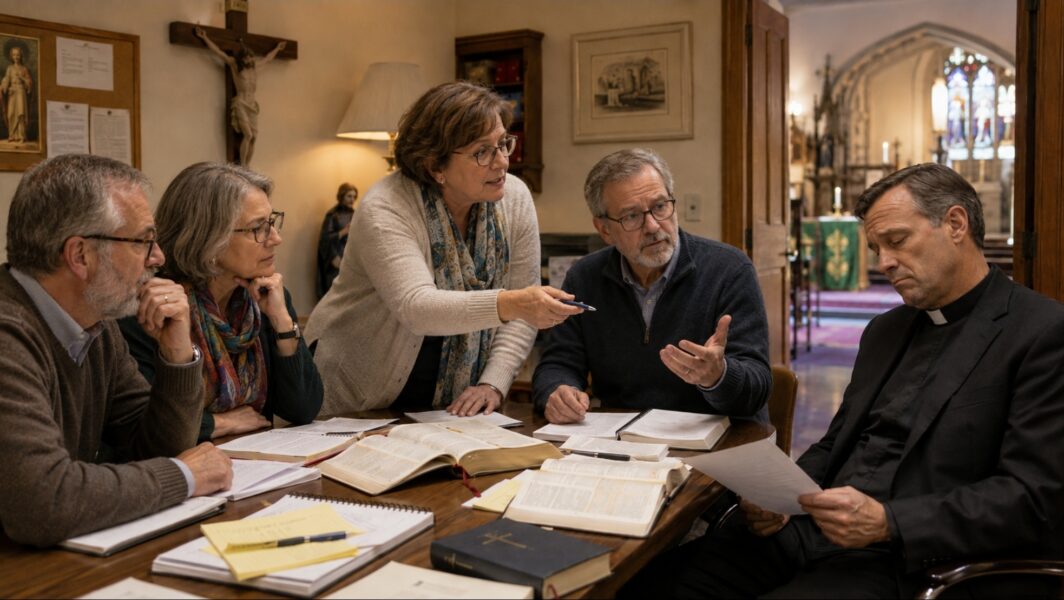
Two months after the Dicastery for Divine Worship closed the door to lay preaching at Mass requested by the German bishops, the magazine Vida Nueva —published by PPC and widely distributed within the official structures of the Church in Spain— publishes an opinion piece proposing to transfer the preparation of the homily to a “Parish Liturgical Council” coordinated by laypeople. The author acknowledges from the outset that she sets aside the arguments from Rome.
The opinion piece, titled “Synodal Homilies” and published on August 19, is signed by Argentine theologian Carolina Bacher Martínez and has also been shared on social media by Venezuelan theologian Rafael Luciani, expert of the General Secretariat of the Synod and advisor to CELAM and CLAR.
The “no” from Rome that the opinion piece chooses to sidestep
The context is well known. On March 30, the German Episcopal Conference —endorsing a resolution of the Synodal Way— requested an indult from Rome allowing laypeople with theological formation to preach at the Eucharist in “exceptional circumstances.” The response from the Dicastery for Divine Worship, signed by Cardinal Arthur Roche and addressed to Bishop Heiner Wilmer on June 17, was unequivocal: the reservation of the homily to the priest or deacon (can. 767 § 1) “is not merely a disciplinary norm, but derives from the very nature of the liturgy,” and therefore admits no dispensation. The homily, Rome recalled, is an exercise of the munus docendi entrusted to ordained ministers by the sacrament of Holy Orders, and neither better theological preparation nor greater communicative skills of the laity justify delegating it to them. The Dicastery even rejected the terminological subterfuge proposed by the Germans —distinguishing between “homily” and a lay “preaching” placed after the Gospel— because it substantially coincides with the homily itself.
Despite the forcefulness of the refusal, in Germany the matter was not considered settled: recent statements by German bishops point to an attitude of explicit insubordination regarding this mandate from Rome.
The proposal: the priest delivers, the community prepares
It is in this scenario that the Vida Nueva opinion piece appears. Its author explicitly states that the reflection “will set aside this exchange and the foundations that support it.” In other words: it does not discuss Rome’s arguments, it simply sets them aside in order to “imagine what steps are possible” in applying the Final Document of the Synod on Synodality.
The concrete proposal consists of reconfiguring the usual parish liturgy group as a “Parish Liturgical Council” that, “presided over by a presbyter or deacon,” would assume as its central task “the communal prayerful discernment of the biblical texts” for the homily, whether daily, Sunday, or for major feasts. The text speaks of “homilies in differentiated co-responsibility,” calls for prioritizing the presence of women and young people in these councils, and suggests entrusting the “coordination of the space” to “lay theologians, religious, or lay ministers,” articulating “the role of presidency with that of coordination.” All of this is interspersed with citations from the Final Document (DF 67, 103, 106, 142, and 144).
The formula attempts to circumvent the letter of canon 767: it would be the ordained minister who delivers the homily. But its preparation —the discernment, the content, the orientation— would pass to a communal body coordinated by laypeople. Precisely what Cardinal Roche’s letter excluded when it recalled that, for the priest, “the preparation and proclamation of the homily constitute an integral part of his priestly ministry and spirituality, and cannot be separated from them.” What Rome denied at the front door in Berlin is now proposed to be brought in through the back door of “synodality,” with the priest reduced, in practice, to a spokesperson for what has been discerned by a council.
Who is Vida Nueva
Vida Nueva is not a marginal medium nor one alien to ecclesial structures. Founded in 1958, the magazine is published by PPC, the religious publishing house of the SM Group —an institution linked to the Marianist religious— and enjoys wide distribution within the Spanish ecclesial circuit: it is distributed in dioceses, parishes, and religious communities, its awards and events regularly feature the participation of bishops and cardinals, and its pages regularly host contributions from the episcopate and the curia. In short, it is a medium that lives within the perimeter of the official Church in Spain, although with an editorial line clearly identified with the progressive wing and with maximum enthusiasm for the synodal process. That it is precisely this outlet, and not a dissenting bulletin, that publishes a proposal circumventing an express and recent refusal from the Holy See, gives relevance to the gesture and places Spanish synodalism behind Germany in the race to dismantle the priesthood and the Mass.
Who is the author
Carolina Bacher Martínez is a laywoman, doctor in Pastoral Theology from the Catholic University of Argentina, where she serves as associate professor in the postgraduate program. Her doctoral thesis was directed by priest Carlos María Galli, one of the Argentine theologians closest to the pontificate of Francis and to Cardinal Fernández. She is a member of the Theological-Pastoral Reflection Team of CELAM for the 2024-2028 period, a member of Teologanda —an association of feminist-profile theologians—, has been vice president of the Argentine Society of Theology, and participated in drafting the Argentine report for the Synod on Synodality. Her academic production revolves around “pastoral theology in a synodal key” and ecclesial participation bodies: the Vida Nueva opinion piece is, in fact, the popular translation of her research program.
Her profile, together with the dissemination given to it by Luciani, places the proposal at the heart of the CELAM-Synod theological network. After Rome’s rejection in Berlin, the debate on the role of the laity in preaching has not been closed: from the Spanish-speaking world, an indirect path is now being tested that, in a surreptitious way, empties of content what the Holy See has just reaffirmed as inseparable from the ordained ministry and seeks to collectivize a task that is intrinsically priestly.