


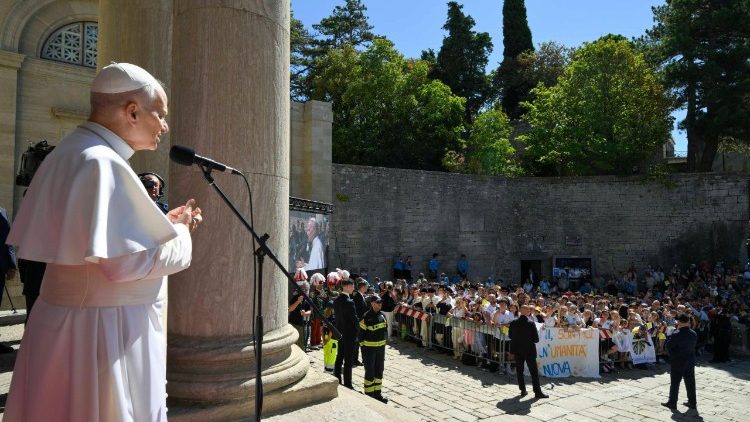
The pastoral visit of Leo XIV to San Marino and Rimini this Saturday, August 22, left an extensive series of interventions in which the Pontiff addressed issues ranging from the defense of life and the family to education, vocations, the evangelization of secularized societies, the exercise of authority, and synodality.
Before the authorities of the Republic of San Marino, the ecclesial community of the diocese, the young people, the participants of the Meeting for Friendship among Peoples organized by Communion and Liberation, and finally the faithful gathered for Mass at the port of Rimini, Leo XIV made some of the most significant statements of the day.
Life, from conception to natural death
Before the authorities of San Marino, Leo XIV placed the defense of life among the obligations of a society that wishes to put the care of the person at its center.
“The protection of all life, in each of its stages, from conception to natural death.”
The Pope linked this principle to the need to build a society capable of recognizing the other “as a face and not as a function,” even in the face of technological advances.
Freedom and conscience
Reflecting on Libertas, the historic motto of San Marino, the Pontiff maintained that political independence is not enough to guarantee a truly free society.
“There is no true civil freedom without personal freedom, that is, without respect for and the promotion of the dignity of the human person.”
Leo XIV connected this freedom with respect for conscience and recalled those who suffer consequences for remaining faithful to it.
“We express our solidarity with those who, at this moment, personally pay the price for not having betrayed their own conscience.”
True freedom is found in Christ
In his subsequent greeting to the young people gathered in San Marino, the Pope brought the reflection on freedom into explicitly Christian territory.
“True freedom is found only in Jesus Christ; it is found in the truth.”
Leo XIV contrasted this freedom with “a world often full of lies, full of deceptions” and encouraged the young people to listen to what Christ wants to say to each one of them.
Parents, the first responsible for transmitting the faith
During his meeting with the ecclesial community of San Marino-Montefeltro, the Pontiff highlighted the role of priests, catechists, and educators, but placed the responsibility of parents first.
“Parents [are the] first responsible for the education in the faith of their children.”
And he defined the proper place of that transmission:
“The family is the first place of formation in the faith, the natural womb in which the Gospel is learned and breathed daily from childhood.”
Leo XIV therefore called for a “strong formative synergy” between families and ecclesial communities.
Marriage, consecrated life, and priesthood: “Do not be afraid”
The Pope also issued a call to young people to discover their vocation and take on definitive commitments.
“Do not be afraid to make demanding decisions, such as marriage, consecration, ordained ministry, professional life, social and political commitment.”
He asked them to recognize God’s particular call and to place the gifts they have received at His service.
“Let us free education from ideology”
In Rimini, before the Meeting for Friendship among Peoples, Leo XIV delivered one of the most forceful exhortations of the day.
“Let us free coexistence from suspicion, culture from arrogance, education from ideology, work from the idolatry of profit, technology and finance from the business of death.”
The Pontiff also called for “unmasking unjust power relations” that lie at the root of poverty, inequalities, war, and environmental disasters.
Evil is not fought with evil
In the same speech, Leo XIV contrasted the logic of power with a response based on mercy.
“Evil is not fought with evil.”
And in the face of contemporary “false realism”:
“To the false realism that rearms minds, words, and nations, Catholic culture today must oppose the realism of mercy.”
The future is not a threat
To the young people present at the Meeting, many of them volunteers, Leo XIV addressed a message of hope.
“You are a sign that the future is a promise, not a threat.”
At the same time, he asked that their belonging to movements and communities not end up enclosing them:
“The Movement, the groups, the communities should be a springboard from which to launch yourselves into all of reality.”
Thousands of young people ask for Baptism
Addressing secularization, Leo XIV drew attention to young people who are approaching Christianity.
“It is moving to see the thousands of your peers who are asking for Baptism in societies considered among the most secularized in the world.”
For the Pope, however, the numerical data was not the essential point:
“It is a question of freedom: truth is found only in freedom.”
The Church grows “by attraction”
Leo XIV also took up a well-known formulation used by his predecessors when speaking of evangelization.
“The Church does not proselytize. It grows rather by attraction.”
The Pontiff suggested that “a certain loss of influence” that some adults had “feared and fought” could help rediscover the proper strength of the Gospel and the bonds it generates.
“Always love the Church!”
In an exhortation directed specifically at Communion and Liberation, the Pope insisted on ecclesial communion.
“Always love the Church! Love and preserve unity.”
And he later specified that unity:
“With those who are called to lead the Movement, with the Apostolic See that has recognized you, and with the Successor of Peter.”
What Leo XIV understands by synodality
The Pope linked the renewal of ecclesial movements with the synodal dimension of the Church and formulated an especially explicit definition:
“Synodality is not the name of a process, but the nature of a people who, in friendship and in encounter with the other, perceive that they belong only to God.”
Leo XIV added that this walking together must take place “under the guidance of the pastors” and explained what the place of authority should be:
“Authority becomes service, which honors differences and facilitates their harmony.”
The sick, persons with disabilities, and the poor, at the center
During his meeting in the Cathedral of Rimini with people assisted by Caritas, Leo XIV recalled Christ’s behavior toward those who suffered.
“Jesus, when He encountered sick people, or people with disabilities, or the poor, welcomed them and placed them at the center.”
The Pope explained that Christ acted this way “to heal them, to restore to them a life in accordance with their dignity,” and encouraged those present to participate actively in the life of the Church.
Authority in the Church is service
At the Mass celebrated at the port of Rimini, Leo XIV began from the handing over of the keys to Saint Peter to refer directly to the exercise of ecclesial authority.
“In the Church, at every level, authority is service.”
The requirement, he specified, begins with the hierarchy itself:
“The Pope, the bishops, the priests, and the deacons are the first ones called to live it this way.”
Ambition, greed, and abuse of power
The Pope illustrated his reflection on authority through the biblical figure of Shebna, an official of King Hezekiah.
“Through ambition and greed, this powerful man had begun to abuse the authority conferred on him, accumulating wealth for himself and for his circle of friends and relatives, and lording it over the people.”
Leo XIV also recalled what the consequence was:
“For this he was removed from office and his mission entrusted to Eliakim, an honest man free from conditioning.”
Amusements that leave the heart empty
Finally, speaking of Rimini as a tourist destination, the Pope distinguished true rest from certain contemporary forms of entertainment.
“The world in which we live offers many forms of amusement, some of which, however, lead more to dispersion and ruin than to a true ‘coming to oneself,’ and leave emptiness in the heart.”
Leo XIV questioned a conception of amusement as “escape,” “as if ordinary life were a prison from which to flee,” and pointed out that true rest also requires interior recollection and an encounter with God.