


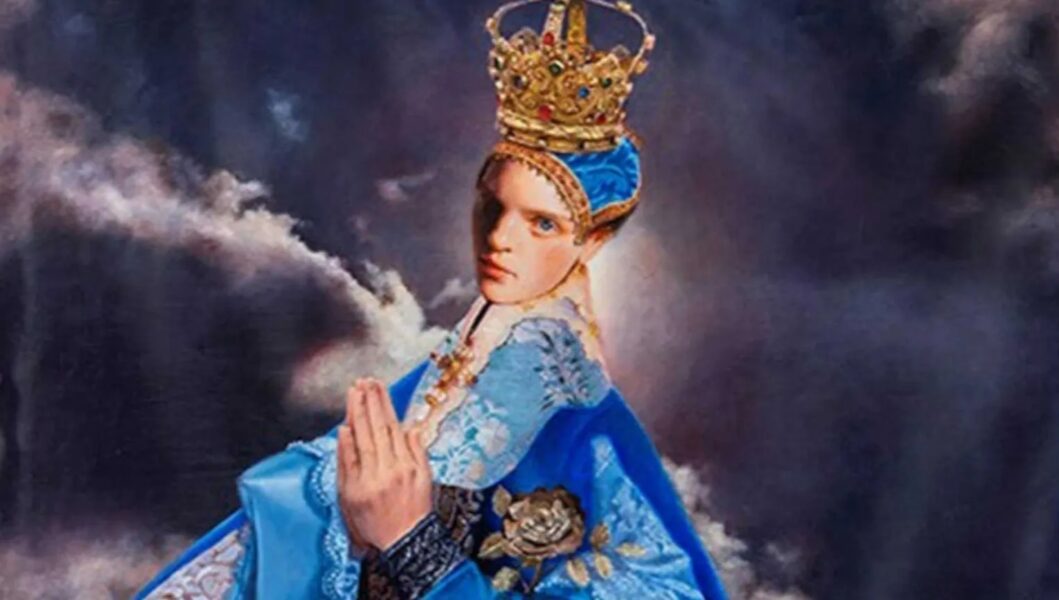
The image of the Virgin chosen for the Drappellone of the Palio of the Assumption in Siena has sparked controversy due to its androgynous features and its departure from traditional Marian iconography. Cardinal Augusto Paolo Lojudice, Archbishop of Siena, has himself acknowledged that the representation “reflects neither the canons of cultural tradition nor those of devotion,” while the archdiocese has called for prior dialogue in the future regarding a work that, though not an object of worship, it considers “certainly more sacred than profane.”
The work is by Romanian artist Teodora Axente and will be awarded to the victorious contrada of the Palio dedicated to the Virgin of the Assumption, whose race had to be postponed for two days due to weather conditions. La Nuova Bussola Quotidiana has reported on the controversy surrounding Mary’s face and the various ecclesial reactions to a representation that the artist herself defines as her personal vision of the Virgin.
A Virgin removed from traditional iconography
The City Council of Siena commissioned Axente to create the Drappellone for the August Palio, a silk piece popularly known as the cencio, which serves as the prize for the winning contrada. The August Palio is traditionally dedicated to the Virgin of the Assumption and forms part of a celebration in which the civil and popular dimensions maintain a close historical connection with religious devotion.
The work features in its upper section a figure of Mary with a serious expression, short hair, and features that have sparked debate over their androgynous character. In the lower section, references to Siena and its contrade appear, while the composition also commemorates the fifth centenary of the Battle of Camollia, in which Sienese forces defeated their Florentine and papal adversaries in 1526.
When announcing the commission, the City Council had presented Axente as an artist whose work is inspired by her family, her religious faith, and her knowledge of art history. Born in Sibiu, Romania, in 1984, her painting combines traditional references with surrealist elements and places special emphasis on the transformation of the human figure.
The artist herself has explained the personal meaning of her representation: “This is the Virgin I dream of, it is my vision of the Virgin.”
The issue raised by the work, however, is not limited to artistic taste. The Drappellone of the August Palio must represent the Virgin of the Assumption and is integrated into religious ceremonies within a tradition that the City Council itself describes as a combination of popular expressions, celebrations, and Marian devotion.
Cardinal Lojudice: “It does not reflect the canons of tradition”
Cardinal Augusto Paolo Lojudice addressed the controversy in an interview with La Nazione. Although he refrained from entering into a definitive discussion about the possible androgynous character of the figure, he openly acknowledged its distance from Marian tradition.
“It is a Virgin that reflects neither the canons of cultural tradition nor those of devotion, of the expression of the Madonnas as we are accustomed to and as would be right to express,” the archbishop stated.
Lojudice added that he personally perceives a “very somber” Virgin, although he admitted that others may interpret the work differently.
The cardinal did not attribute a provocative intention to Axente, but he did raise the need to review the procedure followed for such commissions. In his view, it would be advisable for the Church to be able to intervene during the preparation phase of the work and not only once it is already completed.
“One cannot go each time with fingers crossed, saying: ‘Let’s see what comes out,’” he stated.
The issue has a practical consequence for the archdiocese, since the Drappellone subsequently participates in religious ceremonies and is traditionally blessed before the race.
The archdiocese admits that “the results have not met” expectations
The Archdiocese of Siena-Colle di Val d’Elsa-Montalcino also issued a statement signed by Father Enrico Grassini, which adopts a cautious stance regarding the artist’s intention but acknowledges the problem raised by the outcome.
Grassini recalled Axente’s cultural formation, shaped since childhood by the Orthodox churches of Romania and the tradition of Byzantine icons, as well as her knowledge of Siena’s artistic heritage. For this reason, he considers that the language of provocation is foreign to the intention of the work.
This does not prevent him, however, from admitting that “the premises were there, but perhaps the results have not met expectations.”
The statement also raises an essential question about the nature of the Drappellone. “It is not a sacred image before which to pray, but is itself a prayer addressed to the Virgin,” Grassini explains. For this reason, although the piece does not in itself constitute an object of worship, it possesses a character that is “certainly more sacred than profane.”
The archdiocese believes that these particularities should be explained to the artist before the work is conceived, to avoid the problem arising only once the final result has already been publicly presented.
A blessing without directly sprinkling the “Drappellone”
The controversy also reached the traditional religious ceremony preceding the Palio. On the eve of the Solemnity of the Assumption, the Procession of the Candles and Censers carried the Drappellone to Siena Cathedral.
Lojudice had anticipated that he saw no reason to refuse to bless an assembly simply because the controversial work was present. In the end, he opted for that formula.
During his address, he did not directly engage with the controversy. Pointing to the image of the Madonna del Voto located in the cathedral, he reminded those present that “it is she and she remains the only important image to turn to and toward which to direct our devotion.”
He then imparted the blessing to those present without approaching the Drappellone or sprinkling the piece directly, unlike what has occurred in other editions.
This would not be the first controversy of its kind in Siena. In 2018, then-Archbishop Antonio Buoncristiani decided not to bless directly another disputed Drappellone, created by Belgian artist Charles Szymkowicz.
“Christian iconography does not arise from a creative whim”
The discussion has also extended into the theology of sacred art. Father Paolo Morocutti has pointed out in statements reported by the SIR agency that a distinction must be made between purely aesthetic judgment, which is necessarily subjective, and the suitability of a representation to Christian iconography.
For Morocutti, there exists “a second level of judgment that is not a matter of opinion”: that corresponding to “codified Christian iconography, which does not arise from a creative whim, but from centuries of theological, liturgical, and conciliar reflection.”
The priest considers that the Christian traditions of East and West have historically developed recognizable characteristics in the representation of the Mother of God. In the face painted by Axente, he specifically misses “that specific femininity that Christian iconographic orthodoxy” has traditionally attributed to the Virgin.
The debate thus raises a question that goes beyond determining whether the work is aesthetically appealing. The City Council may commission the Drappellone from contemporary artists—Axente was selected by the municipal council in January—but the piece is not a work entirely detached from its purpose: it is created for a Palio dedicated to the Assumption and must contain a representation of the Virgin.
The recent history of the Palio shows that the use of contemporary languages does not necessarily require dispensing with a recognizably Marian representation. In the official descriptions of previous years’ Drappelloni, the Virgin appears explicitly as the center of the composition and linked to the iconography of the Assumption.
This year’s controversy therefore leaves an open question for future editions: how far does the artist’s interpretive freedom extend when the commissioned work not only participates in a popular festival, but must also represent the Mother of God within a centuries-old religious tradition.