


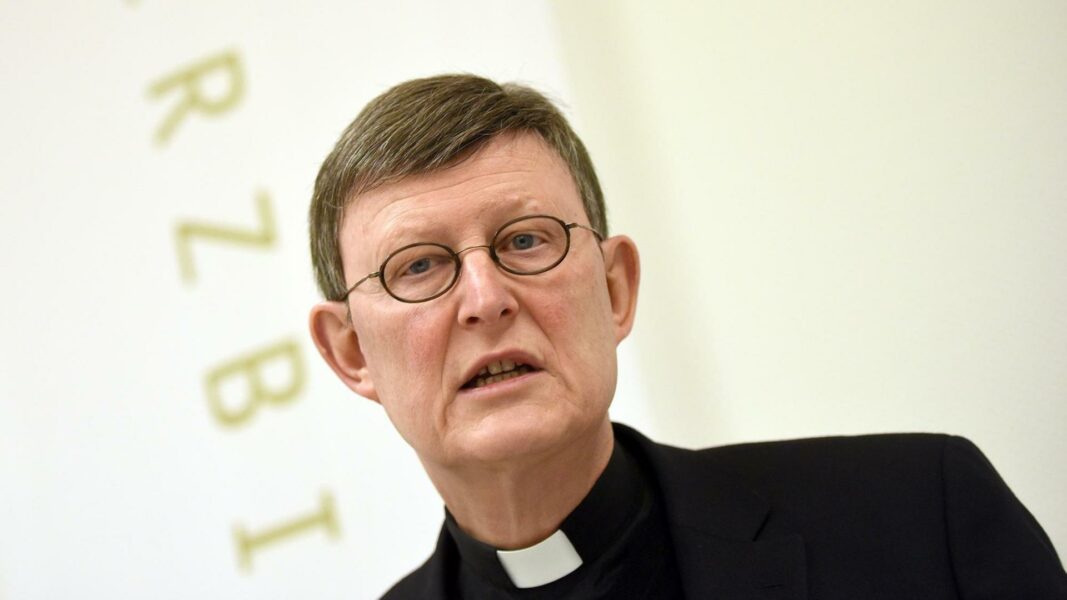
Cardinal Rainer Maria Woelki, Archbishop of Cologne, has called for a clear definition of synodality for the entire Church and has once again distanced himself from the model developed in Germany. Coinciding with his 70th birthday, which he celebrates this Tuesday, August 18, the prelate stated that the German process placed emphasis on structures of participation and co-governance to the point of losing sight of the Church’s hierarchical and sacramental constitution.
In an interview granted to Die Tagespost and published on Monday, Woelki maintains that “one of the great challenges consists in defining for the universal Church what synodality is.” The Archbishop of Cologne, one of the main critical voices within the German episcopate regarding the Synodal Path, also links this issue to evangelization and hopes that Rome will introduce the “necessary corrections” to the proposals coming from Germany.
“It is not our Church, but His Church”
Woelki points out that Leo XIV presents synodality and evangelization as two closely related dimensions. “Synodality is a tool for evangelization and mission,” he states, defining it as a spiritual path of seeking in the Holy Spirit and of discernment.
The problem, in his view, arises when this concept is transferred primarily to the realm of power structures. Referring to the German Synodal Path, the cardinal maintains that it was especially marked by the attempt to implement “certain formats of participation and forms of co-governance.”
“In doing so, we overlooked the fact that the Church is hierarchically structured and sacramental,” he warns. He adds a clarification that lies at the heart of his critique: “It is not our Church, but His Church. We all live under Christ as head and under the Word of God.”
For this reason, Woelki considers that synodality cannot consist in deciding what kind of Church one wants to build, but rather in “recognizing what the Lord wants from us.”
The cardinal’s position remains consistent with the line he has defended in recent years. In January, he stated that, for him, the German Synodal Path was “closed” and expressed his reservations about the creation of permanent structures that would extend the process.
Read also: Woelki: “For me, the Synodal Path is closed”
Awaiting the “corrections” from Rome
The statements take on special relevance as the future of the so-called Synodal Conference remains pending—the body formed by bishops and laity intended to give institutional continuity to the Synodal Path.
Its launch will likely not take place in November, as initially planned, due to the examination of its statutes by the Holy See. The President of the German Bishops’ Conference, Georg Bätzing, had already acknowledged that the new structure would not begin functioning without Rome’s approval.
Woelki now recalls that it is up to the Magisterium to determine “what constitutes the faith and doctrine of the Church and what belongs constitutively to its apostolicity and catholicity.”
The cardinal also echoes Bätzing’s assertion that Germany must remain united with the universal Church and that “there will be no special German path.” Precisely for this reason, he considers it positive that the work carried out has been submitted to the Pope.
“Now we await to see where the Holy Father and his collaborators make the corrections that, in my judgment, are necessary,” he states.
The conflict is not new. Woelki, together with Bishops Gregor Maria Hanke, Stefan Oster, and Rudolf Voderholzer, refused to participate in the Synodal Committee tasked with preparing the new structures, following repeated objections raised from Rome.
The debate on the limits of the German process
The underlying question remains how far a national synodal structure can go without altering the proper competencies of bishops or contradicting the sacramental constitution of the Church.
Tensions have recently resurfaced in specific matters. Last June, after Rome rejected the possibility of laypeople delivering the homily during Mass, organizations linked to the Synodal Path called for keeping the debate open and raising the issue again with the Holy See.
In contrast to a conception of synodality focused on new structures of participation and decision-making, Woelki once again places the debate on another level: synodality as an instrument at the service of mission and subject to doctrine, to the hierarchical constitution of the Church, and to the discernment of God’s will.