


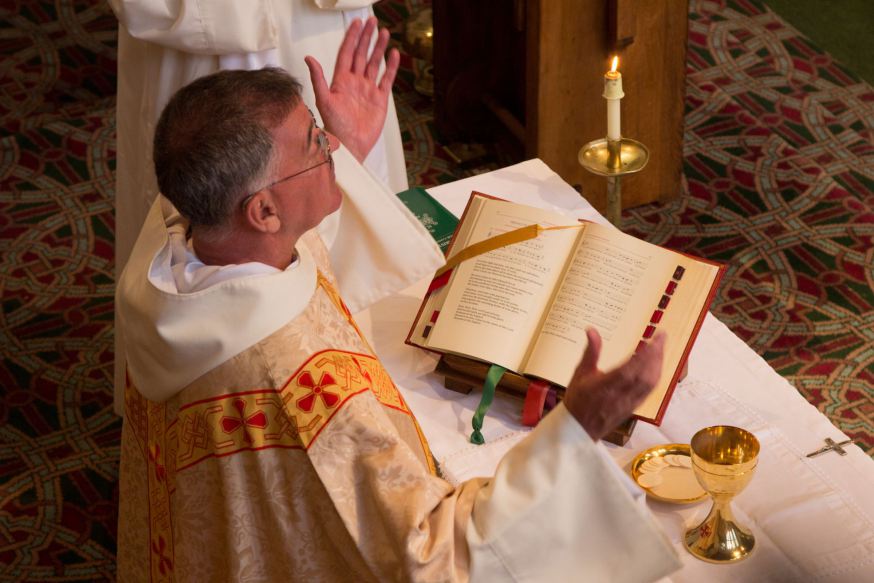
Eucharistic Prayer II, one of the formulas most widely used today in the celebration of the Mass, was not a translation of the ancient prayer attributed to Hippolytus of Rome, but a new composition drafted during the liturgical reform following the Second Vatican Council. This is shown by the testimonies of Annibale Bugnini and Louis Bouyer, direct protagonists of that reform, now recovered in a study on the historical origins of this prayer.
The work, signed by Ignacio Gallardo Tampe and published by New Liturgical Movement, compares the text of Eucharistic Prayer II with the anaphora contained in the so-called Apostolic Tradition. The research also recalls that the identification of the latter with Hippolytus of Rome and with the Roman liturgy of the third century, widely accepted for much of the twentieth century, has subsequently been questioned by numerous specialists.
Bugnini acknowledged that it was not a new edition of Hippolytus
Annibale Bugnini, secretary of the Consilium ad exsequendam Constitutionem de Sacra Liturgia and one of the principal figures of the liturgical reform, expressly explained that the new prayer only took the anaphora attributed to Hippolytus as a model.
“The aim was to produce an anaphora that was brief and very simple in its ideas,” Bugnini wrote when explaining its elaboration.
The person responsible for the reform himself specified that Eucharistic Prayer II “is not, so to speak, a new edition” of that ancient prayer.
The original structure could not be preserved in its entirety because it lacked elements that the Consilium considered necessary in a Roman Eucharistic prayer, among them the Sanctus, a consecratory epiclesis before the institution narrative, the intercessions, and the commemoration of the saints.
Some expressions from the ancient text that Bugnini considered “archaic or difficult to understand” were also eliminated or reformulated.
Bouyer: completed on a terrace in Trastevere
The most striking testimony comes from Louis Bouyer, the French theologian who participated directly in drafting Eucharistic Prayer II together with Dom Bernard Botte.
In his memoirs, Bouyer described the working conditions in especially critical terms and spoke of the “deplorable conditions” in which that phase of the reform took place.
According to his own account, he and Botte had to prepare with great haste a new prayer that would incorporate certain elements of the ancient anaphora and, at the same time, add others that were not present in it.
Bouyer recalled that both men finished adjusting the text on the terrace of a café in Trastevere, Rome, in order to present it within the established deadline.
He later described the result as an “improbable composition” and maintained that some of its “incredible weaknesses” could provoke “ridicule or indignation.” At the same time, he acknowledged that the prayer also contained valuable elements that, in his judgment, should be preserved in any future revision.
The value of this testimony lies in the fact that it does not come from an external critic of the reform, but from one of the men personally charged with drafting the text.
Two texts with substantial differences
The comparison carried out by Gallardo shows that there are coincidences between the two prayers, but also important modifications.
The so-called anaphora of Hippolytus contains the initial dialogue, a thanksgiving centered on Christ, the institution narrative, the memorial of his death and Resurrection, an invocation of the Holy Spirit, and a brief doxology.
Eucharistic Prayer II preserves part of this scheme and some expressions, but incorporates other elements of new composition.
Among them appear the Sanctus, the epiclesis over the gifts before the consecration, the intercessions for the Church, the Pope, the bishop, the clergy, and the dead, as well as the commemoration of the Virgin, the Apostles, and the saints.
The text attributed to Hippolytus also contains christological expressions that did not pass into the modern prayer, such as the reference to Christ who conquers death, breaks the bonds of sin, destroys the power of hell, and leads the just toward the light.
Therefore, the frequent designation of Eucharistic Prayer II as the “anaphora of Hippolytus” is historically imprecise. The ancient source served as inspiration, but the text finally promulgated was a new composition.
The attribution to Hippolytus is also questioned
The study adds a second historical problem.
The so-called Apostolic Tradition was considered for decades a work of Hippolytus of Rome, dated approximately to the beginning of the third century. In part, its interest for those responsible for the liturgical reform rested on that interpretation.
However, subsequent specialized research has questioned those premises.
The original Greek is not preserved, and the current text has had to be reconstructed from various later versions, including Latin, Coptic, Ethiopic, and Arabic translations.
Jesuit John F. Baldovin has pointed out that the document cannot be attributed with certainty to Hippolytus nor used without reservation as a witness to Roman liturgical practice of the third century.
Michael Uwe Lang has likewise noted that, due to uncertainties about its date and provenance, the Apostolic Tradition can hardly be considered a reliable source of the ancient Roman liturgy.
Some researchers have proposed an Eastern origin for the document, while others consider it a compilation formed from materials coming from different places and periods.
A source of scant influence on Roman liturgy
This discussion acquires special importance because the Apostolic Tradition, according to Lang, had very limited influence on the historical development of Western liturgy before the twentieth century.
Its reception was much greater in certain Eastern traditions.
The fact introduces a relevant question about the way in which the incorporation of that anaphora was presented during the liturgical reform: rather than recovering a formulary belonging to the living tradition of the Roman rite, the drafters resorted to an ancient text whose origin, authorship, and concrete use are today uncertain.
The debate is related to the principle established by Sacrosanctum Concilium that new liturgical forms should grow “organically” from those already existing.
A prayer expressly conceived to be brief
The sources cited also allow us to know one of the criteria that governed the elaboration of the text.
Bugnini acknowledged that the aim was expressly a prayer that was “brief and very simple.”
This characteristic helps to explain its wide subsequent diffusion. Eucharistic Prayer II, because of its shorter length, has become in many places the option most frequently used in preference to other Eucharistic prayers of the Missal, including the Roman Canon.
Gallardo considers that this predominance represents an impoverishment of liturgical practice, an assessment he will develop in the continuation of his study.
The historical datum, however, remains apart from that assessment: the prayer currently known as Eucharistic Prayer II was conceived during the reform after Vatican II as a brief formula, partially inspired by an ancient text, but subjected to significant reworking.
The research thus allows us to clarify an explanation repeated for decades. Eucharistic Prayer II is not the ancient “anaphora of Hippolytus” transferred to the Missal of Paul VI, but a twentieth-century composition inspired by a source whose attribution to Hippolytus and to the ancient Roman liturgy is today the object of serious academic reservations.