


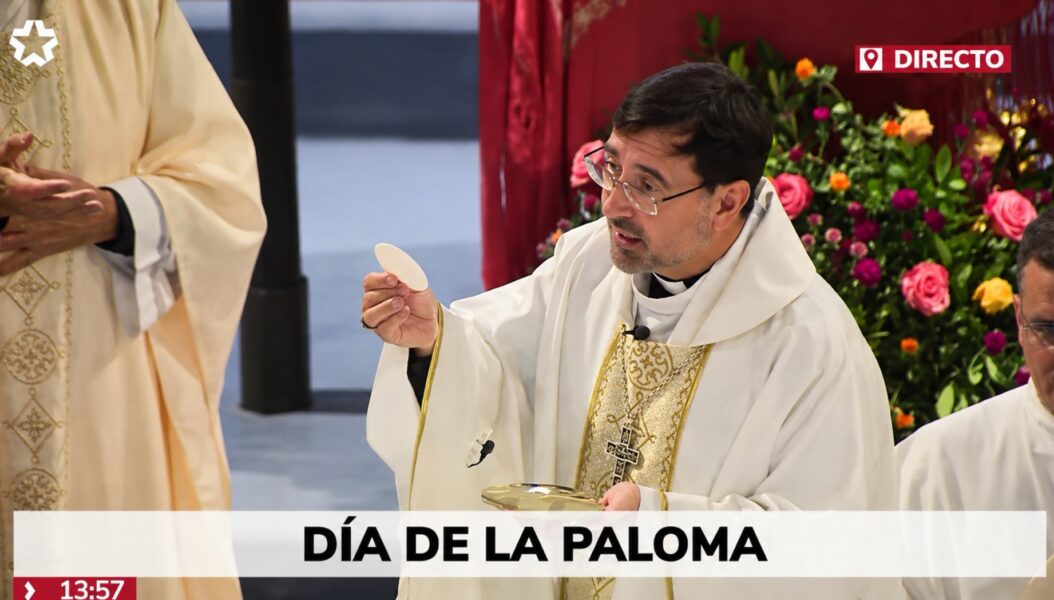
Cardinal José Cobo, Archbishop of Madrid, made a striking gesture this Saturday, August 15, during the solemn Mass celebrated on the occasion of the Assumption of the Virgin and the feast of the Virgin of the Paloma. You can watch the video that has caused scandal among some of the faithful by clicking here. The celebration, presided over by Cobo at the parish of the Virgin of the Paloma and Saint Peter the Real, was broadcast live by Telemadrid.
At the central moment of the Eucharistic Prayer, when pronouncing the words “Take and eat, all of you, for this is my Body,” Cobo raised his gaze toward the congregation and extended toward them the bread he held in his hands. He later repeated the gesture with the chalice when saying “Take and drink, all of you.”
At first glance, the scene might seem like a simple gestural liberty on the part of the celebrant. However, the problem is not merely aesthetic nor a matter of liturgical sensitivity. The Eucharistic Prayer is not a prayer the priest directs to the faithful. It is a prayer addressed to God the Father. And precisely for that reason, a gesture that visually turns the words of consecration into an address from the celebrant to the assembly is theologically problematic.
The General Instruction of the Roman Missal expresses this with absolute clarity in number 78 when explaining the nature of the Eucharistic Prayer: the priest associates the people “with the prayer that he directs in the name of the entire community to God the Father, through Jesus Christ, in the Holy Spirit.”
This point is fundamental. From the beginning of the preface to the final doxology—“Through Christ, with Him and in Him”—the great Eucharistic Prayer is addressed to the Father. The priest is not engaging in a dialogue with the congregation during the consecration, nor is he theatrically representing the Last Supper before them.
Naturally, the words “Take and eat” and “Take and drink” reproduce the words spoken by Christ to his disciples in the Upper Room. The priest pronounces them within the narrative of the institution and consecration. But one thing is to sacramentally reproduce Christ’s words within a prayer directed to the Father, and quite another to accompany them with a gaze and a gesture of offering toward the faithful, as if they were at that moment the direct interlocutors of the celebrant.
Here lies precisely the gravity of the confusion. An error regarding the recipient of a prayer is not a secondary detail when it concerns the central prayer of the Holy Mass. Visually changing the direction of the Eucharistic Prayer alters the faithful’s understanding of the liturgical action itself.
The Missal, moreover, carefully distinguishes between the moment of consecration and the moment immediately following, when the priest shows the consecrated species to the faithful.
During the narrative of the institution, the priest takes the bread and holds it over the altar while pronouncing Christ’s words. Only after concluding “for this is my Body, which will be given up for you” does he raise and show the consecrated Host to the people, place it back down, and genuflect. The same occurs with the chalice: the sacramental words are pronounced first, and only afterward is the chalice shown to the faithful.
Showing the Host and the chalice to the people is, therefore, a gesture expressly provided for by the liturgy. The problem arises when that gesture is transformed or anticipated during the very words “Take and eat” and “Take and drink,” creating the impression that the priest is offering the species to the assembly while personally addressing them.
The difference between these two actions is significant. Catholic liturgy does not function solely through texts. Gestures, bodily orientation, gaze, bows, elevations, and genuflections also carry meaning. Precisely for this reason, they are regulated by the liturgical books and are not subject to the celebrant’s personal creativity.
When the priest visibly looks at the congregation and extends the bread toward them while saying “Take and eat, all of you,” the image conveyed is that of a dramatization of the Upper Room: the celebrant appears to dramatically place himself in Christ’s position while the faithful visually occupy the place of the Apostles.
But the priest is not an actor portraying Jesus Christ before an audience. In the liturgy, he acts sacramentally in the person of Christ and within an action of the entire Church directed to the Father. Reducing this reality to a staged representation of the Last Supper gravely impoverishes and confuses the meaning of the celebration.
The very structure of the Mass makes this clear. There is a later moment when the priest does directly address the faithful while holding the consecrated Host. It is immediately before Communion, when he shows the Body of Christ and proclaims: “This is the Lamb of God, who takes away the sin of the world. Blessed are those called to the supper of the Lord.”
Here there is indeed an invitation expressly directed to the assembly. The priest presents Christ to those about to receive Communion. The fact that the rite itself reserves that gesture and direct address for a specific moment shows that they should not be artificially projected onto the consecration.
During the Eucharistic Prayer, the faithful participate in the prayer, but they are not its recipients. The prayer rises to the Father. The Church offers to the Father, in the Holy Spirit, the sacrifice of Christ and offers herself with Him. Confusing those who participate in the offering with the One to whom the offering is directed constitutes a theological confusion of the first order.
Redemptionis Sacramentum also recalls the particular importance of the Eucharistic Prayer, “the summit of the entire celebration,” whose proclamation belongs to the priest while the people unite themselves to it in the manner established by the Church.
The Second Vatican Council likewise established in Sacrosanctum Concilium that “no one, not even a priest, may add, remove, or change anything on his own initiative in the liturgy.” The norm does not stem from empty rubricism, but from the conviction that the liturgy belongs to the Church and that its signs convey a doctrine that the celebrant cannot reshape according to his own expressiveness.
The issue becomes even more relevant when the one presiding is the Archbishop of Madrid, a cardinal of the Church, and when the celebration is publicly broadcast on television. A bishop’s gestures inevitably carry an exemplary and catechetical dimension. What he does at the altar also teaches priests and faithful how to understand what is taking place.
That is why the problem with Cobo’s gesture does not simply consist in whether he raised the Host more or less or looked in a certain direction. The problem lies in the meaning it conveys: it visually transforms a prayer directed to the Father into a scene that appears directed to the faithful.
The liturgy does not require the celebrant to dramatize Christ’s words to make them more comprehensible. The Roman rite already establishes with precision when the words of institution are pronounced, when the Body and Blood of the Lord are shown to the people, and when the priest directly addresses the faithful to invite them to Communion. Confusing these things does not clarify the mystery: it distorts it.