


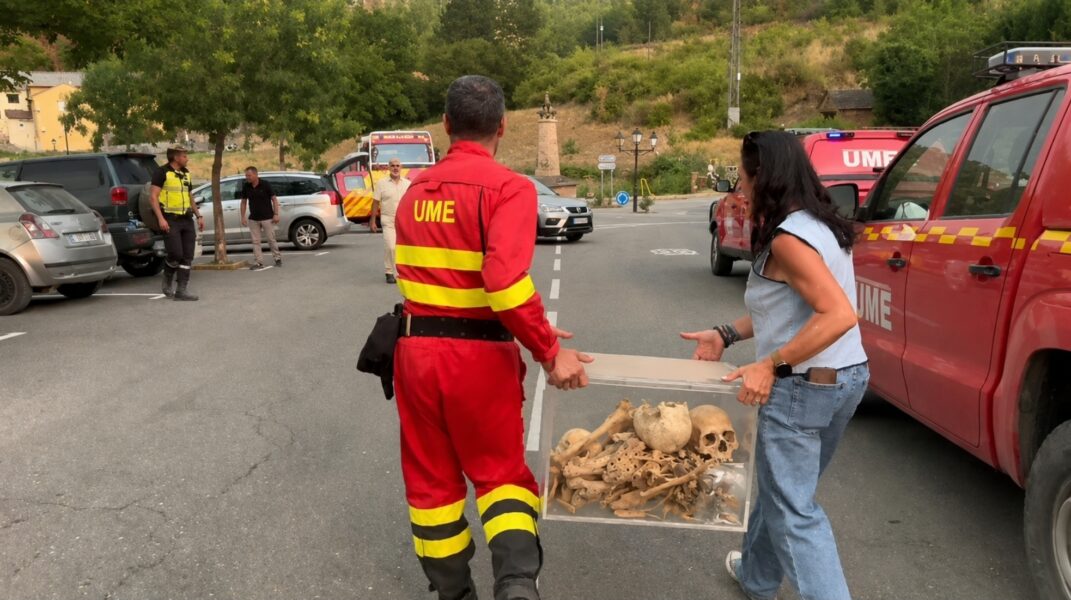
An “in extremis” rescue at the Monastery of the Holy Grail: UME personnel and Heritage technicians yesterday removed from the Old Monastery the urns of the Royal Pantheon—containing the remains of Ramiro I, Sancho Ramírez, Pedro I and four kings of Pamplona—the replica of the holy chalice and other assets, amid the threat of the Las Peñas de Riglos wildfire, which has already exceeded 8,000 hectares.
The Monastery of San Juan de la Peña, spiritual cradle of the Kingdom of Aragon, lived through its most anguished hours this Thursday since the fire that devastated it in 1675. The flames entered the protected natural area and reached the vicinity of the two monasteries, the Old and the New, without reaching them so far. The critical moment occurred between one and five in the afternoon, when the front moved directly toward the monastic complex.
Faced with the risk of fire invading the Old Monastery, the UME, the Civil Guard and a team of restorers and technicians from the Directorate General of Culture and Heritage of the Government of Aragon—in coordination with the Elder Brother of the Brotherhood of San Juan de la Peña, Félix Longás—entered the monastery. A first intervention had to be interrupted due to the proximity of the flames; on the second access they managed to extract the skeletal remains from the Royal Pantheon, the funerary coat of the 10th Count of Aranda, mural paintings transferred to support, capitals, carvings and the replica of the Holy Grail. Everything now rests, with chain of custody and guaranteed conservation conditions, in the Museum of Huesca, “awaiting their return when normality resumes.”
In the Royal Pantheon rest the first kings of Aragon—Ramiro I, Sancho Ramírez and Pedro I—and also four kings of Pamplona, among them Sancho Garcés II Abarca and García Sánchez II the Trembler. That the bones of the kingdom’s founders had to be removed from their millennial tomb gives the measure of the gravity of what happened. The Aragonese vice-president, Mar Vaquero, spoke of “tremendous anguish” and thanked the “heroic bravery” of the personnel.
The monastery of the Grail and of the first Roman Mass in Spain
Carved beneath the great rock of Mount Pano above the cave of the hermit Juan de Atarés, the Old Monastery (10th–12th centuries) is one of the foundational sites of Hispanic Christianity. According to a venerable tradition, the Holy Grail, the chalice of the Last Supper now venerated in Valencia Cathedral, was kept there for centuries, brought to the rock to save it from the Muslim invasion.
And there, on 22 March 1071, the first Mass in the Roman rite was celebrated in Spain: the monastery, promoted by King Sancho Ramírez in communion with the See of Peter and linked to the Cluniac reform, opened the way from the old Hispano-Mozarabic rite to the Roman rite in the peninsular kingdoms. Its Romanesque cloister, sheltered under the rock’s visor, is one of the pinnacles of European medieval sculpture, and the monastery preserves the memory of St. Indaletius, an apostolic man whose relics arrived there in the 11th century.
History threatens to repeat itself: in 1675 a fire destroyed much of the Old Monastery and forced the Benedictines to build the New Monastery, today also under the direct threat of the front; in 1994 fire already besieged the complex. Some 500 personnel and around thirty aerial assets are working with the defense of both monasteries—National Monument since 1889—as an absolute priority, while nearly 900 people from twelve villages, including Botaya and Santa Cruz de la Serós, remain evacuated.
Meanwhile, the remains of the kings who made Aragon await in Huesca for the fire to retreat from the rock that for a thousand years has guarded their sleep. May St. John the Baptist, patron of the monastery, and the Virgin on the eve of her Assumption protect what the flames of 1675 could not destroy.