


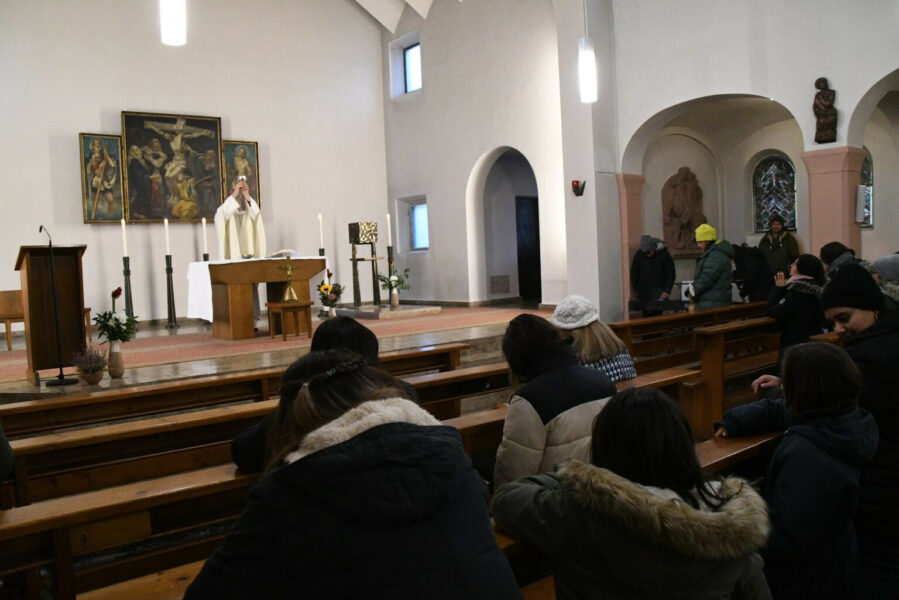
The crisis of the Church in Germany is once again reflected in its figures. Barely 1.3 million of the approximately 19.2 million Catholics in the country attended Mass regularly during 2025, placing Sunday practice at 6.8%. Eleven years earlier, in 2014, it still reached 10.9%.
The decline in Mass attendance does not appear in isolation. During the past year, more than 307,000 people formally left the Church, funerals were almost double the number of baptisms, and the shortage of priestly vocations continues. Faced with this scenario, the German Bishops’ Conference (DBK) maintains that the situation cannot be interpreted solely in terms of decline and upholds synodality as one of its main commitments for the future.
More funerals than baptisms
The demographic data show a Church that is losing faithful both through formal departures and through the absence of generational replacement. In 2025, just over 109,000 baptisms were recorded, while funerals exceeded 203,000.
This difference has been repeated in recent years. In 2023 there were 131,245 baptisms compared to 226,179 funerals, and a year later the figures were 116,274 and 213,046, respectively.
This is compounded by the phenomenon of administrative apostasies. The approximately 307,000 departures in 2025 represent an improvement compared to previous years, but they still represent a considerable loss. In 2024 more than 320,000 people left the Church; in 2023 there were more than 400,000 and in 2022 the figure was around half a million.
The situation also affects the clergy. Germany has nearly 9,000 parishes and 11,083 active priests, of whom approximately 2,300 come from other countries.
Wilmer rejects speaking only of «decline»
The president of the German Bishops’ Conference, Bishop Heiner Wilmer, acknowledges that the faithful, attendance, pastoral staff, and economic resources are decreasing. However, he rejects that these figures can be reduced to «a mere story of decline.»
For Wilmer, the statistics also show «dedication, reliability, and great responsibility,» and the Church’s presence should not be measured exclusively by the number of people who participate in Sunday liturgy.
«The Church is not only present where Mass is celebrated,» maintains the president of the DBK, who also points to personal accompaniment, consolation, social responsibility, and dialogue as areas of ecclesial presence.
The bishops’ response continues to center on synodality
Amid this deterioration of the main indicators of religious practice and ecclesial belonging, the German hierarchy continues to defend synodality as a fundamental part of its pastoral response.
Wilmer defines it not so much as a procedure but as «a way of spiritual life,» based on listening and sharing responsibilities within the Church.
This commitment is being developed after years of the Synodal Path, a process that has promoted proposals on sexual morality, ecclesial governance, blessings for same-sex couples, and women’s ministry, and which has provoked repeated tensions with Rome.
The disagreements remain open. The apostolic nuncio in Germany, Archbishop Georg Gänswein, recently warned that the debates of the Synodal Path continue to be «a burden» and consume energy in structural discussions while projects that, according to him, «depart from the Catholic faith» remain pending.
Also within German Catholicism itself, initiatives contrary to this orientation have emerged. Last July, Pro Fide Ecclesiae was established, a movement of laypeople that denounces that Catholics faithful to the magisterium do not feel represented by the direction of the Synodal Path.
The 2025 data thus once again place before the German bishops a question that structural reforms have so far failed to resolve: fewer and fewer Catholics participate regularly in Mass and the Church continues to lose hundreds of thousands of members each year.