


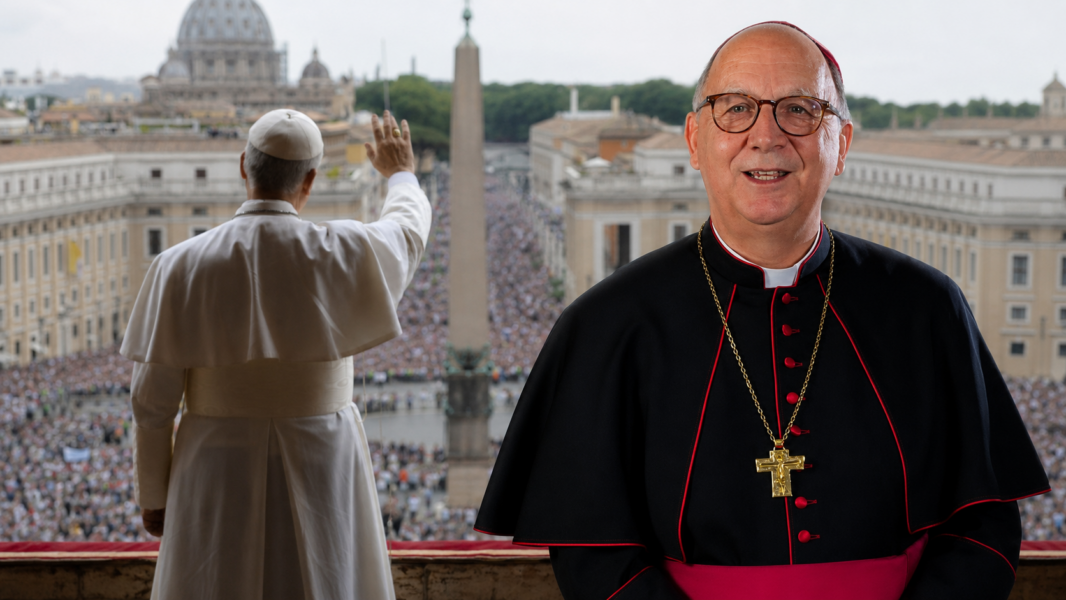
The auxiliary bishop emeritus of Chur (Switzerland), Bishop Marian Eleganti, has questioned the growing media exposure of recent pontiffs and warns that the multiplication of audiences, interviews, trips, and public appearances may end up displacing the essential tasks of the Successor of Peter: to teach with clarity, govern the Church, and safeguard the faith.
The reflection stems from the private audience that Leo XIV held on July 31 with the American singer, poet, and artist Patti Smith at the Apostolic Palace. Eleganti downplays the meeting itself, but uses it to raise a broader question: “Does he really have nothing more important to do than grant this type of private audiences?”
When the Pope’s image becomes the message
Eleganti believes the phenomenon did not begin with Leo XIV. He traces its development back to the pontificate of Saint John Paul II and argues that, over the decades, popes have increasingly intervened informally, granted spontaneous interviews, and multiplied encounters with figures from the political, cultural, and media worlds.
In his view, this dynamic can present the Pope to society as “just another member of the international establishment” and turn his personality into the protagonist. “I think that, as a result, recent popes have lost authority and spiritual capital,” he states.
The problem takes on a doctrinal dimension when audiences are granted to individuals known for defending positions contrary to the Church’s teaching. Eleganti recalls Francis’s meetings with Emma Bonino, his conversations with Eugenio Scalfari, and the audiences granted to Jesuit James Martin.
The bishop warns that a photograph with the Pope can acquire a meaning that goes beyond the private nature of the encounter, especially when it is later used to promote certain causes. If there is not at the same time a public and unequivocal defense of doctrine, he maintains, “the Pope himself obscures the Church’s position” and may even cause scandal among the faithful.
The priorities of the Successor of Peter
Eleganti’s criticism is not directed at the diplomatic, institutional, or protocol obligations inherent to the pontificate, which he expressly excludes from his reflection. The singular condition of the Pope unites in one person the pastoral governance of the universal Church and the responsibilities derived from the sovereignty of the Holy See and the Vatican City State.
This temporal dimension is precisely at the service of the independence necessary for the exercise of the Petrine ministry. As EWTN News recently explained when analyzing the different functions of the pontiff, the sovereignty of the Holy See guarantees the libertas Ecclesiae: the freedom of the Church from any political power.
Eleganti’s objection therefore focuses on those activities he considers ancillary. In contrast to the time devoted to audiences, greetings, trips, and appearances, he asks whether sufficient space remains for “reflecting on matters in prayer,” studying documents, and preparing interventions in which the Pope “teaches with authority and without ambiguities.”
He also points to other less visible responsibilities: directing the Curia, coordinating the dicasteries, meeting with those who must advise the pontiff, and addressing pending issues in the life of the Church.
Eleganti warns of the danger of “activism”
The prelate believes that the accumulation of public acts can lead to an “activism” that distracts from doctrinal and governance problems. He cites the heterodox positions defended by certain bishops, with special reference to the German Synodal Way, and maintains that they should be clearly identified and their leaders admonished or, where appropriate, removed from their positions.
He also laments that issues such as the liturgy are sidelined and considers the effective role of cardinals as advisors to the pontiff insufficient, a matter on which Eleganti has previously spoken. InfoVaticana reported in January his call for the College of Cardinals to address the liturgical crisis and pending questions about the reform of the Roman rite.
His criticism also extends to the progressive personalization of the papacy. Eleganti mentions the major public appearances of Saint John Paul II, the interviews and books of Benedict XVI, and especially the exposure of numerous personal aspects during the pontificate of Francis.
“The popes have become too human in the exercise of their office. Their personality, not their office, occupies the center,” he maintains.
“He must increase, but I must decrease”
Eleganti is not calling for a Pope distant from the faithful, but for greater awareness of the dignity and uniqueness of the Petrine ministry. In his view, closeness does not require turning every aspect of the pontiff’s personality into part of his public message.
For this reason, he also upholds the value of silence: speaking when necessary, with few words, clear and unequivocal, and allowing the person to remain in the background before the office he holds.
The bishop summarizes his approach by invoking the words of Saint John the Baptist: “He must increase, but I must decrease” (Jn 3:30). For Eleganti, the principle should also apply to the Successor of Peter: it is not the Pope’s personality that should occupy the center, but Christ, of whom he is servant and representative.
Note: The full article by Bishop Marian Eleganti can be read in English in the publication disseminated by Edward Pentin and in Per Mariam, where it was published at the bishop’s express request.