


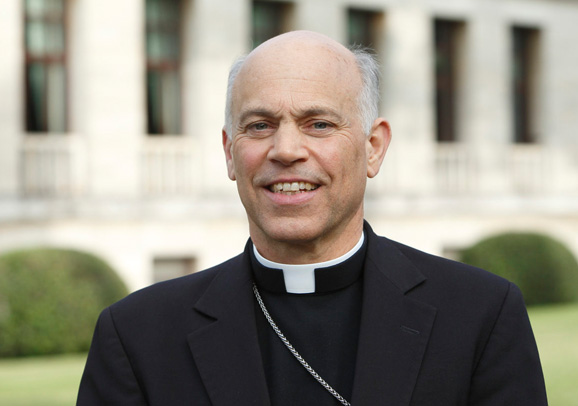
The Archbishop of San Francisco, Monsignor Salvatore Cordileone, has warned against attempts to modify the Gospel received and transmitted by the Church from the Apostles. During his sermon for the XI Sunday after Pentecost, the prelate recalled that the Catholic faith is not a construction that each generation can adapt to its will, but a deposit received that must be welcomed and faithfully transmitted.
Cordileone developed this reflection during the Mass celebrated at the parish of Santa Monica, drawing on the readings of the traditional liturgy to address three interrelated aspects: the universality of the Church, its common liturgical heritage, and fidelity to the Gospel as a response to the confusion of our time.
A universal Church, not an international organization
Starting from the account of the healing of the deaf-mute, Cordileone highlighted that Christ entered pagan territory and extended His mercy beyond the limits of the chosen people. For the archbishop, Saint Mark thus presents Christ as a model of a Church called to carry the Gospel beyond any cultural boundary.
This universality, he explained, does not mean that the Church is simply “an international organization.” Although it gathers faithful from all nations, cultures, and languages, it possesses a common heritage that allows its members to live according to one and the same faith.
Cordileone cited his own archdiocese, San Francisco, historically marked by the arrival of immigrants from numerous countries, as an example. The Church respects those particular cultures, he noted, but at the same time provides all its children with a shared Catholic culture.
Cordileone claims Latin as “common Catholic heritage”
Within that shared culture, the archbishop especially highlighted the liturgical language of the Church.
“Like all cultures, the Church speaks a common language. This language, of course, is Latin,” he stated.
Cordileone recalled that the Second Vatican Council called for preserving Latin in the liturgy and also pointed to the proper place of Gregorian chant and polyphony within the Catholic heritage.
“Latin is our common Catholic heritage: it unites us across different races and languages,” he maintained.
The archbishop extended this idea beyond language. The Church, he explained, also possesses a sacramental language through which visible reality leads toward a spiritual reality. The same occurs with works of charity, which do not consist solely in providing material assistance, but in making Christ’s love present to those who suffer.
“The Gospel is not one that we invent”
Cordileone then focused his reflection on the First Letter of Saint Paul to the Corinthians, where the Apostle reminds the Christians that he transmitted to them what he himself had received.
“That Gospel we put into practice is not one that we invent, nor that we compose; rather, it is received,” the archbishop affirmed.
From this premise he issued a warning about attempts to alter the received teaching:
“There are those who would like to change the Gospel we have received, the Gospel the Church has transmitted in every generation from the time of the Apostles until today. But that does not lead us to the life of heaven.”
For Cordileone, Saint Paul offers precisely the opposite example. After having persecuted the Christians, his encounter with the truth of the Gospel led him to repentance and then to a life marked by fidelity, even in the face of persecution and martyrdom.
A warning in “times of great confusion”
The archbishop finally applied this teaching to the present situation. “We live in times of uncertainty, of great confusion,” he stated, noting that many people face the future with fear.
In this situation, Cordileone warned that the response cannot consist in accommodating Christian demands to one’s own desires.
“The worst thing we could do in such a situation would be to turn our backs on the Lord, to pretend as if the Lord were pleased with us when we live as we please without taking into account what He teaches us,” he noted.
Faced with that temptation, the archbishop invited the faithful to receive the Gospel transmitted by the Church in its entirety and to recognize the heritage that accompanies it through the centuries: its teaching, its worship, its art, and its service to those in need.
Fidelity to that Gospel, Cordileone concluded, does not lead to fear, but to the “peace, hope, and confidence” that the Christian needs precisely in times of uncertainty.