


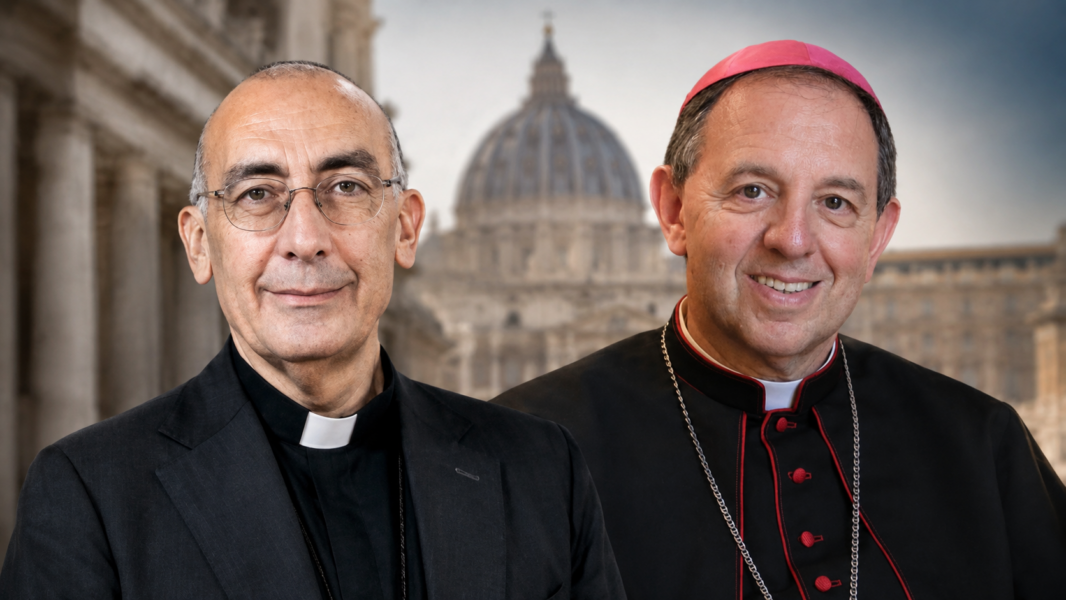
Two Italian dioceses have prevented, within just a few hours of each other, the celebration of Catholic funerals for two prominent members of Freemasonry. In Rome, Cardinal Baldassare Reina denied the funeral Mass planned for Bruno Battisti D’Amario, a guitarist linked for years to Ennio Morricone and former leader of the Grande Oriente d’Italia; shortly afterward, the Bishop of Ventimiglia-Sanremo, Antonio Suetta, suspended the funeral rites of Mario Tarducci, who had been the venerable master of a local lodge.
In both cases, the Masonic affiliation of the deceased came to light after the ceremonies had already been scheduled. The decisions were made in accordance with the Church’s discipline on ecclesiastical funerals, while the doctrinal judgment remains in force that membership in Freemasonry is incompatible with the Catholic faith.
Rome suspends the funeral of a prominent member of the Grande Oriente
The first case occurred in Rome. Bruno Battisti D’Amario had died on August 5 at the age of 88, and his funeral was scheduled at the Basilica of Santa Maria in Montesanto, known as the Church of the Artists, located in the central Piazza del Popolo.
The celebration had been requested by the family and initially accepted by the church authorities, who were unaware of the deceased’s Masonic background.
It was the Grande Oriente d’Italia itself that made this affiliation public when announcing his death. The Masonic organization announced the “passing to the Eternal Orient of our beloved brother master Bruno Battisti D’Amario” and detailed the responsibilities he had held for years within its structure.
Battisti D’Amario had been the founder of the Roman Giuseppe Leti lodge, composer of the official anthem of the Grande Oriente, twice president of the Circumscriptional College of Venerable Masters of Lazio, and counselor of the Order.
Upon learning of this background, the rector of Santa Maria in Montesanto, Monsignor Antonio Staglianò, referred the case to Cardinal Baldassare Reina, Vicar General of His Holiness for the Diocese of Rome.
As Staglianò explained to La Nuova Bussola Quotidiana, Reina consulted with the diocesan legal office and later communicated in writing that the funeral Mass could not be authorized.
“We verified, also by speaking with the daughter, who unfortunately told us she knew nothing about this story, but the father, as the Grande Oriente d’Italia revealed, was a Mason in a prominent position,” Staglianò noted.
A family prayer instead of the funeral
The rector explained that the basilica authorities were completely unaware of Battisti D’Amario’s Masonic affiliation when they initially authorized the celebration. According to his daughter, she too had no knowledge of that aspect of her father’s life.
Following Cardinal Reina’s decision, the funeral rites were replaced by a prayer with the family to commend the soul of the deceased to the mercy of God, with a priest present without liturgical vestments.
Staglianò clarified that the refusal to hold the funeral does not prevent Masses from being offered later for the repose of the deceased’s soul.
Battisti D’Amario was a recognized figure in Italian music. A professor of classical guitar, he maintained a long collaboration with Ennio Morricone and participated in some of his best-known film scores.
A second funeral suspended in Ventimiglia-Sanremo
Just a day later, a similar case reached the Diocese of Ventimiglia-Sanremo, located in the Italian region of Liguria, near the border with France.
Bishop Antonio Suetta suspended the ecclesiastical funeral rites scheduled at the parish church of San Marco in Camporosso for Mario Tarducci, after learning that the deceased had belonged to a local Masonic lodge where he had served as venerable master.
In this case as well, the funeral had already been scheduled when the diocese became aware of the Masonic affiliation.
The diocese itself explained in a statement that the information came through a local publication and publicly displayed obituaries. Suetta then held conversations with the parish priest and the deceased’s family and requested instructions from higher authorities on how to proceed.
Unable to obtain them within the short time available and aware of the decision just made by Cardinal Reina in a similar case in Rome, the bishop decided to follow the same criterion.
“In light of a similar case, presented simultaneously in the Diocese of Rome, sharing the same indications given there by the Vicar of His Holiness, Cardinal Reina, the bishop, in accordance with canon 1184, has ordered that the scheduled ecclesiastical funeral rites not be celebrated,” the diocese stated.
Ventimiglia-Sanremo also announced that it would later publish a note with legal-pastoral guidelines on ecclesiastical funerals.
The Church maintains its judgment on Freemasonry
The decisions of both dioceses take place within a doctrinal context that the Holy See has reiterated on various occasions.
In 1983, the Congregation for the Doctrine of the Faith, then presided over by Cardinal Joseph Ratzinger, issued a declaration to clarify doubts that arose after the new Code of Canon Law ceased to explicitly mention Masonic associations.
“Therefore, the Church’s negative judgment on Masonic associations remains unchanged, because their principles have always been considered irreconcilable with the doctrine of the Church,” the dicastery stated.
The declaration further specified that “the faithful who belong to Masonic associations are in a state of grave sin and cannot approach Holy Communion.”
Forty years later, in November 2023, the Dicastery for the Doctrine of the Faith again addressed the issue. With the approval of Francis, it reiterated that “active affiliation with Freemasonry by a member of the faithful is prohibited” due to the “irreconcilability between Catholic doctrine and Freemasonry.”
Canon 1184
Canon 1184 of the Code of Canon Law regulates cases in which ecclesiastical funerals must be denied.
The norm establishes that, unless they had given some sign of repentance before death, notorious apostates, heretics, and schismatics, as well as “other manifest sinners to whom ecclesiastical funerals cannot be granted without public scandal to the faithful,” must be deprived of them.
When any doubt exists, the same canon provides that the Ordinary of the place must be consulted and his decision respected.
In Rome, Staglianò turned to Cardinal Reina once Battisti D’Amario’s Masonic background became known. In Camporosso, Suetta explicitly cited canon 1184 when announcing the suspension of Tarducci’s funeral and took as reference the criterion adopted a few hours earlier by the Pope’s vicar.
Canon 1185 further establishes that the funeral Mass must be denied to anyone who has been excluded from ecclesiastical funerals.
These provisions regulate the public celebration of the Church’s funeral rites and do not constitute a judgment on the eternal destiny of the deceased. In the two Italian cases, the question presented to the respective bishops was whether a Catholic funeral could be celebrated after the prominent Masonic affiliation of the deceased became publicly known.
The Dioceses of Rome and Ventimiglia-Sanremo resolved, within just a few hours of each other, that the ecclesiastical funeral rites could not be celebrated.